
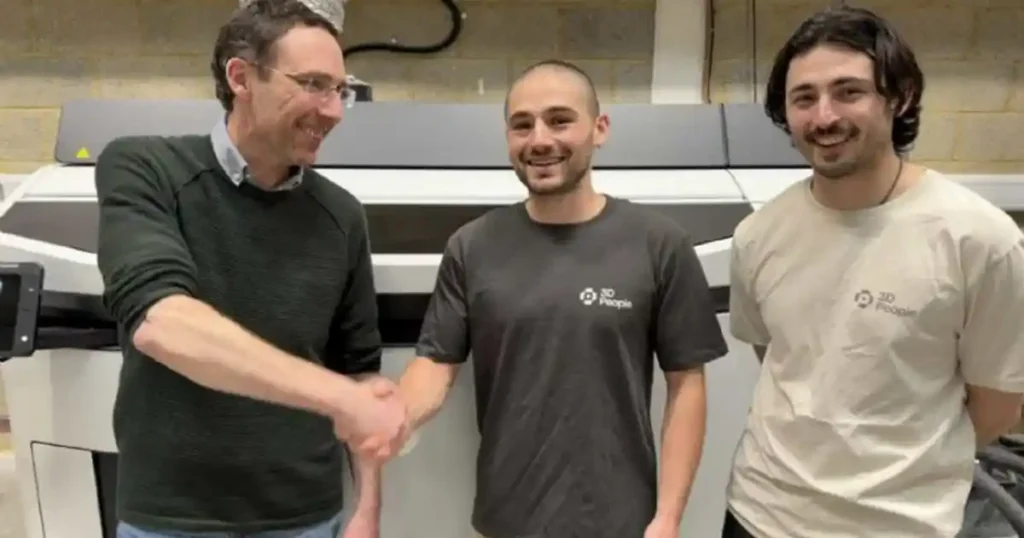
Discover how 3D People deployed AMIS Runtime across its London facility to automate build preparation, reduce errors, and increase additive manufacturing capacity. Read the full case study at LAVA3DP.
Introduction
In a significant development for the industrial 3D printing sector, London-based service provider 3D People has completed the full deployment of AMIS Runtime across its additive manufacturing facility. The implementation, announced in early March 2026, represents a major step forward in production workflow automation for polymer-based powder bed fusion technologies .
This article examines how 3D People leveraged AMIS Runtime to transform its build preparation processes, the tangible benefits already realized, and what this means for the broader additive manufacturing services landscape. For businesses seeking similar production efficiency gains, LAVA3DP offers comprehensive industrial 3D printing services tailored to high-volume, high-mix manufacturing requirements.

The Challenge: Scaling High-Mix, High-Volume Production
3D People has established itself as one of the United Kingdom’s leading providers of industrial additive manufacturing services, delivering end-use PA12, TPU, and engineered polymer components to sectors including automotive, marine, robotics, electronics, and film and television production .
The company faced increasing customer demands for:
- Higher quality components with repeatable mechanical properties
- Shorter lead times for both prototypes and production runs
- Greater repeatability across multiple shifts and operators
- Scalable production capabilities from single parts to thousands of units
These requirements placed significant pressure on the company’s production workflow, particularly during the build preparation stage—a traditionally labor-intensive process involving file import, repair, nesting, slicing, and export preparation.
The Solution: AMIS Runtime Deployment
In 2025, 3D People secured a grant from UK Made Smarter, a government initiative supporting digital transformation in manufacturing. The funding enabled the company to develop and implement an automated process for preparing, nesting, and scheduling 3D print builds .
Working collaboratively with Belgian software developer AMIS, 3D People tested and validated AMIS Runtime across its London facility using real-world production scenarios. The software, officially launched in February 2026, is described as the first platform to offer “fully autonomous, continuously re-nested build preparation” for additive manufacturing .
Key Features Implemented
The deployment encompassed several critical automation capabilities:
End-to-end scripted workflows for importing, repairing, nesting, slicing, and exporting every part entering production
Intelligent nesting algorithms that consider part geometry, size class, shell density, and metadata flags to maximize build density
Continuous re-nesting functionality that automatically regenerates builds when new orders arrive or priorities change, maintaining “always up-to-date” batches
Automated metadata pipelines ensuring complete traceability and consistent part numbering
Clean 3MF exports with accompanying part lists for internal tracking and customer documentation
These features now operate across 3D People’s entire SLS and MJF production lines, supporting both Multi Jet Fusion and Selective Laser Sintering technologies .
Visualizing the Impact
Figure 1: Build Preparation Time Reduction
| Process Stage | Manual Workflow | AMIS Runtime | Reduction |
|---|---|---|---|
| File Import & Validation | 15-20 minutes | 2-3 minutes | 85% |
| Nesting Optimization | 30-45 minutes | Automated (2-5 min) | 90% |
| Slicing & Export | 10-15 minutes | <1 minute | 95% |
| Batch Regeneration | 20-30 minutes | Real-time (continuous) | 100% |
Figure 2: Projected Growth of Industrial 3D Printing Software Market
| Year | Market Size (Billions USD) | Growth Rate |
|---|---|---|
| 2024 | 3.87 | — |
| 2025 | 4.68 | 20.9% |
| 2026 | 5.66 | 20.9% |
| 2033 | 21.35 | 20.9% (CAGR) |
Source: Industrial 3D Printing Market Report
Benefits Realized
According to Sasha Bruml, Co-founder of 3D People, the deployment “marked a key step in our long-term digital manufacturing strategy. It builds upon our existing MES platform, closing the loop between digital order management and physical production” .
Operational Improvements
The implementation has delivered measurable benefits across multiple dimensions:
Reduced human error through consistent application of predefined rules across all operators and shifts
Increased repeatability ensuring that parts manufactured weeks apart maintain identical specifications
Higher build density through part-aware nesting algorithms that optimize every cubic millimeter of build volume
Faster turnaround times enabled by eliminating manual bottlenecks in build preparation
Enhanced capacity utilization allowing the team to handle more orders without increasing headcount
Felix Manley, Co-founder of 3D People, emphasized the strategic value: “Our production relies on consistency and the ability to respond quickly when priorities change. Runtime lets us automate the repetitive tasks, so our team can focus on engineering, quality and customer support—the areas where we add the most value” .
Industry Context: The Automation Imperative
The 3D People deployment reflects broader trends in the additive manufacturing services sector. According to recent market analysis, the global industrial 3D printing market is projected to grow from USD 4.68 billion in 2025 to USD 21.35 billion by 2033, representing a compound annual growth rate of 20.9 percent .
Market Drivers
Several factors are accelerating automation adoption among 3D printing service providers:
Increasing order complexity as customers demand more sophisticated parts with tighter tolerances
Labor cost pressures making manual build preparation economically unsustainable at scale
Quality consistency requirements from regulated industries including aerospace and medical devices
Competition from low-cost producers forcing established service bureaus to differentiate through reliability and speed
Comparative Analysis
Other service providers are pursuing similar digital transformation strategies. Technology Applied, Poland’s leading 3D printing service bureau, selected 3YOURMIND’s workflow software to streamline order intake and production scheduling . Meanwhile, manufacturers like Atlas Copco have achieved 30 percent cost reductions and 92 percent lead time improvements by bringing additive manufacturing in-house with EOS technology .
Technology Deep Dive: How AMIS Runtime Works
Understanding the technical capabilities that 3D People now leverages provides insight into the future of industrial 3D printing automation.
Build Preparation Automation
AMIS Runtime operates as a programmable build preparation engine that integrates directly with existing MES and production systems. Unlike traditional nesting software that requires manual intervention for each build, Runtime applies consistent rules across all incoming orders .
Continuous Re-Nesting
The “continuously re-nested” functionality represents a paradigm shift in production scheduling. As long as a build has not been sent to the printer, the system automatically regenerates the nesting configuration whenever:
- New parts are added to the queue
- Customer priorities change
- Rush orders require expedited handling
- Machine availability shifts
This dynamic approach ensures that production capacity is always optimized for current demand, rather than locked into static batch configurations .
Multi-Technology Support
AMIS Runtime supports automation across multiple additive manufacturing platforms, including:
This flexibility proved essential for 3D People, which operates diverse polymer production equipment serving different customer requirements.
Implementation Journey
The successful deployment at 3D People followed a structured approach that other service bureaus can emulate.
Phase 1: Grant Funding and Planning
The UK Made Smarter grant provided resources to thoroughly evaluate automation options and develop a comprehensive implementation strategy .
Phase 2: Collaborative Development
AMIS and 3D People worked closely to adapt Runtime for real production environments. Kris Binon, Managing Director at AMIS, noted: “3D People represents exactly the type of partner Runtime was built for. They’re fast, industrially-focused and committed to quality. Their input during development helped shape Runtime into a practical tool for their real production environment—not just a lab experiment” .
Phase 3: Real-World Validation
Before full deployment, 3D People validated Runtime on multiple live use cases, including:
- Daily automated nesting for MJF and SLS builds
- Batch regeneration when urgent orders arrived
- Density-aware nesting to maximize throughput
- Automated documentation workflows
Phase 4: Full Integration
Following successful validation, AMIS Runtime became part of 3D People’s operational backbone, now delivering efficiency, quality, and utilization gains across the entire facility .
Future Implications
The 3D People deployment offers lessons for the broader additive manufacturing industry.
For Service Providers
Automation is no longer optional for 3D printing service bureaus seeking to remain competitive. As 3DPrint.com observed: “When human labor power is the greatest limiting factor for a potential manufacturing resurgence, the companies that succeed will be the ones who can yield the greatest increase in productivity with the smallest addition of new human workers” .
For Software Developers
The success of AMIS Runtime demonstrates strong demand for specialized automation tools that address specific production bottlenecks. The industrial 3D printing software segment is expected to grow significantly as more facilities follow 3D People’s lead .
For Customers
End users of additive manufacturing services benefit from these developments through:
- More consistent part quality
- Faster turnaround times
- Greater production capacity
- Lower costs through improved efficiency
Conclusion
The deployment of AMIS Runtime across 3D People’s London facility demonstrates how automation is transforming industrial additive manufacturing. By eliminating manual build preparation bottlenecks, the service provider has achieved faster turnaround times, higher consistency, and increased production capacity—benefits that flow directly to customers.
For businesses evaluating 3D printing services, these developments mean greater reliability, shorter lead times, and more competitive pricing. The automation trend in additive manufacturing shows no signs of slowing, with software innovation enabling service bureaus to handle increasingly complex production requirements efficiently.
LAVA3DP remains at the forefront of these developments, offering industrial 3D printing services that combine technical expertise with efficient production workflows. Whether you need functional prototypes, bridge production, or full-scale manufacturing, our team is ready to support your next project.
Contact LAVA3DP today to discuss your industrial 3D printing requirements and discover how automated workflows can benefit your production timeline.
Frequently Asked Questions (FAQs)
1. What industrial 3D printing services does LAVA3DP offer?
LAVA3DP provides comprehensive industrial 3D printing services including Selective Laser Sintering (SLS), Multi Jet Fusion (MJF) , Fused Deposition Modeling (FDM) , and stereolithography for production parts, functional prototypes, and end-use components. Our facility supports engineering-grade polymers including PA12, TPU, PA11, glass-filled nylons, and flame-retardant materials suitable for automotive, aerospace, medical, and industrial applications.
2. How quickly can LAVA3DP deliver industrial 3D printed parts?
Turnaround times vary based on part complexity, quantity, and material requirements. For most industrial 3D printing projects, LAVA3DP offers expedited services ranging from 24-hour rapid prototyping to standard 5-7 day production scheduling. We recommend contacting our engineering team with your specific requirements for accurate delivery estimates based on current capacity and your project specifications.
3. What quality assurance processes does LAVA3DP implement?
LAVA3DP maintains rigorous quality management systems including dimensional inspection, material certification traceability, and first-article inspections. Our industrial additive manufacturing facility follows ISO-compliant procedures for process validation, operator training, and equipment calibration. We provide comprehensive documentation including material certificates, measurement reports, and part serialization for regulated industries.
4. Can LAVA3DP handle high-volume production runs?
Yes. LAVA3DP specializes in scaling from prototype validation to full production volumes. Our industrial 3D printing infrastructure includes multiple production platforms with automated workflows similar to the AMIS Runtime deployment described in this article. We support ongoing production programs with repeatable quality, scheduled deliveries, and inventory management options for clients requiring consistent part supply.
5. How do I get started with LAVA3DP for industrial 3D printing?
Beginning a project with LAVA3DP is straightforward. Upload your 3D models through our website for automated analysis, or contact our applications engineers to discuss material selection, design optimization, and production requirements. We provide design for additive manufacturing (DfAM) feedback, material recommendations, and firm pricing before production begins. Our team supports clients throughout the product development cycle from concept through series production.