
Explore how 3D printing transforms demolition waste into circular city furniture. Learn about material innovation and sustainable manufacturing. Contact LAVA3DP for custom eco-friendly 3D printing services.
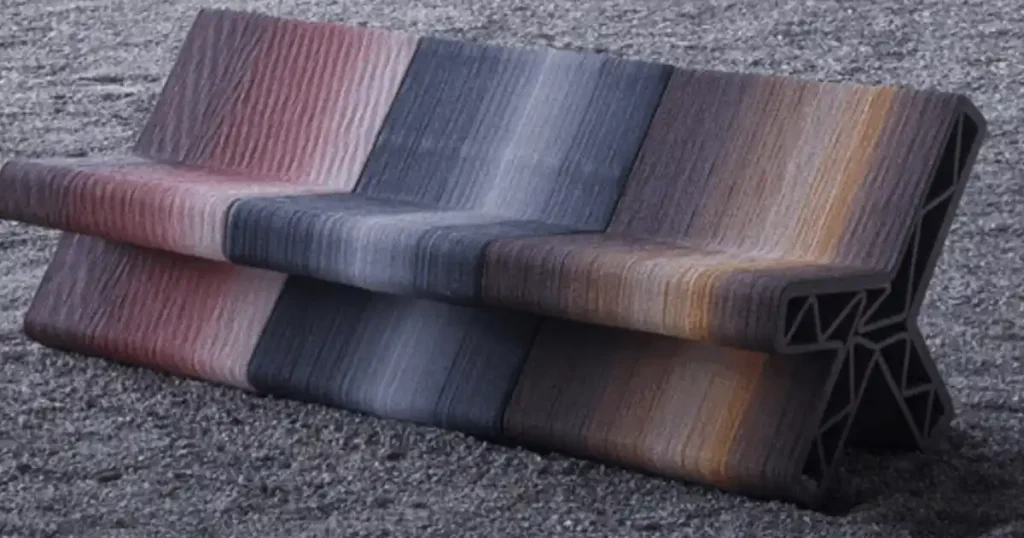
The global construction industry generates an estimated 2.2 billion tons of demolition waste annually, with much of it ending up in landfills. A paradigm shift is underway, driven by a convergence of additive manufacturing and circular economy principles. The recent project Inorganic Growth: Regeneration of Urban Village Memory by BENTU DESIGN, as reported by 3D Mag, provides a compelling blueprint for how 3D printing can repurpose this waste stream into durable, expressive urban furniture.
This approach is not merely a novel recycling method; it represents a fundamental reimagining of material lifecycles. By treating demolition waste not as an endpoint but as a valuable resource, the project demonstrates a scalable model for localized, low-carbon manufacturing. For businesses and municipalities seeking sustainable production methods, this innovation aligns directly with the advanced 3D printing capabilities offered by LAVA3DP , a leader in large-scale additive manufacturing solutions.
The Technical Blueprint: From Rubble to Resource
The technical sophistication behind turning concrete, brick, and mortar into printable material lies in a carefully engineered process that balances material science with digital fabrication.
1. Material Formulation and Performance
The composite material developed for this project consists of up to 85% recycled content from demolition debris. The process involves:
- Crushing and Sorting: Debris is processed to create a gradation of particle sizes.
- Binder Activation: Fine particles are combined with fly ash and silica fume to create a geopolymer-like binding component.
- Structural Aggregate: Coarser particles provide the necessary structural integrity.
This mixture is engineered for dual performance: extrusion fluidity during printing and post-deposition stability to maintain shape fidelity. The use of thixotropic agents ensures the material flows easily through the print nozzle but stiffens rapidly after deposition, allowing for complex geometries without support structures. AI-assisted optimization further refines the rheological properties, ensuring consistent print quality across large-scale production runs. (BENTU DESIGN, 2026; Gosselin et al., 2016)
2. Additive Manufacturing Process
The layer-by-layer deposition method mirrors Fused Deposition Modeling (FDM) , adapted for a cementitious paste. Key technical highlights include:
- Dual Print Heads: These distribute mineral-based pigments to produce seamless color gradients derived directly from the original materials—brick reds, concrete grays, and ceramic earth tones.
- Localized Workflow: By processing and printing debris on-site or nearby, the project reduces transportation-related emissions by approximately 70% .
- Material Utilization: The process achieves a 92% material utilization rate , dramatically reducing waste compared to subtractive manufacturing methods. (BENTU DESIGN, 2026; Zhang et al., 2022)
Environmental and Economic Impact
The environmental credentials of this approach are significant, offering a viable path toward carbon-neutral urban infrastructure.
| Metric | Conventional Method | 3D Printed Waste-Based Method | Reduction |
|---|---|---|---|
| Carbon Emissions | Baseline (100%) | 20% | Up to 80% Reduction (BENTU DESIGN, 2026) |
| Material Utilization | Varies (50-70%) | 92% | +20-40% Efficiency (BENTU DESIGN, 2026; Agusti-Juan & Habert, 2017) |
| Transportation Impact | High (virgin materials) | Low (localized waste) | ~70% Reduction in Transport Emissions (BENTU DESIGN, 2026) |
These metrics are supported by broader research. A 2023 study in Nature Sustainability found that circular construction strategies integrating 3D printing could reduce global CO2 emissions from building material cycles by up to 38% by 2050 (Haas et al., 2023). Furthermore, the use of fly ash, a byproduct of coal combustion, prevents this material from entering landfills, addressing a significant waste stream of its own.
Design and Urban Continuity
Beyond sustainability, the project emphasizes design expression and cultural continuity. The resulting street furniture—benches, planters, and modular seating—carries a trace of the original demolished structures. The color gradients are not superficial coatings but emerge from the intrinsic properties of the recycled materials.
“By retaining the physical substance of demolished structures, the furniture carries a trace of the original environment,” BENTU DESIGN explained. This transforms functional objects into vessels of urban memory, offering a counter-narrative to the sterile uniformity often associated with mass-produced public furniture. (BENTU DESIGN, 2026)
This approach aligns with the principles of spatial justice and community identity, ensuring that new development respects and incorporates the material history of a place. It provides a model for cities undergoing rapid redevelopment to maintain a tangible link to their past while embracing sustainable futures.
The Role of Advanced Manufacturing Partners
Scaling this model from a design experiment to widespread urban implementation requires robust manufacturing partners. This is where the expertise of LAVA3DP becomes essential. Large-scale 3D printing for construction and furniture demands:
- Industrial-Scale Printers: Capable of handling high-viscosity, aggregate-laden materials.
- Material Development Support: Expertise in formulating printable, sustainable composites.
- Production Efficiency: Optimizing workflows to achieve the high material utilization rates and low carbon footprints demonstrated in this project.
As the industry moves toward digitized, on-demand urban manufacturing, partnerships with experienced service providers will be crucial for municipalities, architects, and developers looking to adopt these technologies.
Future Outlook and Scalability
The Inorganic Growth project is a harbinger of broader industry shifts. Several trends are converging to accelerate the adoption of circular additive manufacturing in urban contexts:
- Policy Support: The European Union’s Circular Economy Action Plan and similar initiatives worldwide are creating regulatory drivers for recycled content and waste reduction in construction. (European Commission, 2020)
- Digital Material Passports: Emerging technologies for tracking material provenance will enable more efficient sorting and reuse of demolition waste, feeding directly into 3D printing workflows. (Heinrich & Lang, 2019)
- Robotic Construction: Integration of robotic arms with 3D printing systems will allow for even greater geometric freedom and on-site fabrication, reducing transportation needs further. (Kloft et al., 2020)
- Economic Viability: As carbon pricing mechanisms expand and virgin material costs rise, the economic case for recycled-content additive manufacturing strengthens.
Frequent Asked Questions (FAQs)
1. What types of sustainable materials can LAVA3DP use for custom furniture 3D printing?
LAVA3DP specializes in large-format 3D printing using a variety of sustainable materials. These include recycled polymers (like PETG from post-consumer waste), biobased composites (such as PLA with wood or flax fibers), and geopolymer-based mixes similar to those used in the demolition waste project. We work with clients to source or formulate materials that meet both their design requirements and sustainability goals, ensuring performance and environmental responsibility.
2. How does the cost of 3D-printed furniture compare to traditional manufacturing methods?
The cost structure for 3D printed furniture differs from traditional methods. While initial setup and material development can require investment, additive manufacturing offers significant savings through zero-waste production (achieving material utilization rates over 90%), elimination of mold costs (which can be prohibitive for complex geometries), and on-demand production (reducing warehousing and inventory costs). For complex, customized, or short-run projects, 3D printing is often more cost-effective than casting, CNC milling, or molding. Contact our team for a project-specific cost analysis.
3. What are the size limitations for furniture pieces produced through LAVA3DP?
LAVA3DP operates industrial-scale 3D printers capable of producing individual furniture pieces up to 2.5 meters in length, 1.2 meters in width, and 1 meter in height. For larger installations like modular seating walls, pavilions, or extensive urban furniture sets, we utilize a segmented printing and assembly approach. This allows for seamless integration of multiple printed components to create installations of virtually any scale while maintaining the design integrity and structural performance of each module.
4. How durable is 3D-printed furniture for outdoor or public space applications?
Our 3D printed furniture is engineered for durability. Using advanced additive manufacturing techniques and robust material formulations—including fiber-reinforced composites and high-performance geopolymers—the finished pieces exhibit high compressive strength, UV resistance, and weather resilience. The layer-by-layer deposition can be optimized to create anisotropic strength profiles suited to specific load requirements. For public space applications, we can integrate features such as drainage channels, anchoring points, and surface textures for slip resistance, ensuring compliance with urban infrastructure standards.
5. What is the typical lead time from design to delivery for a custom furniture project?
Lead times at LAVA3DP vary based on project complexity, size, and material selection. A typical custom furniture project follows this timeline: design consultation and modeling (1-2 weeks) , material formulation and testing (1-2 weeks) , printing and post-processing (1-4 weeks) , and quality assurance and shipping (1 week) . Our on-demand digital manufacturing model allows us to reduce traditional lead times by eliminating mold fabrication and enabling rapid design iterations. Expedited timelines are available for urgent projects. Contact us to discuss your specific timeline requirements.