
In the realm of modern fabrication, a revolution is being poured—literally. Concrete 3D printing services, also known as 3D Concrete Printing (3DCP), is rapidly transitioning from a novel academic concept to a cornerstone of custom part manufacturing and architectural innovation. At Lava3DP, we are at the forefront of this transformation, offering state-of-the-art construction 3d printing service solutions designed to bring your most ambitious projects to life. Whether you need custom concrete 3d printing for architectural facades, durable urban furniture, or complex structural components, our service delivers unmatched precision, speed, and design freedom.
This article delves deep into the world of concrete 3D printing, exploring how concrete 3d printing works, its advantages, the materials that make it possible, its diverse applications, and why it represents a paradigm shift for custom manufacturing.
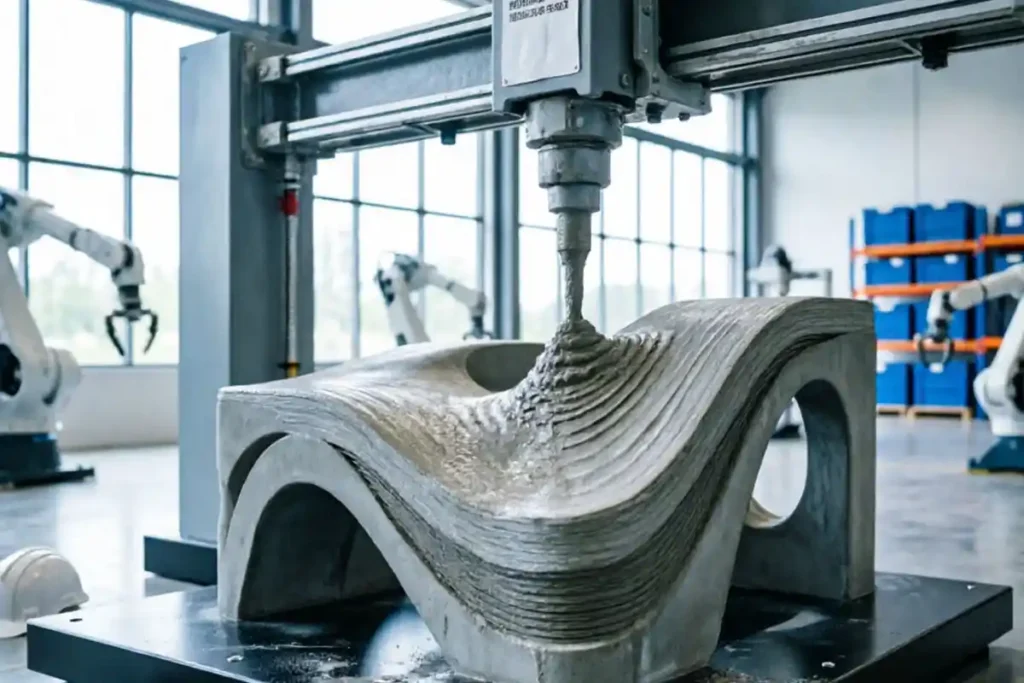
Digital Construction with Concrete 3D Printing
Traditional concrete construction is heavily reliant on formwork—expensive, labor-intensive molds that limit design complexity and generate significant material waste. Concrete 3D printing services disrupt this model entirely. It is an additive construction technology where a specialized concrete mixture is extruded layer-by-layer concrete printing through a nozzle attached to a robotic construction printing system or gantry system, directly following a digital 3D model.
This formwork-free construction approach is not just an evolution; it is a leap forward in how we conceive and create solid structures. As the market data suggests, this is a sector experiencing exponential growth in large scale 3d printing construction.
Chart: Projected Growth of the Global 3D Concrete Printing Market (2025-2033)
To visualize the explosive growth of this industry, consider the following projections based on market research data. The table below illustrates the increasing valuation of the 3DCP market, highlighting the rapid adoption of this technology worldwide.
Year Market Size (USD Billion) Notes Source 2025 $3.61 Billion Historic market size, marking the beginning of exponential growth. 3D Concrete Printing Market Report 2026 $5.39 Billion Projected rapid expansion as technology matures. 3D Concrete Printing Market Report 2030 $26.56 Billion Forecasted market size, driven by automation and sustainability. 3D Concrete Printing Market Report 2033 $15.98 Billion Long-term projection showing sustained, massive growth. 3D Concrete Printing Market Size, Share & Trends Analysis Report By Site Type, By Printing System, By Element Type, By Application, By End User, By Region, And Segment Forecasts, 2026 – 2033 *Note: The slight variation in 2033 figures from different reports reflects differing methodologies but confirms a multi-billion dollar industry trajectory.*
Key Benefits of Concrete 3D Printing Technology
Why should a designer, architect, or engineer choose 3DCP over conventional methods? The advantages are multifaceted, impacting cost, sustainability, and creative potential.
Unmatched Design Freedom and Complexity
The most immediate benefit of 3DCP is the liberation from the “straight line.” Traditional formwork is expensive to build in curves, making organic shapes prohibitive. With 3D printing, complexity comes free. We can fabricate intricate lattice structures, sweeping curves, and customized textures that would be impossible or financially unviable to create with cast concrete. This enables design freedom in construction and supports parametric architecture fabrication, allowing for mass customization—producing unique, one-off 3d printed concrete structures without the need for unique molds.
Significant Material Efficiency and Sustainability
Sustainability is a driving force in modern construction, and 3DCP is inherently aligned with eco-friendly building techniques and sustainable building technology. By placing material only where it is needed, the process drastically reduces waste. Studies show that through topological optimization, 3D printing can save up to 50-70% of material compared to traditional methods. Furthermore, the elimination of wooden formwork saves trees and reduces construction debris. The ability to use industrial waste products, such as steel slag or fly ash, as binders further lowers the carbon footprint in cement-based 3d printing.
Enhanced Speed and Reduced Labor Costs
Time is money in any project. 3D printing automates the construction process through construction automation services, significantly reducing the labor required on-site. A building element that might take weeks to form and pour can often be printed in a matter of hours using rapid construction solutions. This leads to shorter project timelines and lower overall costs. Although the initial investment in technology is high, the operational savings in labor and material are substantial.
Economic Viability
While the upfront costs of printing equipment can be a barrier, the economic model becomes highly favorable when considering the entire value stream. In a futuristic scenario analysis where the 3D printing supply chain is as mature as traditional construction, cost of concrete 3d printing could significantly decrease, reducing total construction costs by up to 61%. At the construction phase itself, cost reductions of nearly 80% have been observed when compared to conventional methods.
Advanced Concrete Materials for 3D Printing
The “ink” used in 3DCP is a high-performance mortar, specifically engineered to balance conflicting properties: it must flow easily through a pump (pumpability), hold its shape once extruded (buildability), and bond with the previous layer. Lava3DP utilizes a range of advanced material systems, including printable concrete mix design and high-strength cement composites, to meet specific project requirements.
Fiber-Reinforced Concretes
To compensate for concrete’s low tensile strength and to add ductility, fibers are a critical additive. The type of fiber used dramatically alters the mechanical properties of the final part.
- Steel Fibers: These provide the greatest enhancement to strength. Research indicates that adding 0.7% steel fibers can increase compressive strength by 22.5% and flexural strength by a remarkable 71.1% compared to unreinforced concrete. The fibers interlock strongly with the matrix, providing excellent energy absorption .
- Polypropylene (PP) and Basalt Fibers: PP fibers are effective at controlling plastic shrinkage cracking, while basalt fibers offer a good balance of strength and chemical resistance, often failing through rupture rather than pull-out .
Low-Carbon and Geopolymer Concretes
Traditional Portland cement is a major source of CO2 emissions. The industry is shifting towards geopolymer and other low-carbon binders.
- Geopolymer Concrete (GBC): Made from industrial by-products like fly ash and slag, GBC significantly reduces the carbon footprint while offering excellent resistance to heat and chemicals .
- Recycled Aggregates: Incorporating construction and demolition waste—such as brick debris, glass cullet, and recycled concrete aggregate—into printable mixtures is now a viable strategy. While these materials can affect water demand and rheology, they are key to achieving a circular economy in construction .
Innovative Composite Systems
The future of 3DCP lies in multi-material printing. For instance, researchers are developing composite walls where a structural concrete layer is printed alongside a cellulose-based layer for interior acoustic insulation. These hybrid systems align with modular construction 3d printing principles and are part of evolving smart construction solutions. These systems allow for dry assembly and eventual disassembly, enabling components to be reused—a principle known as “Design for Disassembly”.
Applications of 3D Printed Concrete Structures
The versatility of concrete 3d printing services makes it suitable for a vast array of applications across different sectors. At Lava3DP, we cater to a global clientele as a global concrete 3d printing company with diverse needs.
Custom Architectural Elements
This is where 3DCP truly shines. We can produce bespoke facade panels, column cladding, and decorative screens that feature complex geometric patterns through architectural concrete 3d printing. These elements allow architects to establish a unique visual identity for their buildings without the cost and lead time of custom formwork.
Urban Furniture and Landscape Design
Imagine park benches with organic, flowing forms, planters integrated into seating, or bollards with custom branding. 3D printing allows for the creation of durable, site-specific urban furniture that enhances public spaces and supports urban development 3d printing.
Structural and Infrastructure Components
While large-scale house printing is well-known, 3DCP is also perfect for smaller structural elements and infrastructure 3d printing applications. This includes load-bearing walls, bridge segments, and foundations such as 3d printed bridges. The ability to create compression-dominant structures allows for stable constructions with minimal material.
Specialized Industrial Parts
Beyond buildings, 3DCP can produce molds for precast concrete, lost formwork for complex joints, or heavy-duty machine bases. The ability to integrate voids and channels directly into the print is invaluable for creating lightweight yet stiff components using industrial grade concrete 3d printing.
Why Choose Lava3DP for Concrete 3D Printing
Choosing Lava3DP for your concrete printing needs means partnering with a trusted 3d printing construction partner and an experienced construction 3d printing provider. We combine industrial-scale printing technology with material science expertise to deliver parts that are not only geometrically perfect but also structurally sound, ensuring engineering-grade 3d printed structures. Our process begins with your digital model, which we optimize for printability, ensuring features like overhangs are managed and layer adhesion is maximized.
As the industry moves toward integrating sensors for structural health monitoring and incorporating phase-change materials for thermal management, Lava3DP remains committed to staying ahead of the curve, offering expert additive construction solutions aligned with the future of construction technology.
The Future of 3D Printed Construction
Concrete 3D Printing is more than just a new way to build; it is a new way to think. By merging digital design with physical fabrication, it unlocks a world of geometric complexity, material efficiency, and sustainable practice that traditional methods cannot match. Whether you are looking to create a one-of-a-kind sculpture or a series of load-bearing wall panels, on demand concrete 3d printing offers the precision, speed, and freedom to realize your vision.
Ready to build the future? Contact Lava3DP today to request concrete 3d printing quote and start your next project.
Frequently Asked Questions (FAQs)
What File Formats and Size Limits Are Supported for Concrete 3D Printing?
At Lava3DP, we accept standard 3D file formats such as STL, STEP, STP, OBJ, and 3MF. For concrete printing, the design must be a watertight mesh. While our robotic printing systems are capable of producing parts up to several meters in size, the exact limitations depend on the geometry and weight of the part. For very large structures, we often utilize a modular approach, printing interlocking segments that can be assembled on-site . Contact us with your model, and our engineering team will optimize the file for printability and provide a feasibility analysis.
How Strong Is 3D Printed Concrete vs Traditional Concrete?
3D printed concrete parts are engineered to be highly durable. The mechanical properties depend on the material mix used. For instance, we offer fiber-reinforced options where adding 0.7% steel fibers can increase compressive strength by over 22% compared to standard mixes . While the layer-by-layer process introduces some anisotropy (meaning strength can vary by direction), we optimize print paths and interlayer bonding to ensure structural integrity that meets or exceeds the requirements for most architectural and non-structural applications. For load-bearing elements, we can integrate reinforcement strategies, including the post-tensioning or placement of rebar .
Is Concrete 3D Printing an Eco-Friendly Construction Method?
Yes, it offers significant sustainability advantages over traditional methods. Firstly, it eliminates the need for wooden formwork, reducing deforestation and construction waste. Secondly, the additive process is highly material-efficient, often using up to 50-70% less material than conventional casting by placing concrete only where it is structurally necessary . Furthermore, Lava3DP utilizes low-carbon concrete mixes that incorporate recycled materials like fly ash, slag, or ground brick waste, helping to reduce the overall carbon footprint of your project .
What Is the Lead Time for Concrete 3D Printing Projects?
One of the primary benefits of 3D printing is speed. Lead times are significantly shorter than traditional methods that require formwork construction. For small to medium-sized parts, production can begin within days of design finalization. The actual print time for an object might range from a few hours for a small planter to a day or two for a large architectural panel. However, total lead time also includes post-processing, such as curing and surface finishing. We provide accurate timelines during the project quotation phase.
Can Concrete 3D Printing Handle Complex Geometries and Cavities?
Absolutely. This is where 3D concrete printing excels. Unlike traditional casting, which requires expensive and complex molds to create undercuts or voids, 3D printing builds these features directly into the digital model. We utilize advanced slicing software to manage overhangs, often without the need for temporary supports. We can also design and print intricate internal geometries, such as optimized lattice structures that reduce weight without compromising strength, or cavities designed to run utilities or reduce thermal bridging .