
Introduction: Advancing Composite Manufacturing with Continuous Fiber 3D Printing
In the rapidly evolving landscape of advanced composite manufacturing and additive technologies, a transformative technology is redefining what’s possible in part strength, lightweight design, and material efficiency. Continuous fiber 3D printing represents a revolutionary leap beyond conventional plastic 3D printing, enabling engineers and designers to create high strength 3D printed composites with mechanical properties that rival—and in some cases surpass—traditional metals. This advanced manufacturing process integrates continuous fiber reinforcements like continuous carbon fiber, fiberglass, and Kevlar directly into thermoplastic matrices during the printing process, resulting in lightweight structural composite parts with exceptional high strength to weight ratio components and structural integrity.
At LAVA, we’re pioneering accessible, high-performance continuous fiber 3D printing service solutions and fiber reinforced additive manufacturing technology that bridges the gap between prototyping and end-use part production. This comprehensive guide explores the technical foundations, applications, and future potential of this groundbreaking technology, demonstrating how LAVA3DP is empowering industries through industrial composite 3D printing and next generation additive manufacturing without constraints.
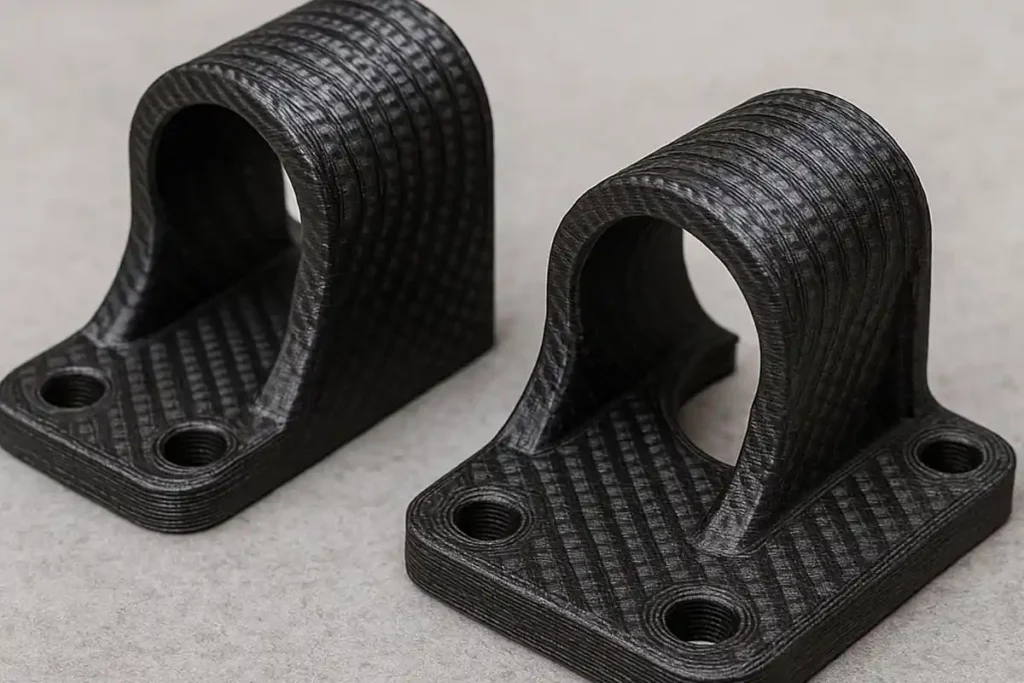
Understanding Continuous Fiber Reinforced 3D Printing Technology
The Core Process: How Continuous Fiber Reinforcement Works
Continuous fiber 3D printing, often referred to as continuous fiber fabrication technology (CFF) or composite 3D printing service, fundamentally differs from traditional filament-based methods. While conventional FDM (Fused Deposition Modeling) printers extrude only thermoplastic material, continuous fiber systems incorporate two distinct components simultaneously: a thermoplastic matrix (typically nylon, PLA, or PETG) and a continuous fiber reinforcement strand, enabling fiber reinforced thermoplastic printing and composite reinforced polymer printing.
The process involves a dual-nozzle system or specialized print head that precisely deposits the thermoplastic filament alongside the continuous reinforcement fiber. As these materials are co-extruded, the thermoplastic melts and fully impregnates the fiber, creating a continuous fiber reinforced polymer (CFRP) printing structure with aligned reinforcement along precise stress paths determined by the digital design. This enables what is known as anisotropic reinforcement—the ability to place strength exactly where it’s needed in the part through fiber oriented toolpath printing, rather than relying on isotropic material properties. These resulting anisotropic composite structures allow engineers to produce structural composite 3D printed parts with optimized performance.
Key Materials: Thermoplastics and Reinforcement Fibers
The versatility of continuous fiber additive manufacturing stems from the wide range of compatible material combinations used in industrial composite manufacturing and precision composite fabrication:
- Thermoplastic Matrices: Common matrix materials include Nylon (PA6, PA12) for durability and chemical resistance, PLA for ease of printing, PETG for impact resistance, and advanced thermoplastics like PEEK and PEI for high-temperature applications. These reinforced thermoplastic materials enable the production of high performance composite structures.
- Reinforcement Fibers: The strength component comes from continuous strands of:
- Carbon Fiber: Offering the highest strength-to-weight ratio and stiffness, ideal for carbon fiber reinforced 3D printing and carbon fiber reinforced polymer parts used in structural applications.
- Fiberglass (Glass Fiber): Providing excellent strength at a lower cost, widely used in glass fiber reinforced 3D printing and fiberglass reinforced polymer components.
- Kevlar (Aramid Fiber): Delivering exceptional impact resistance and toughness, commonly used in aramid fiber composite printing and Kevlar / aramid fiber composites.
- Basalt Fiber: A sustainable reinforcement material used for lightweight engineering components and high performance engineering parts with strong thermal stability.
Table 1: Mechanical Properties Comparison of Continuous Fiber Materials
| Material Combination | Tensile Strength (MPa) | Flexural Modulus (GPa) | Density (g/cm³) | Best Applications |
|---|---|---|---|---|
| Nylon + Carbon Fiber | 480-520 | 40-50 | 1.3-1.4 | Structural components, aerospace parts, high-stress fixtures |
| Nylon + Fiberglass | 320-380 | 18-25 | 1.6-1.8 | Automotive brackets, enclosures, industrial tooling |
| PLA + Carbon Fiber | 280-330 | 25-30 | 1.4-1.5 | Prototypes, lightweight fixtures, consumer product components |
| PETG + Kevlar | 220-260 | 8-12 | 1.3-1.4 | Impact-resistant parts, protective gear, vibration damping |
Advantages of Fiber-Reinforced Additive Manufacturing vs Traditional Methods
Unmatched Strength-to-Weight Ratio
The most significant advantage of continuous fiber reinforced composites is their exceptional strength-to-weight ratio. Continuous carbon fiber 3D printing service allows engineers to create high strength lightweight composite 3D printing parts capable of achieving strength comparable to aluminum while maintaining lower weight. Carbon fiber reinforced parts can achieve strength comparable to 6061 aluminum at approximately 60% of the weight, or match the weight of plastic parts while offering 5-10 times greater strength. This capability enables lightweight yet strong components and aerospace composite parts, automotive lightweight components, and drone structural components.
Design Freedom and Part Consolidation
Continuous fiber composite printing enables complex geometries that would be impossible or prohibitively expensive with traditional composite manufacturing methods like layup or compression molding. Engineers can create organic, optimized structures that follow natural stress paths, enabling topology optimized composite design and structural performance optimization. This allows consolidation of multiple parts into single high tolerance composite production components used in industrial tooling and fixtures and robotics structural parts.
Customizable Anisotropic Properties
Unlike traditional manufacturing methods that produce materials with uniform properties in all directions, fiber reinforced 3D printing allows for anisotropic property control. Reinforcement can be placed precisely along predicted load paths within a part, optimizing material usage and performance. This approach supports automated composite fabrication and enables engineers to produce composite reinforced functional prototypes with near net shape composite manufacturing.
Industrial Applications of Continuous Fiber Composite 3D Printing
Aerospace and Aviation
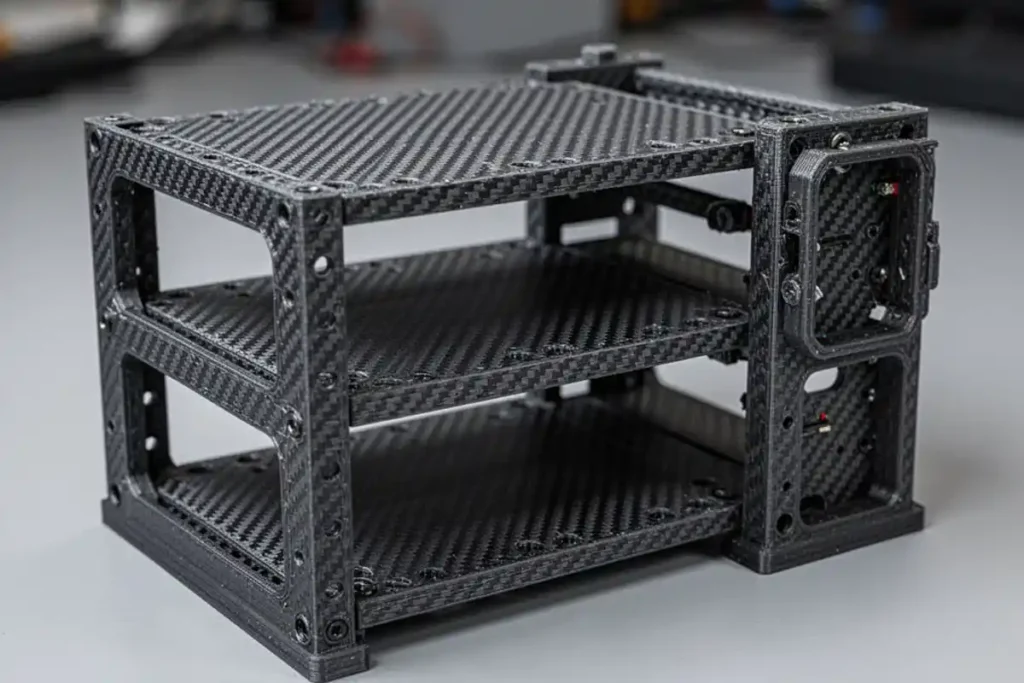
The aerospace industry has been an early adopter of continuous fiber additive manufacturing due to its relentless pursuit of weight reduction without sacrificing strength. Applications include:
- Lightweight drone frames and components
- Custom brackets and mounting hardware for aircraft interiors
- Conformal tooling for composite part fabrication
- Prototype and end-use parts for satellites and space systems
Automotive and Transportation
Automotive manufacturers leverage continuous fiber 3D printing for both prototyping and production applications:
- Custom jigs, fixtures, and assembly aids
- Lightweight structural components for performance vehicles
- End-use parts for low-volume specialty vehicles
- Composite tooling for carbon fiber part production
Industrial Manufacturing and Robotics
In industrial settings, continuous fiber composites enable:
- Strong, lightweight end-effectors and grippers for robotic systems
- Custom reinforcement for existing components
- Replacement parts for machinery with improved performance
- Wear-resistant tooling and fixtures

Medical and Orthotics
The medical field benefits from the customization capabilities of continuous fiber technology:
- Custom orthopedic devices with optimized strength profiles
- Surgical guides and instruments
- Lightweight prosthetics and exoskeleton components
- Specialized equipment with embedded reinforcement
Material Science and Mechanical Performance of Fiber-Reinforced Parts
Mechanical Property Validation
Independent testing confirms the exceptional performance of LAVA3DP engineering grade composite materials produced through industrial grade additive manufacturing. In standardized ASTM tests:
- Tensile Strength: Nylon with continuous carbon fiber reinforcement achieves 500+ MPa, demonstrating the capability of continuous fiber reinforced nylon 3D printing and carbon fiber reinforced polymer parts comparable to aluminum alloys.
- Flexural Modulus: Stiffness values reach 40+ GPa, enabling the creation of high performance composite structures used in lightweight engineering components.
- Impact Resistance: Kevlar reinforced parts demonstrate remarkable toughness, withstanding impacts that would shatter conventional 3D printed parts, making them suitable for medical orthotics composites and other demanding environments.
Thermal and Chemical Performance
Beyond mechanical properties, fiber reinforced additive manufacturing composites offer enhanced performance in challenging environments and enable quality controlled composite production:
- Thermal Stability: Fiber reinforcement reduces coefficient of thermal expansion, improving dimensional stability across temperature ranges and supporting precision composite fabrication.
- Chemical Resistance: Proper matrix selection combined with fiber reinforcement creates parts resistant to oils, solvents, and industrial chemicals, making them ideal for industrial prototyping services and industrial composite manufacturing.
- Fatigue Performance: Continuous fibers inhibit crack propagation, significantly improving fatigue life compared to unreinforced thermoplastics and enabling structural composite 3D printed parts for demanding engineering applications.
Comparative Analysis with Traditional Composites
When compared to traditional composite manufacturing methods, continuous fiber 3D printing offers distinct advantages:
| Parameter | Continuous Fiber 3D Printing | Traditional Layup | Compression Molding |
|---|---|---|---|
| Setup Time | |||
| Tooling Cost | |||
| Design Complexity | |||
| Part Consolidation | |||
| Customization | |||
| Waste Material |
Emerging Trends in Continuous Fiber Additive Manufacturing
Emerging Materials and Hybrid Approaches
The future of continuous fiber additive manufacturing includes exciting developments in material science and digital manufacturing for composites:
- High-Temperature Composites: Integration of advanced thermoplastics like PEEK and PEKK with continuous fibers for high-performance additive manufacturing with fiber reinforcement applications.
- Multimaterial Printing: Simultaneous deposition of different fiber types within a single part for optimized performance zones in advanced composite manufacturing.
- Functional Integration: Embedding conductive fibers for electrical functionality or sensing capabilities within composite reinforced polymer printing structures.
- Sustainable Composites: Development of bio-based resins and recycled reinforcement fibers used in mold free composite manufacturing.
Software and AI Integration
Advanced software will further enhance continuous fiber 3D printing service capabilities and support digital to part composite fabrication workflows:
- Generative Design Algorithms: AI-driven optimization of fiber placement based on simulated load conditions supporting topology optimized composite design.
- Topology Optimization: Combined structural optimization with fiber path generation for high strength engineering materials.
- In-Process Adaptive Control: Real-time adjustment of printing parameters based on sensor feedback for precision composite fabrication.
- Digital Twin Integration: Full lifecycle tracking and performance prediction for printed parts within composite additive production workflow.
Market Growth and Adoption Projections
The market for continuous fiber composite printing and industrial 3D printing service provider technologies is experiencing rapid growth. Analysts project strong adoption across international additive manufacturing services markets.
Key drivers include:
- Decreasing system costs making continuous fiber 3D printing service online more accessible to small and medium enterprises.
- Growing recognition of weight reduction benefits in global custom carbon fiber parts manufacturing across transportation sectors.
- Increased material options enabling rapid composite prototyping and low volume composite production.
- Advancements in speed and reliability making industrial continuous fiber composite printing viable for production applications.
How to Start a Continuous Fiber 3D Printing Project with Lava3DP
Implementation Considerations
Organizations adopting custom continuous carbon fiber 3D printing service technologies should evaluate:
- Application Alignment: Identify parts where high strength to weight ratio components provide advantages.
- Skill Development: Training teams in advanced CAD to manufacturing workflow and additive design principles.
- Workflow Integration: Integrating digital manufacturing for composites with existing engineering processes.
- Economic Justification: ROI based on performance improvements from high strength lightweight composite 3D printing.
LAVA3DP Support Ecosystem
LAVA3DP provides comprehensive support as a global continuous fiber printing service and online continuous fiber 3D printing service provider.
- Application Engineering: Collaborative design optimization for composite reinforced functional prototypes.
- Material Selection Guidance: Expert recommendations for engineering grade composite materials.
- Training Programs: Comprehensive instruction on industrial grade additive manufacturing systems.
- Technical Support: Dedicated engineering assistance for precision composite fabrication and production workflows.
Conclusion: The Future of High-Strength Composite Manufacturing
Continuous fiber 3D printing represents more than just an incremental improvement in additive manufacturing—it’s a paradigm shift in how we design and produce high performance composite structures and lightweight engineering components.
By combining the design freedom of 3D printing with the mechanical performance of advanced composites, this technology enables innovation across industries through industrial composite 3D printing and advanced composite manufacturing.
At LAVA3DP, we’re committed to advancing and democratizing this transformative technology by offering continuous fiber 3D printing service online, enabling engineers and manufacturers worldwide to order carbon fiber reinforced 3D printed parts and develop next-generation products.
Frequently Asked Questions(FAQs)
What are the key advantages of continuous fiber 3D printing over standard plastic 3D printing?
The primary advantage is dramatically improved mechanical properties. While traditional 3D printing produces plastic parts suitable for prototypes and non-structural applications, continuous fiber 3D printing creates composite parts with strength and stiffness comparable to metals. Carbon fiber reinforced parts can be 5-10 times stronger than similar plastic parts while maintaining similar weight, enabling production of end-use structural components.
What composite materials are available in Lava3DP continuous fiber 3D printing services?
LAVA3DP systems support a wide range of materials for maximum flexibility. For the matrix, we support common engineering thermoplastics including various nylons (PA6, PA12), PLA, PETG, ABS, and advanced materials. For reinforcement, we offer continuous carbon fiber, fiberglass (glass fiber), Kevlar (aramid fiber), and basalt fiber. Our open-system approach allows customers to choose from multiple suppliers to optimize cost and performance.
How strong are continuous carbon fiber 3D printed parts compared to aluminum?
The strength comparison depends on the specific materials and fiber orientation, but carbon fiber reinforced nylon typically achieves tensile strength of 480-520 MPa, which is comparable to many aluminum alloys (e.g., 6061 aluminum has tensile strength of 240-300 MPa). More importantly, continuous fiber composites offer a superior strength-to-weight ratio—they can match aluminum’s strength at approximately 60% of the weight, or exceed aluminum’s strength at equal weight when optimally designed.
What CAD and slicing software is used to design continuous fiber reinforced parts?
LAVA3DP provides proprietary slicing software that converts standard 3D models into instructions for our printers with optimized fiber paths. This software includes tools for specifying reinforcement zones, fiber directions, and layer parameters. The software accepts common 3D file formats (.STL, .OBJ, .3MF) and integrates with popular CAD packages. For optimal results, we recommend designing specifically for additive manufacturing to leverage anisotropic reinforcement capabilities.
Is continuous fiber 3D printing suitable for end-use production parts or only prototyping?
Absolutely, continuous fiber 3D printing is increasingly used for end-use production parts across industries. While excellent for prototyping due to rapid iteration capabilities, the technology truly shines in production applications where its advantages—light weight, part consolidation, customization, and performance—provide tangible value. Industries from aerospace to automotive are already using continuous fiber reinforced parts in final products, particularly for low-to-medium volume production where traditional composite manufacturing would be cost-prohibitive.