
The landscape of modern manufacturing is undergoing a seismic shift. As industries demand larger, stronger, and more complex metal components with shorter lead times, traditional subtractive methods like CNC machining and casting are increasingly showing their limitations. Enter Directed Energy Deposition (DED), a category of additive manufacturing technology poised to revolutionize how we build, repair, and rethink metal parts using Directed energy deposition 3D printing and metal DED additive manufacturing.
At LAVA3DP, we are committed to providing our global clients with the most advanced custom parts fabrication solutions. We are thrilled to announce the expansion of our service offerings to include state-of-the-art DED 3D printing service and industrial DED 3D printing solutions. This article serves as your comprehensive guide to understanding DED technology, its advantages, materials, applications, and why it might be the perfect solution for your next project and on-demand metal additive manufacturing service.
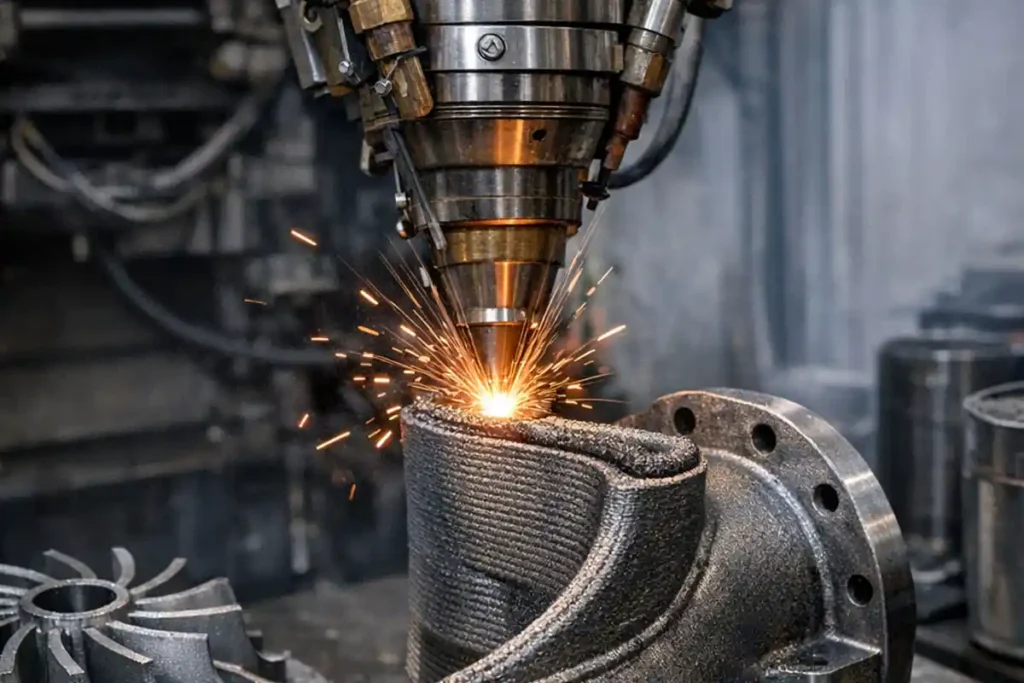
Directed Energy Deposition (DED): Process & Technology Overview
At its core, Directed Energy Deposition (DED) is a sophisticated metal deposition process that functions much like an automated, high-precision welding robot. Unlike other metal 3D printing methods that operate within a bed of powder, DED uses a focused energy source—typically a laser, electron beam, or electric arc—to melt material as it is being deposited, commonly known as laser metal deposition (LMD) or electron beam DED printing.
Here’s a simple breakdown of how it works:
Energy Source: A nozzle mounted on a multi-axis arm (or gantry) directs a concentrated energy beam onto a substrate or existing part, creating a small molten pool using multi-axis DED printing capabilities.
Material Feedstock: Metal in the form of powder or wire is simultaneously fed into this melt pool, enabling wire arc additive manufacturing (WAAM) and other feedstock options.
Layer-by-Layer Build: The nozzle moves along a programmed path. As it moves, the material solidifies, building up features layer by layer. This allows for the creation of near-net shape manufacturing parts or the addition of features onto existing components for custom metal part fabrication using DED.
This unique “micro-welding” approach gives DED its distinctive capabilities, setting it apart from other additive technologies and enabling precision metal deposition services.
DED vs. Powder Bed Fusion (PBF): Key Differences Explained
When discussing metal 3D printing, most people think of Laser Powder Bed Fusion (LPBF). While both are metal additive processes, they serve different purposes. The core trade-off: PBF is ideal for small, highly complex parts with fine features, while DED is built for speed, scale, and repair. PBF offers superior surface finish and detail, but DED wins in high deposition rate 3D printing and large-scale metal 3D printing capabilities.
To visualize the differences, consider the following comparison:
DED 3D Printing Market Trends & Core Advantages
The global DED 3D printing market is on an explosive growth trajectory. According to a comprehensive report by Meticulous Research, the market is projected to reach $5.76 billion by 2036, growing at a robust Compound Annual Growth Rate (CAGR) of 17.5% from 2026 to 2036. This surge is driven by increasing demand for industrial-scale additive manufacturing solutions and the rising adoption of hybrid manufacturing CNC + DED.
So, why are industries from aerospace to energy turning to DED? The advantages are compelling.
1. High-Speed Metal Deposition for Large-Scale Parts
A 2025 study comparing DED and PBF for Ti-6Al-4V alloy found that DED builds parts up to ten times faster. For industries needing large structural components, this speed translates directly to faster time-to-market and high-speed metal deposition advantages.
2. Cost-Efficient Metal Manufacturing with Minimal Waste
DED significantly reduces the “buy-to-fly” ratio—the weight of raw material needed versus the weight of the final part. A 2024 review by Haley et al. in the Journal of Manufacturing Processes reported that hybrid DED and machining processes can cut material costs by an astounding 97% compared to traditional CNC-only workflows. Furthermore, a July 2024 study by Navneet Khanna and his team demonstrated that PBF can be about five times more expensive than DED for parts of the same size, making it a cost-effective metal repair solution and helping reduce material waste additive manufacturing.
3. Advanced Repair & Remanufacturing with DED Technology
One of DED’s “superpowers” is its ability to repair high-value components like turbine blades, molds, and dies using metal repair 3D printing service and additive repair technology. A recent study by Blaha et al. (2024) confirmed that DED repairs can restore jet parts while maintaining the structural integrity of the underlying component, supporting turbine blade repair 3D printing and extending lifecycle benefits.
4. Hybrid Manufacturing: Combining CNC Machining with DED
DED integrates seamlessly with traditional manufacturing. By mounting a DED head on a CNC machine or robotic arm, you can create hybrid manufacturing cells that combine additive and subtractive processes in one setup. This allows for the creation of functionally graded materials and enables metal cladding and coating as well as corrosion-resistant metal coating printing where needed.
DED Metal Materials: Alloys & Engineering-Grade Options
The guiding principle for DED materials is weldability. Because the process is a form of automated welding, any metal that can be welded is a candidate for DED. At LAVA3DP, we leverage this versatility to offer a wide range of high-performance materials including titanium DED printing, stainless steel DED manufacturing, Inconel 3D printing service, and aluminum alloy DED printing.
Core Material Categories and Applications
At Formnext 2025, Meltio demonstrated the power of multi-material printing by showcasing a dual combustion chamber printed with Inconel 718 for hot zones and a copper alloy for cooling zones—all in a single build . This is the future of design that DED enables.
Industrial Applications of DED Across Global Sectors
The versatility of DED makes it a game-changer for numerous sectors.
Aerospace & Defense: The largest end-use industry for DED. Applications include aerospace component repair and defense part manufacturing such as turbine blades, engine nozzles, and structural airframes.
Automotive: DED is used for automotive tooling repair and performance parts with high-strength alloy 3D printing.
Energy, Oil & Gas: Ideal for oil and gas equipment refurbishment and energy sector component repair like turbine casings and valves.
Marine & Heavy Machinery: Perfect for shipbuilding metal repair and heavy equipment part restoration due to scalability.
Why Choose Lava3DP for Industrial DED 3D Printing Services
At LAVA, we don’t just offer a technology; we offer a solution. By integrating DED into our platform, we provide a global metal additive manufacturing service and online DED 3D printing service worldwide.
Expertise: We deliver expert additive manufacturing solutions backed by experienced additive manufacturing engineers.
Scalability: From prototypes to industrial components, we provide scalable metal production solutions.
Quality Assurance: We ensure quality-controlled metal part production with certified material quality assurance.
Global Reach: As an international DED printing supplier, we serve markets including DED 3D printing service USA, metal 3D printing Europe, and DED 3D printing UAE.
Whether you need to breathe new life into a worn-out turbine blade or manufacture a large, complex bracket from titanium, LAVA3DP’s custom directed energy deposition 3D printing service online and rapid turnaround DED metal printing solutions are your partner in innovation.
Frequent Asked Questions
How Does DED Compare to SLM and Other Metal 3D Printing Technologies?
The main difference lies in the process and application. Selective Laser Melting (SLM) is a Powder Bed Fusion (PBF) process ideal for creating small, highly complex parts with intricate details and smooth surfaces. DED, on the other hand, is like automated welding. It uses a nozzle to deposit metal onto a surface, making it significantly faster and more cost-effective for large parts, near-net shapes, and adding material to existing components for repair . If you need a detailed, small bracket, SLM is often the best choice. If you need a large structural part or need to repair a high-value tool, DED is the superior solution.
What File Formats and Design Guidelines Are Required for DED Printing?
We accept standard 3D file formats such as .STL, .STEP, and .IGES. For a successful DED build, we recommend designing with the process in mind. Unlike PBF, DED is best for creating “near-net” shapes, meaning parts are printed slightly oversized and then machined to their final dimensions for a superior surface finish. Our engineering team at LAVA3DP can review your design and provide feedback to optimize it for DED, ensuring manufacturability and cost-efficiency. Simply upload your file to our platform for an instant, confidential review.
What Are the Typical Lead Times and Costs for DED Projects?
Turnaround times vary based on part size and complexity, but DED is typically much faster. For example, a complex stub axle that might take weeks to forge and machine can be printed via DED in as little as 21 hours . In terms of cost, DED can dramatically reduce expenses by minimizing material waste. Studies show hybrid DED/machining processes can cut material costs by up to 97% compared to machining a part from a solid block of metal . For a precise quote and timeline tailored to your project, upload your design to LAVA3DP.
Which Metals Are Supported in DED, and Can Customer Materials Be Used?
We offer a comprehensive range of engineering-grade metals including Titanium (Ti-6Al-4V), Nickel Superalloys (Inconel 625/718), Stainless Steels (316L, 17-4PH), Tool Steels (H13), and Aluminum alloys. The key requirement for DED is that the material must be weldable . We primarily use virgin, high-quality wire and powder feedstocks to ensure part integrity. Please contact us directly to discuss using customer-supplied material; we can evaluate its compatibility with our systems on a case-by-case basis.
Can DED 3D Printing Repair or Restore Worn Metal Components?
Absolutely. Repair and remanufacturing is one of the strongest applications of DED technology . If you have a high-value component like a turbine blade, a large mold, or a hydraulic shaft that is worn or damaged, DED can precisely deposit new material only where it is needed. This adds minimal heat to the rest of the part, preserving its original properties. After deposition, the repaired area can be machined back to its original specifications, giving your expensive part a new life at a fraction of the replacement cost. Submit your part details or 3D scan to LAVA3DP for a feasibility assessment.