
Discover the precision of micro SLA 3D printing service at LAVA3DP. Learn about micron-level resolution, advanced materials, and applications for medical, jewelry, and microfluidics. Upload your CAD file for an instant quote today!
In the rapidly evolving world of micro additive manufacturing, the push toward miniaturization has created a demand for parts that are not just small, but incredibly intricate and precise. While standard high resolution 3D printing service technologies have become mainstream, they often fall short when it need to create features smaller than a human hair. Enter micro stereolithography printing (Micro-SLA) —a revolutionary technology that bridges the gap between conventional prototyping and high accuracy SLA prototyping.
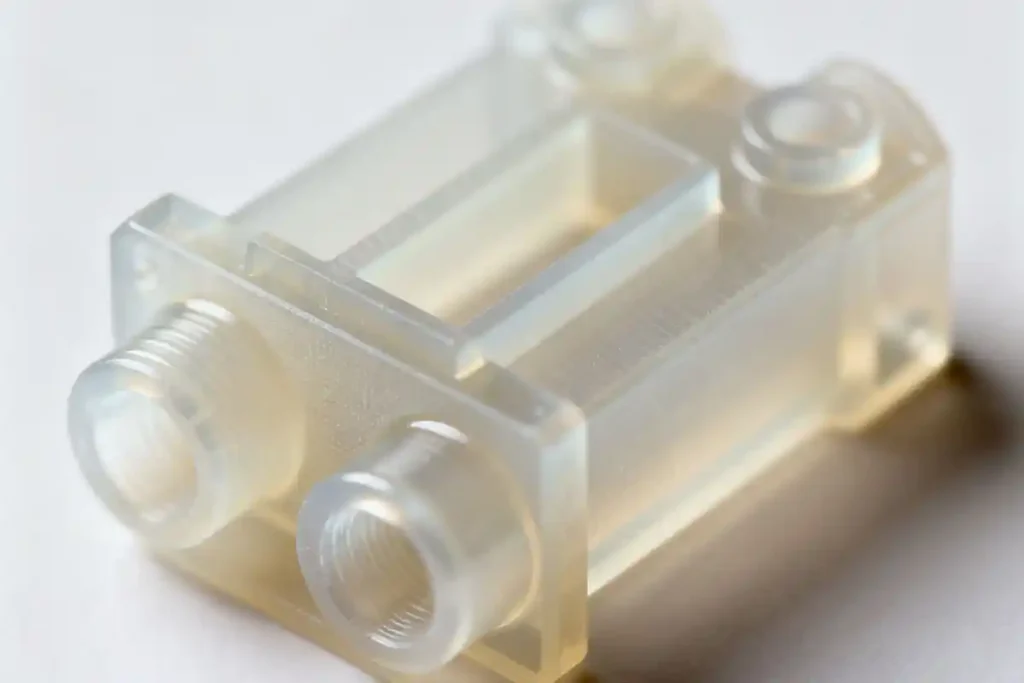
At LAVA3DP, we are proud to introduce our state-of-the-art micro 3D printing company solutions through our Micro-SLA 3D Printing Service, designed to turn your most detailed digital concepts into physical reality. Whether you are developing a lab-on-a-chip device, intricate jewelry, or micro-connectors for electronics, our precision SLA printing services deliver the accuracy you need.
This guide explores the science, advantages, materials, and applications of Micro-SLA, demonstrating why it is the ultimate solution for micro fabrication service and custom microfabrication.
Micro-SLA 3D Printing: High-Resolution Micro Manufacturing Explained
Micro-SLA, or Micro Stereolithography, is an advanced variant of traditional stereolithography (SLA) specifically optimized for achieving ultra fine detail 3D printing. While standard SLA might print layers at 50 to 100 microns, Micro-SLA operates at the micron level, with layer thicknesses as thin as 5 to 25 microns and feature resolutions down to 2 µm, enabling sub-millimeter 3D printing.
The process utilizes a focused light source—often a precision laser or a DLP (Digital Light Processing) projector—to selectively cure liquid photopolymer resin. However, unlike conventional SLA, Micro-SLA employs specialized optics and tight focus to create features with exceptional detail and smoothness, making it ideal for photopolymer micro printing.
How Micro-SLA Works: Precision Photopolymerization Technology
Micro-SLA typically falls under the umbrella of Projection Micro Stereolithography (PµSL). This technique uses a digital light engine to flash an entire layer of resin at once, polymerizing it through a mask. This method allows for:
High Throughput: Entire layers are cured simultaneously, making it faster than laser point-by-point scanning and supporting rapid micro prototyping services.
Exceptional Detail: With DMD (Digital Micromirror Device) chips, resolution is determined by pixel size, allowing for features as small as 0.6 µm in some configurations, enabling fine feature 3D printing.
Complex Geometries: It excels at creating intricate internal channels, undercuts, and fine lattice structures that are impossible with traditional machining, ideal for micro-scale product development.
Table: Comparison of resolution and speed across 3D printing technologies .
Key Benefits of Micro-SLA for Ultra-Fine Custom Parts
Choosing Micro-SLA for your project unlocks a suite of benefits that other manufacturing methods simply cannot match.
1. Unmatched Precision and Accuracy
Micro-SLA achieves extremely fine resolutions, making it ideal for applications requiring detailed microstructures and small tolerance 3D printing. The minimum feature sizes are often measured in single-digit microns, ensuring that even the smallest part of your design is rendered perfectly.
2. Superior Surface Finish
One of the standout features of Micro-SLA is its ability to produce near-injection-mold quality surfaces. Because the layers are so thin, the “stair-stepping” effect common in 3D printing is virtually eliminated, resulting in smooth, clear, and optically transparent finishes, ideal for high resolution photopolymer printing.
3. Complex Geometries and Design Freedom
Unlike traditional MEMS (Microelectromechanical Systems) fabrication, which is largely planar, Micro-SLA builds fully three-dimensional structures. This allows for the creation of complex, functional designs that would be impossible with etching or micro-machining, supporting micro engineering prototypes.
4. Accelerated Prototyping and R&D
Traditional microfabrication requires expensive masks and tooling, slowing down iteration. Micro-SLA prints directly from CAD data in hours, allowing researchers to test and refine designs rapidly, making it perfect for research-grade micro prototyping.
5. Cost-Effective Low-Volume Production
For small to medium production runs, Micro-SLA eliminates the need for expensive hard tooling. This makes it economically viable for bridge production or customized end-use parts, especially in small batch micro manufacturing.
Micro-SLA Materials: High-Performance Photopolymer Resins
At LAVA3DP, we utilize a wide range of photopolymer resins tailored to specific mechanical and aesthetic needs. The material properties are critical to the success of your application and are backed by advanced photopolymer technology.
- High-Precision Standard Resins: Ideal for general prototyping, master patterns, and concept models. They offer a great balance of detail and cost while enabling detailed resin prototypes.
- Biocompatible Resins: Certified for medical applications, these materials are perfect for surgical guides, dental implants, and drug delivery devices, supporting medical micro device prototyping.
- High-Temperature Resins: Capable of withstanding thermal challenges, these resins are used in aerospace and automotive components where parts must endure harsh environments, ensuring industrial grade SLA printing.
- Flexible and Tough Resins: For parts that need to bend without breaking, such as soft grips, seals, or snap-fit assemblies, these materials support miniature part manufacturing.
- Ceramic-Filled Resins: These provide the rigidity and thermal properties of technical ceramics post-sintering, enabling precision engineering 3D printing.
Micro-SLA Applications: Industries That Demand Micro Precision
The precision of Micro-SLA is transforming industries across the globe. Here is how different sectors are leveraging this technology.
1. Medical Devices and Bio-MEMS
The medical field demands precision and customizability. Micro-SLA is used to create micro-needles, stents, surgical tools, and scaffolds for tissue engineering, making it ideal for high precision micro resin printing for medical devices.
2. Microfluidics and Lab-on-a-Chip
Microfluidics relies on intricate channels and chambers. Micro-SLA enables the rapid fabrication of microfluidic devices with complex capillary structures, making it perfect for microfluidic device printing.
3. Electronics and MEMS
As consumer electronics shrink, so do their components. Micro-SLA is ideal for printing micro-connectors, sensor housings, and chip sockets that require high tolerance and precision, supporting electronics micro components printing.
4. Jewelry and Luxury Goods
Jewellers use Micro-SLA for high-detail master patterns for lost-wax casting, enabling jewelry micro casting patterns with exceptional detail.
5. Optics and Photonics
The smooth surface finish achievable with Micro-SLA makes it suitable for micro-lenses and optical fiber connectors, supporting micro optics fabrication 3D printing.
Why Choose LAVA3DP: Trusted Experts in Micro-Scale 3D Printing
At LAVA, we don’t just print parts; we provide solutions. Our new Micro-SLA service is backed by a team of expert micro fabrication engineers who understand the nuances of microfabrication. We are a trusted micro 3D printing provider delivering consistent quality. We offer:
- Design for Manufacturing (DfM) Support: We help you optimize your designs to ensure they are not only printable but perfect, making us a reliable prototyping partner.
- Rigorous Quality Control: Every part is inspected to ensure it meets the specified tolerances, ensuring quality controlled SLA printing.
- Global Reach: We serve clients worldwide, ensuring that no matter where you are, you have access to online micro SLA printing worldwide.
Ready to bring your micro-designs to life? Upload your 3D model to LAVA3DP today for an instant quote and experience the future of precision manufacturing with a custom micro 3D printing service.
Frequently Asked Questions
What Are the Minimum and Maximum Part Sizes in Micro-SLA Printing?
At LAVA3DP, our Micro-SLA service is optimized for high detail. While we can achieve features as small as 5-10 microns, the overall build volume can accommodate parts up to approximately 100mm x 100mm x 100mm, depending on the specific machine configuration. For larger parts, we recommend splitting the design or using our standard SLA service .
Which File Formats Are Supported and What Are the Design Guidelines for Micro-SLA?
We accept standard 3D file formats such as STL, OBJ, and 3MF. To ensure a successful print, we recommend a minimum wall thickness of 0.2 mm – 0.3 mm for self-supporting features. For extremely fine details, our team will review your file and provide feedback. It is crucial that your model is watertight (manifold) and free of non-manifold edges .
What Is the Typical Lead Time for Micro-SLA 3D Printing Orders?
Due to the high-resolution nature of the process, print times can vary based on the part’s height and the chosen layer thickness. However, because Micro-SLA uses a projection system, it is surprisingly fast. Typical turnaround times for prototyping start from as little as 2-3 business days for production and shipping, depending on your location. We offer express options for urgent projects .
Are Micro-SLA Materials Safe for Medical or Food-Contact Applications?
Yes, we offer a selection of resins that are biocompatible (e.g., ISO 10993 certified). These are perfect for medical devices, dental applications, and surgical guides. However, for food contact, additional verification may be needed depending on the specific resin and application. Please contact us with your specific requirements so we can recommend the best material .
What Post-Processing Options Are Available for Micro-SLA Printed Parts?
We provide a range of post-processing services to meet your needs. Standard finishing includes cleaning and UV curing. We also offer support removal and fine polishing. For specific requirements, we can provide dyeing (coloring), assembly, and surface coating to enhance durability or aesthetics. The surface finish of Micro-SLA parts is already exceptionally smooth, often requiring no further work before use .