

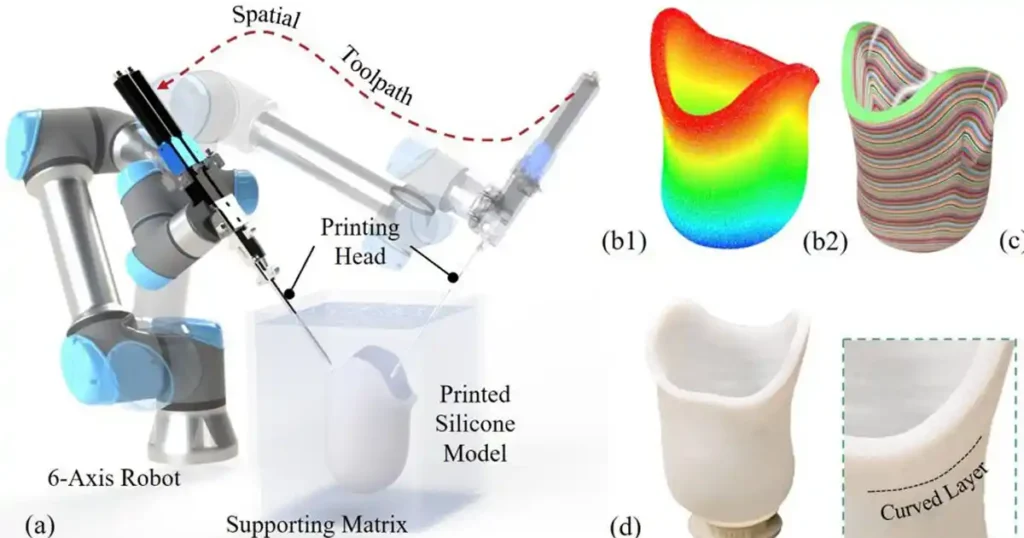
The world of additive manufacturing is witnessing a paradigm shift, moving beyond the traditional flat layering technique to embrace the complexity of the third dimension. A groundbreaking development from a joint research team, including the Hong Kong Chinese University, University of Manchester, Chinese Academy of Sciences, and Nottingham Trent University, has introduced a novel approach to silicone 3D printing. Their work on a robot-assisted multi-axis embedded silicone printing system solves long-standing issues of precision and density in soft material fabrication, achieving an unprecedented infill density of 99.47% . At LAVA3DP, we are dedicated to bringing insights into such transformative technologies that are shaping the future of digital manufacturing.
The Challenge of Printing Soft Matter
Silicone materials are prized in biomedical engineering and soft robotics for their biocompatibility and flexibility . However, their low viscosity makes them notoriously difficult to print using conventional methods. Traditional fused deposition modeling (FDM) struggles with support, while direct ink writing (DIW) often leads to gravitational collapse in complex structures .
To counter this, embedded printing (ESP) was developed, where silicone ink is deposited into a gelatinous support matrix (like Carbopol), effectively “suspending” the print in mid-air to prevent sagging . Yet, until now, ESP was limited by its toolpath algorithms. Standard 3-axis systems and planar slicing produce a “staircase effect” on curved surfaces, leading to poor surface finish and internal voids that compromise mechanical integrity .
Soft-Hard Integration: The Multi-Axis Solution
The Hong Kong-led team has moved past the planar limitation by integrating a 6-degree-of-freedom (6-DOF) robotic arm—specifically the Universal Robots UR5e—with a sophisticated algorithmic framework . This multi-axis system allows the print nozzle to remain perpendicular to the print surface at all times, a capability impossible for Cartesian printers.
The core innovation lies in the software. The team developed a field-based curved slicing strategy. Instead of chopping a model into flat discs, this algorithm generates curved layers that follow the natural contour of the model . This is paired with a boundary-conformal staggered toolpath. By alternating print directions between layers (like weaving fabric), the system ensures uniform ink deposition and eliminates the gaps found in traditional layer-by-layer stacking .
To visualize how this algorithm improves consistency, consider the reduction in surface deviation compared to traditional methods:
Furthermore, to manage the variable speeds and angles of a robot arm, an adaptive width constraint algorithm was introduced. This ensures that as the nozzle moves, the volume of extruded material adjusts to local conditions, preventing overfilling or underfilling .
The Future of Free-form Fabrication
This research, detailed in Virtual and Physical Prototyping , opens the door for large-format additive manufacturing (LFAM) of soft materials. Future directions include expanding the material library for multi-material printing, developing collision-avoidance algorithms for larger builds , and integrating vision-based closed-loop control to correct errors in real-time .
As the industry moves toward multi-axis, support-free manufacturing , the integration of robotics with intelligent slicing is no longer just an experiment—it is the next industrial standard. At LAVA3DP, we are excited to see how these developments in precision and density will enable our clients to create the impossible.
If you are looking to leverage high-precision volume 3D printing for your next project, from soft robotics to custom medical devices, the team at LAVA3DP is here to help. We invite you to contact us to discuss how we can turn your complex designs into reality.
Frequently Asked Questions (FAQs)
1. What types of volume 3D printing services does LAVA3DP offer?
At LAVA3DP, we specialize in advanced additive manufacturing solutions, including high-precision resin 3D printing and SLS 3D printing. Inspired by cutting-edge research in multi-axis fabrication, we focus on delivering complex geometries and high-density parts for industries ranging from healthcare to engineering. For inquiries about specific volume 3D printing capabilities, please visit our contact page.
2. How does LAVA3DP ensure the high density and accuracy of printed parts?
Leveraging insights from industry advancements, we utilize optimized printing strategies and rigorous quality control. Our processes are designed to minimize internal voids and surface defects, ensuring that parts meet strict tolerances. Whether you need a functional prototype or an end-use component, we prioritize dimensional accuracy and material integrity to deliver reliable results.
3. Can LAVA3DP handle custom medical or soft robotic projects?
Yes. We understand that fields like biomedical engineering and soft robotics require materials with specific properties, such as biocompatibility and flexibility. We work with a range of engineering materials and can advise on the best technology—whether it’s multi-material printing or high-durability resins—for applications like anatomical models, custom wearables, or specialized actuators.
4. What is the typical turnaround time for a volume 3D printing project?
Turnaround times at LAVA3DP vary depending on the complexity, size, and quantity of parts. Volume printing of large or highly detailed models may require additional time for post-processing and quality checks. We recommend submitting your design files for a personalized quote, where we can provide an accurate timeline based on your specific project requirements.
5. How should I prepare my 3D model for a volume printing service?
For optimal results, your 3D model should be watertight and exported in a standard format like STL or OBJ. Complex geometries with overhangs or internal cavities are often well-suited for our services. If you are unsure about file preparation for volume 3D printing, our team at LAVA3DP is available to provide design for manufacturing (DFM) feedback. Reach out to us via the contact page to get started.