

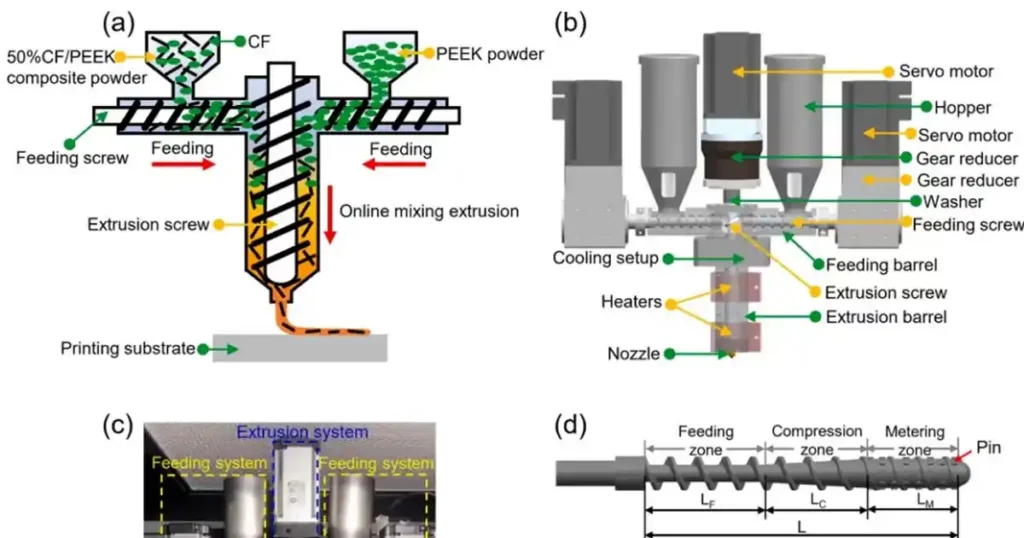
In the field of additive manufacturing, carbon fiber-reinforced polyetheretherketone (CF/PEEK) composites have long been sought after for high-end applications such as aerospace and biomedical engineering due to their exceptional mechanical properties and heat resistance. However, the traditional fused filament fabrication (FFF) process has faced a persistent bottleneck when preparing these composites: low fiber content, typically below 20%, which limits further improvements in performance.
Recently, Professor Dichen Li’s team at Xi’an Jiaotong University has achieved a significant breakthrough in this area. They developed an online mixing 3D printing method based on screw extrusion, successfully increasing the fiber content of CF/PEEK composites to 50% and systematically investigating the impact of fiber content on the mechanical properties of the printed parts. This research opens new pathways for the 3D printing of high-performance composites. As LAVA3DP, a company specializing in FDM 3D printing services, we closely follow such cutting-edge technologies and are committed to providing our customers with superior 3D printing solutions.
Breaking the Fiber Content Barrier of Traditional FDM
The traditional FFF process faces numerous challenges when preparing CF/PEEK composites. As the carbon fiber content increases, the melt viscosity of the material rises sharply, making extrusion difficult and prone to clogging the printing nozzle. Consequently, the fiber content of CF/PEEK composites prepared via the FFF process typically struggles to exceed the 20% threshold.
The screw extrusion-based online mixing 3D printing head developed by the Xi’an Jiaotong University team ingeniously solves this problem. The core innovations of this print head include:
- Dual Screw Feeding System: Two independent feeding screws respectively transport pure PEEK powder and high-content CF/PEEK composite powder.
- Real-time Ratio Adjustment: By precisely controlling the rotational speed ratio of the two screws, composites with a specific fiber content can be prepared directly.
- Direct Powder Forming: The cumbersome step of pre-manufacturing composite filaments is eliminated, significantly improving preparation efficiency.
This design not only overcomes the fiber content limitation of the traditional FFF process but also substantially reduces the research, development, and production costs associated with composite materials.
Fiber Content and Mechanical Properties: A Non-linear Relationship
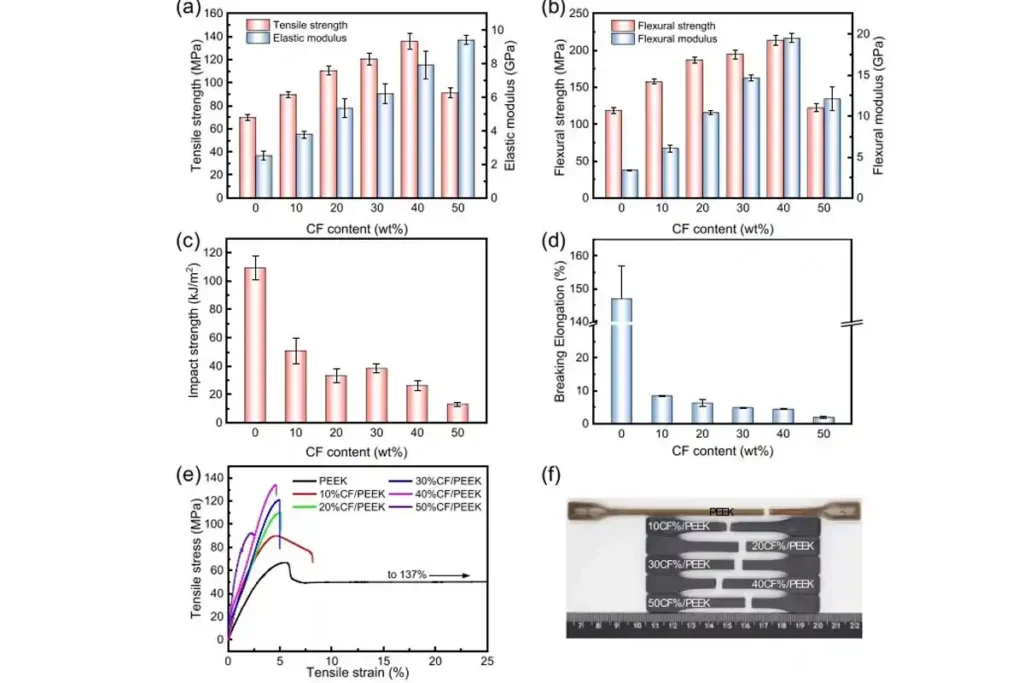
The research team systematically prepared CF/PEEK test specimens with fiber contents ranging from 0% to 50% and comprehensively evaluated their mechanical properties. The results revealed a non-linear relationship between fiber content and the mechanical performance of the parts.
To visually present this relationship, we have created the following chart based on the research data:
| Fiber Content (wt%) | Tensile Strength (MPa) | Flexural Strength (MPa, Unannealed) | Flexural Strength (MPa, Annealed) |
| 0% (Neat PEEK) | ~70.1 | ~118.6 | – |
| 40% | 135.9 | 213.5 | 251.2 |
Trend of Tensile and Flexural Strength with Varying Fiber Content
The chart and data clearly demonstrate:
- Significant Performance Enhancement: Within the 0% to 40% fiber content range, both tensile and flexural strength of the parts increased continuously with higher fiber content. At the optimal point of 40% fiber content, the maximum tensile strength reached 135.9 MPa, and the maximum flexural strength reached 213.5 MPa, representing improvements of 94% and 80%, respectively, compared to neat PEEK.
- Optimal Fiber Content Point: The study identified 40% fiber content as the key point for achieving optimal mechanical properties. Beyond this content, performance gains were limited.
- Influence of Microstructure: Microstructural analysis revealed that when fiber content exceeded 40%, increased interlayer gaps and internal porosity began to limit further improvements in mechanical properties.
Annealing Treatment: The Key to Unlocking Performance Potential
Polyetheretherketone (PEEK), as a semi-crystalline polymer, has its crystallinity critically influencing the final mechanical properties of manufactured parts. The research team further explored the effect of annealing treatment on high-fiber-content CF/PEEK parts.
The results showed that annealing the CF/PEEK samples with 40% fiber content further increased their flexural strength to 251.2 MPa, a remarkable 111% improvement over unannealed neat PEEK parts. This indicates that combining high fiber content with optimized crystallinity can synergistically maximize the performance potential of CF/PEEK composites.
Technology Comparison: Advantages of Online Mixing 3D Printing
To better understand the value of this technology, we compare it with traditional FFF process and injection molding:
| Feature | Traditional FFF Process | Screw Extrusion Online Mixing 3D Printing | Injection Molding |
| Achievable Fiber Content | Typically < 20 wt% | Up to 50 wt% | Up to 40 wt% |
| Material Form | Pre-manufactured Filament | Powder/Pellet Direct Forming | Pellets |
| Processing Steps | Many (Filament Making + Printing) | Few (Direct Printing) | Many (Mold Making + Molding) |
| Design Freedom | High | High | Low (Mold-dependent) |
| Cost Efficiency (Low Volume) | Medium | High | Very Low |
| Key Performance (40% CF) | – | Tensile 135.9 MPa / Flexural 251.2 MPa (Annealed) | – |
Future Outlook: Manufacturing of Heterogeneous Parts
Beyond enabling the printing of high-fiber-content composites, this technology presents an exciting prospect: by dynamically adjusting the speed ratio of the two feeding screws in real-time during a single print job, it may become possible to manufacture heterogeneous parts with varying fiber content in different regions.
This means designers could precisely assign material properties based on the specific stress requirements of different areas within a part. For instance, high fiber content could be imparted to regions requiring high strength (such as snap-fits or load-bearing points), while lower fiber content could be used in areas needing toughness or flexibility (such as hinges or cushioning structures). This concept of “on-demand” material distribution would propel the design freedom offered by 3D printing to an entirely new level.
Conclusion
The research from Xi’an Jiaotong University represents not only a significant leap forward in the 3D printing of CF/PEEK composites but also offers a new perspective for the entire additive manufacturing industry on pushing the boundaries of material properties. The journey from breaking through the 20% barrier to achieving 50% fiber content demonstrates a relentless pursuit of ultimate performance. At LAVA3DP, we are equally dedicated to bringing the best 3D printing solutions to every client. We believe that as technologies like online mixing 3D printing continue to mature and transition from labs to practical applications, more high-performance, functionally graded parts will emerge, injecting new vitality into high-end industries such as aerospace, medical, and automotive. If you have relevant FDM 3D printing needs, we invite you to contact us and explore the boundless possibilities of 3D printing together.
LAVA3DP’s Professional FDM 3D Printing Services
Breakthroughs in cutting-edge technology ultimately serve practical applications. At LAVA3DP, we specialize in transforming mature FDM 3D printing technology into reliable and efficient manufacturing services, helping our clients turn innovative designs into reality. Whether you need rapid prototype validation or small-batch production of end-use parts, we provide professional support.
We understand that selecting the right 3D printing process and material is crucial for project success. Therefore, we have compiled the following answers to frequently asked questions, hoping to provide you with clear guidance.
Frequent Asked Questions (FAQs)
1. What is FDM 3D printing technology? Is it suitable for my project?
FDM (Fused Deposition Modeling) is a widely used additive manufacturing technology. It works by extruding molten thermoplastic filament (such as ABS, PC, Nylon, etc.) through a heated nozzle, depositing it layer by layer according to a digital model to ultimately form a solid three-dimensional object. At LAVA3DP, we utilize industrial-grade FDM equipment. This technology offers a highly cost-effective way to manufacture large-sized parts and functional prototypes with excellent mechanical properties and dimensional stability. It is particularly well-suited for producing tooling, fixtures, and end-use parts for industries like automotive, aerospace, and consumer goods.
2. What high-performance engineering materials are available for LAVA3DP’s FDM service?
We offer a variety of functional engineering plastics to meet diverse application needs. In addition to standard materials, we provide high-performance options such as carbon fiber-reinforced nylon (e.g., Nylon 12 CF), which boasts exceptional specific stiffness and strength, enabling lightweighting by replacing some metal components. Furthermore, depending on your specific requirements, we can offer specialty materials with properties like high temperature resistance, anti-static (ESD), or flame retardancy (FST rated). Visit our contact page to discuss your material needs with our engineers.
3. What is the accuracy and surface quality of FDM printed parts? Can they be used for end-use products?
Industrial FDM technology can achieve high dimensional accuracy. For instance, our Stratasys F900 equipment offers accuracy up to ±0.089 mm or ±0.0015 mm/mm. While FDM parts naturally exhibit visible layer lines, this does not preclude their use as end-use parts. For applications with strict aesthetic requirements, we can significantly enhance the surface finish through post-processing techniques such as sanding, media blasting, painting, or vapor smoothing. The robust mechanical properties of FDM parts make them an ideal choice for manufacturing functional prototypes as well as production-grade tooling, brackets, and housings.
4. What are the advantages and limitations of FDM compared to technologies like SLS or MJF?
FDM’s core advantages lie in its lower material costs and its ability to utilize ultra-high-performance, high-temperature resistant polymers like PEI/ULTEM. It is particularly well-suited for manufacturing large parts and for cost-sensitive prototype validation. A key limitation is that its mechanical properties exhibit some anisotropy (lower strength in the Z-axis), and very complex internal geometries may require support structures. In contrast, SLS (Selective Laser Sintering) and MJF (Multi Jet Fusion) technologies produce nylon parts with properties closer to isotropy and require no supports, making them more suitable for mass-producing complex components.
5. How do I start my first FDM 3D printing project? What files are needed?
Starting a project with LAVA3DP is simple. You only need to provide your 3D model in STL, OBJ, or STEP format. Our engineering team will analyze the model for printability (Design for Manufacturing – DFM) and offer optimization suggestions regarding part orientation, support structures, wall thickness design, and more, ensuring successful printing and part quality. Or you can upload to get an instant quote. If you have any questions about process or material selection, please feel free to contact us. We are here to help.