

HSS (High Speed Sintering)
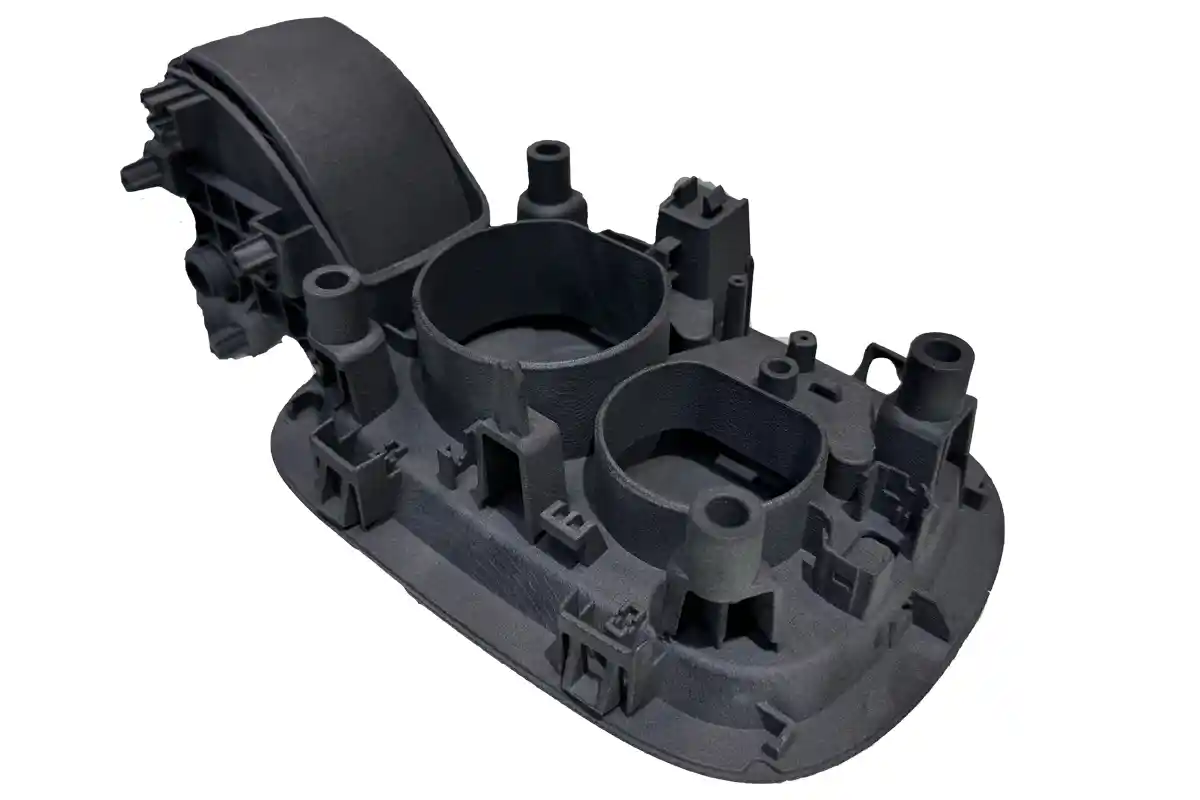
Introducing High-Speed Sintering (HSS) 3D Printing
For decades, injection molding has been the undisputed king of mass production, but its tyranny lies in exorbitant upfront tooling costs and long lead times. On the other hand, traditional 3D printing technologies like Selective Laser Sintering (SLS) have offered design freedom but lagged in production speed and per-part cost efficiency for batch production 3d printing and cost efficient additive manufacturing.
At LAVA3DP, we are proud to announce our investment in this game-changing technology, positioning ourselves at the forefront of hss 3d printing service and hss additive manufacturing. HSS is not just another 3D printing process; it is a fundamental shift that combines the geometric complexity of additive manufacturing with the throughput and economics of injection molding, making it ideal for high speed sintering parts and industrial plastic components manufacturing
Get an Instant QuoteHigh-Speed Sintering (HSS) Explained: Technology & Applications
High-Speed Sintering is a powder bed fusion polymer technology that originated from the labs of Professor Neil Hopkinson at Loughborough University. While it shares a lineage with binder jetting and SLS, its mechanism is uniquely efficient and serves as a strong hp multi jet fusion alternative.
HSS 3D Printing Process: Layer-by-Layer Powder Bed Fusion
Understanding HSS requires a look inside the build chamber. The process can be broken down into four primary steps:
- Powder Deposition: A thin layer of thermoplastic powder (such as Nylon PA12) is spread across the heated build platform using a roller or blade, supporting nylon powder 3d printing applications.
- Selective Inkjet Application: An industrial inkjet printhead, similar to those used in 2D document printing, passes over the powder bed. However, instead of colored ink, it deposits a specialized infrared-absorbing fluid precisely onto the areas that will become the solid part, enabling thermal inkjet sintering.
- Infrared Sintering: Immediately after the fluid is applied, the entire bed is exposed to high-power infrared (IR) lamps. The areas treated with the absorber capture the IR energy and melt, fusing the powder particles together. The untreated powder remains cool and loose, supporting no support structure 3d printing.
- Platform Lowering: The build platform descends by one layer thickness (typically 50-100 microns), and the process repeats until the object is fully formed through layer-by-layer powder fusion.
This “area-wide” sintering is the secret to HSS’s speed. Instead of a laser tracing each part point-by-point (as in SLS), HSS sinters entire layers at once, making it a fast polymer sintering technology.
HSS vs SLS & MJF: The Competition and a Data-Driven Comparison
To appreciate where HSS stands, it must be compared to its main rivals: Selective Laser Sintering (SLS) and HP’s Multi Jet Fusion (MJF), often discussed in hss vs sls 3d printing and hss vs mjf comparison analyses. Our engineering team at LAVA3DP has analyzed independent studies to bring you a clear picture of the performance landscape.
Mechanical Performance of HSS Parts: Strength & Durability
When producing functional parts, mechanical integrity is paramount. Tests conducted on PA12 samples reveal distinct profiles for each technology and are critical for end-use plastic parts production and functional prototype manufacturing.
This table shows the differences in Tensile Strength (MPa), Young’s Modulus (GPa), and Elongation at Break (%) across HSS, MJF, and SLS technologies.
Table 1: Mechanical Properties of PA12 by Technology
| Technology | Tensile Strength (MPa) | Young’s Modulus (GPa) | Elongation at Break (%) |
|---|---|---|---|
| HSS | 40.6 | 1.82 | 8.88 |
| MJF | 43.1 | 1.43 | 16.87 |
| SLS | 45.17 | 1.73 | 17.53 |
Data sourced from 3D Printing Industry benchmark tests
- Tensile Strength: SLS currently leads in raw strength (45.17 MPa), followed closely by MJF (43.10 MPa) and then HSS (40.60 MPa). However, voxeljet notes that parameters can be optimized for strength over detail, potentially closing this gap.
- Stiffness (Young’s Modulus): HSS produces the stiffest parts (1.82 GPa), making it ideal for applications where rigidity under load is required, delivering uniform mechanical properties parts and isotropic strength polymer parts.
Accuracy, Tolerances & Throughput in HSS Printing
While mechanical properties are crucial, production economics are dictated by speed and accuracy in scalable additive manufacturing solutions.
- Dimensional Accuracy: HSS offers the most consistent results. While SLS parts may be slightly more accurate on average, HSS has the lowest standard deviation of error (0.0925mm), meaning parts are highly reproducible and predictable, aligning with hss tolerance and accuracy standards.
- Build Speed and Volume: The VX1000 HSS system boasts a build speed of 7300 cm³/h, significantly outpacing the most productive MJF systems (5058 cm³/h). Furthermore, the build volume allows for efficient nesting, enabling high volume 3d printing service hss and industrial batch production using hss technology.
Advantages of HSS 3D Printing for Production Parts
Why should you, the customer, choose HSS for your next batch of custom parts? The benefits extend beyond the raw data.
1. Unmatched Cost-Efficiency for Series Production
The primary value proposition of HSS is economic. Because it sinters entire layers at once, the time—and therefore cost—to produce a part is not linearly correlated with its complexity. This makes it ideal for custom hss parts manufacturing and low cost hss 3d printing service, especially in medium-volume production.
2. The “Open Platform” Advantage
Unlike some proprietary systems, HSS enables flexibility in sourcing materials. At LAVA3DP, this strengthens our position as a professional hss 3d printing company and reliable hss production partner, allowing better pricing and innovation.
3. Sustainability and Material Recycling
Sustainability is no longer a buzzword; it is a manufacturing imperative. HSS systems boast a powder recycling rate of nearly 100% . The unsintered powder acts as a natural support structure during the print and can be reclaimed, sieved, and mixed with fresh powder for subsequent builds. This drastically reduces material waste compared to subtractive manufacturing methods .
HSS Materials & Applications at LAVA
The material portfolio for HSS is expanding rapidly, supporting materials used in hss 3d printing and diverse applications.
- Polyamide 12 (PA12): Ideal for pa12 3d printing service and durable components.
- Thermoplastic Polyurethane (TPU): Suitable for flexible parts and lightweight functional parts production.
- Polypropylene (PP): Expanding possibilities in industrial polymer 3d printing service.
- Emerging Materials: Innovations continue in advanced polymers for rapid product development solutions.
Why Choose LAVA3DP for HSS 3D Printing Services
At LAVA, we don’t just run machines; we engineer solutions as an experienced additive manufacturing company and certified 3d printing service provider. By integrating HSS technology into our workflow, we offer a truly comprehensive manufacturing service.
- Design for Additive Manufacturing (DfAM) expertise from design for additive manufacturing experts.
- Rigorous strict quality control 3d printing processes.
- Global fulfillment supporting online hss 3d printing worldwide and hss 3d printing service near me searches.
Conclusion: Is HSS Right for Your Manufacturing Needs?
High-Speed Sintering represents a pivotal moment in custom manufacturing. It validates the idea that 3D printing can be a true production technology, enabling on demand production parts and short run manufacturing solutions. By combining speed, size, and an open ecosystem, HSS breaks barriers in complex geometry fabrication.
Are you ready to take your product to the next level without tooling costs? Contact LAVA3DP today for an hss 3d printing service instant quote and experience the best hss 3d printing service for production parts.
Get an Instant Quote