

Discover how 4D printing transforms oil refinery sulfur into recyclable smart materials. Learn about multi-stimuli-responsive soft robots and circular manufacturing at LAVA3DP. Explore the future with us!
In a significant advancement for additive manufacturing, researchers have developed a novel method to utilize sulfur, a byproduct of oil refining, for 4D printing applications. This breakthrough, published in the journal Advanced Materials, demonstrates how waste materials can be transformed into high-performance, programmable structures for soft robotics and beyond . At LAVA3DP , we are closely following these developments to understand how such innovations might shape the future of printing technologies.
The Challenge of Sulfur Waste
The oil refining industry generates approximately 85 million tons of sulfur byproducts annually, according to a 2024 estimate by the U.S. Geological Survey . Traditionally, this sulfur has had limited applications, leading to concerns about disposal costs and environmental impact. However, researchers have been exploring ways to convert this abundant waste into valuable materials known as sulfur polymers or sulfur plastics .
These sulfur-based materials possess unique properties that conventional plastics lack. They can transmit infrared rays, making them suitable for thermal imaging lenses, and can adsorb heavy metals for water purification applications . Despite these advantages, sulfur plastics previously could not be effectively used in 3D printing due to their dense, entangled molecular structure, which resulted in poor fluidity .
Redesigning the Molecular Structure for Printability
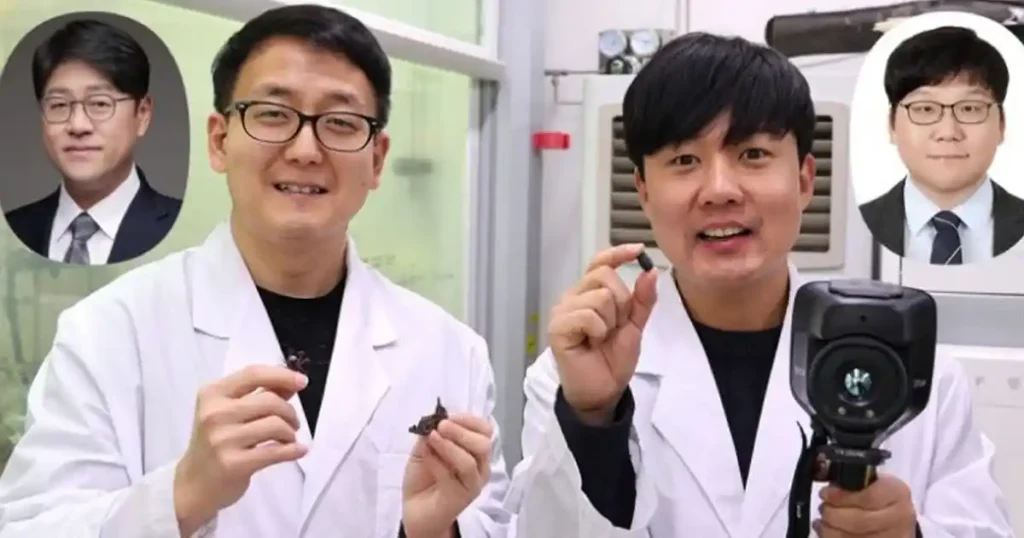
A joint research team led by Dr. Kim Dong-gyun at the Korea Research Institute of Chemical Technology (KRICT), Professor Wi Jae-jeong at Hanyang University, and Professor Kim Yong-seok at Sejong University successfully addressed this limitation . Their innovation involved redesigning the internal mesh structure of sulfur polymers to be looser, which enhanced fluidity and enabled extrusion through a 3D printer nozzle .
The key to this breakthrough lies in the dynamic chemistry of sulfur. The polymers contain disulfide (S─S) bonds that can break and reform under specific conditions . By precisely controlling the sulfur content and network structure, the researchers created a series of materials with varying glass transition temperatures:
| Polymer Type | Sulfur Content (wt%) | Glass Transition Temperature (Tg) |
|---|---|---|
| PSN46 | 46% | ~14°C |
| PSN63 | 63% | ~40°C |
| PSN76 | 76% | ~52°C |
Table: Sulfur-rich poly(phenylene polysulfide) networks (PSNs) with tunable thermal properties .
These variations allow for sophisticated control over when and how a printed object changes shape.
Understanding 4D Printing Technology
4D printing builds upon traditional 3D printing by adding the dimension of time. Objects are printed in three dimensions but are designed to transform their shape or function when exposed to external stimuli such as heat, light, moisture, or magnetic fields . This is made possible through the use of smart materials like the newly developed sulfur polymers .
The global 4D printing market is experiencing rapid growth. According to market reports, the market size is projected to grow from $13.8 billion in 2025 to $63 billion by 2030, representing a compound annual growth rate (CAGR) of approximately 35% . This expansion is driven by increasing demand from aerospace, defense, healthcare, and automotive industries seeking adaptive and lightweight components .
*Figure: Projected growth of the global 4D printing market (2025-2030) .*
How Sulfur-Based 4D Printing Works
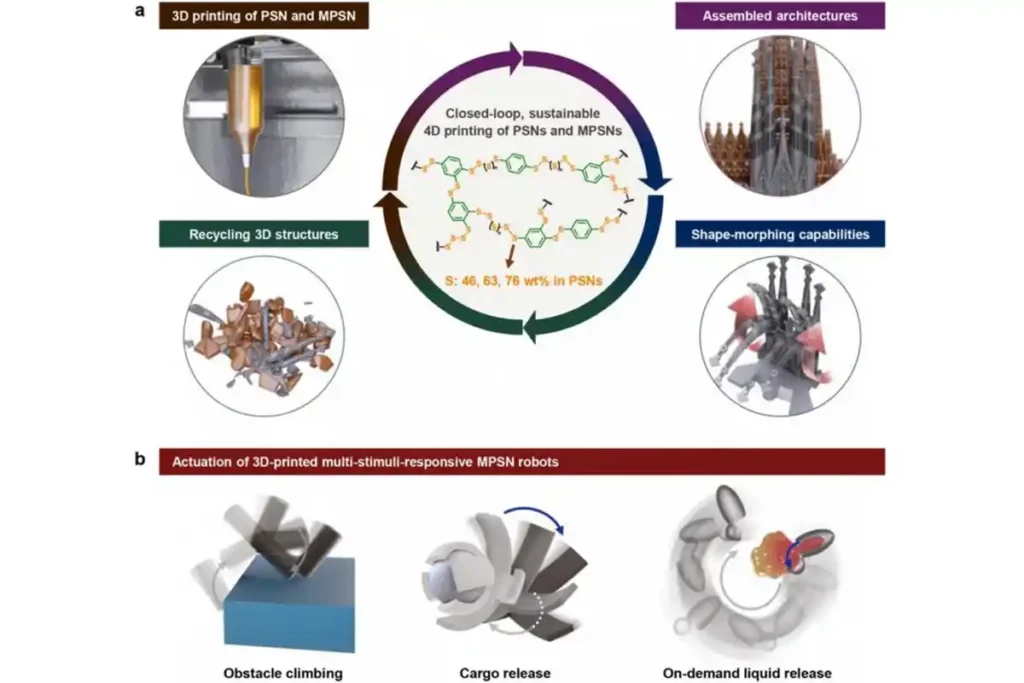
The research team developed poly(phenylene polysulfide) networks (PSNs) that exhibit shear-thinning behavior . This means the material becomes less viscous when forced through a printer nozzle, allowing for smooth extrusion, and then solidifies once printed. After printing, the structures can be programmed with a temporary shape and will recover their original form when triggered by heat or light .
One remarkable feature is the ability to weld printed parts without adhesives. By irradiating the interface with a specific laser for approximately 8 seconds, the S─S bonds temporarily break and then reform, creating a firm, permanent bond . This enables the modular assembly of complex structures from simpler printed components, similar to building with intelligent bricks .
Creating Magneto-Responsive Soft Robots
To expand functionality, the researchers incorporated 20% iron powder into the sulfur polymer, creating magnetic particle composites (MPSNs) . These materials respond not only to heat and light but also to magnetic fields, enabling precise, wireless control of tiny robots.
The team demonstrated several impressive soft robot prototypes:
- Thread-shaped robots smaller than 1 cm that can swim, tumble, and navigate around obstacles underwater when guided by magnets .
- Cross-shaped grippers that can close around an object, carry it, and then release it when heated to a specific temperature .
- Capsule robots that remain closed at room temperature but open under near-infrared (NIR) light to release contents .
In one sophisticated demonstration, an MPSN capsule was used as a magnetic stirring bar containing a chemical catalyst. While stirring a solution at room temperature, the capsule remained closed. When the temperature rose above the cap’s glass transition temperature, the capsule opened, releasing the catalyst and triggering a chemical reaction (carbamate synthesis) . This showcases the potential for autonomous task execution in chemical processing.
The Circular Economy Advantage
Perhaps the most significant aspect of this technology is its sustainability. Traditional thermoset plastics, once cured, cannot be remolded or recycled. In contrast, these sulfur-based materials enable a closed-loop manufacturing process .
Printed structures can be:
- Disassembled by heating or NIR exposure
- Reprocessed into powder
- Reprinted into entirely new forms
This recyclability means the material can be used repeatedly without significant loss of performance, drastically reducing waste . Dr. Kim noted, “This study is the first case of upcycling industrial by-product sulfur into advanced robot materials. Smart materials that can move autonomously and be recycled will become a core driver for future soft robotics and automation industries” .
Broader Applications and Future Potential
Beyond robotics, sulfur polymers show promise in several fields:
- Infrared Optics: Their transparency to infrared light makes them candidates for low-cost thermal imaging lenses, potentially replacing expensive materials like germanium .
- Environmental Remediation: Sulfur polymers can adsorb heavy metals like mercury, lead, and copper from water, offering a solution for pollution cleanup .
- Battery Technology: Research into lithium-sulfur batteries leverages the electrochemical properties of these materials .
- Antibacterial Coatings: The intrinsic antimicrobial properties of sulfur could lead to applications in healthcare settings .
Other research groups are exploring different approaches to 4D printing, such as using liquid crystal elastomers reinforced with continuous carbon fibers for self-heating actuators . These diverse efforts highlight the rapid innovation occurring in the field of smart materials and additive manufacturing.
What This Means for Additive Manufacturing
For companies like LAVA3DP , these developments signal a future where printed objects are not static but dynamic and responsive. While the sulfur-based 4D printing technology is currently in the research phase, its implications are profound. The ability to print objects that change shape over time, respond to their environment, and be fully recycled aligns with growing demands for sustainability and functionality.
As the technology matures, we may see applications in:
- Medical Devices: Stents that expand at body temperature or drug delivery systems that release medication under specific conditions.
- Aerospace Components: Parts that adapt to changing atmospheric conditions or deploy after launch.
- Consumer Products: Clothing that adjusts to temperature changes or furniture that self-assembles.
- Automotive: Components that respond to heat for improved aerodynamics or safety.
Conclusion
The development of 4D printing technology using waste sulfur represents a convergence of sustainability, materials science, and advanced manufacturing. By solving the printability challenge and demonstrating multi-stimuli responsiveness, the Korean research team has opened new possibilities for soft robotics and smart structures .
At LAVA3DP , we believe in staying at the forefront of additive manufacturing innovations. While 4D printing with sulfur polymers is still emerging, it exemplifies the kind of forward-thinking research that will shape the future of our industry. We invite you to explore current 3D printing capabilities and imagine the possibilities that tomorrow’s technologies will bring. For any inquiries about how modern printing solutions can serve your needs today, please do not hesitate to contact us .
Frequently Asked Questions (FAQs)
1. What exactly is 4D printing and how is it different from 3D printing at LAVA3DP?
4D printing is an advanced additive manufacturing process that builds upon traditional 3D printing. While 3D printing creates static three-dimensional objects, 4D printing uses smart materials that allow the printed object to change its shape, properties, or functionality over time when exposed to external stimuli like heat, light, moisture, or magnetic fields. At LAVA3DP , we specialize in high-precision 3D printing services. While we currently focus on 3D printing, we continuously monitor emerging technologies like 4D printing to understand how they might benefit our clients in the future. If you have a project requiring advanced materials or have questions about how 3D printing can solve your current challenges, please contact us .
2. What materials are used for 4D printing, and do you offer them?
4D printing relies on stimuli-responsive materials, often called smart materials. Examples include shape memory polymers (like the sulfur-based polymers discussed in this article), hydrogels that swell in water, liquid crystal elastomers, and magneto-responsive composites. These materials are currently primarily in research and development phases. At LAVA3DP , our expertise lies in a wide range of conventional and engineering-grade 3D printing materials suitable for prototyping and production. We are happy to discuss your project requirements and recommend the best available material for your application.
3. Can LAVA3DP help design a part that changes shape or moves?
Designing for 4D printing requires specialized knowledge in programming material behavior, predicting deformation patterns, and understanding stimulus-response mechanisms. This is a complex field typically involving advanced simulation and materials science. At LAVA3DP , our team excels in design for 3D printing (DfAM), helping clients optimize parts for strength, weight, and manufacturability. While we do not currently offer 4D printing design services, we can certainly help you create complex static geometries and advise on the best 3D printing approach for your project. Reach out to our team to see how we can assist with your design needs.
4. How much does 4D printing cost, and is it commercially available?
4D printing is still an emerging technology predominantly found in academic and industrial research settings. It is not yet widely available as a commercial service. The specialized materials, complex design process, and precise control required for stimulus response currently make it significantly more expensive than conventional 3D printing. In contrast, 3D printing at LAVA3DP is a mature, cost-effective manufacturing solution suitable for a vast range of applications, from rapid prototyping to end-use parts. We offer transparent pricing and efficient turnaround times.
5. What are the potential real-world applications for 4D printing?
Researchers are exploring numerous exciting applications for 4D printing, including:
- Biomedical: Self-expanding stents, drug delivery systems that release medication at specific temperatures.
- Aerospace: Deployable structures, components that adapt to environmental conditions.
- Robotics: Untethered soft robots for search and rescue or medical procedures.
- Consumer Goods: Adaptive clothing or self-assembling furniture.
While these applications are promising, many are still in development. For immediate, reliable manufacturing solutions, 3D printing at LAVA3DP is an excellent choice. We can produce functional prototypes, complex end-use components, and detailed models across various industries. Contact us to discuss your project today.