

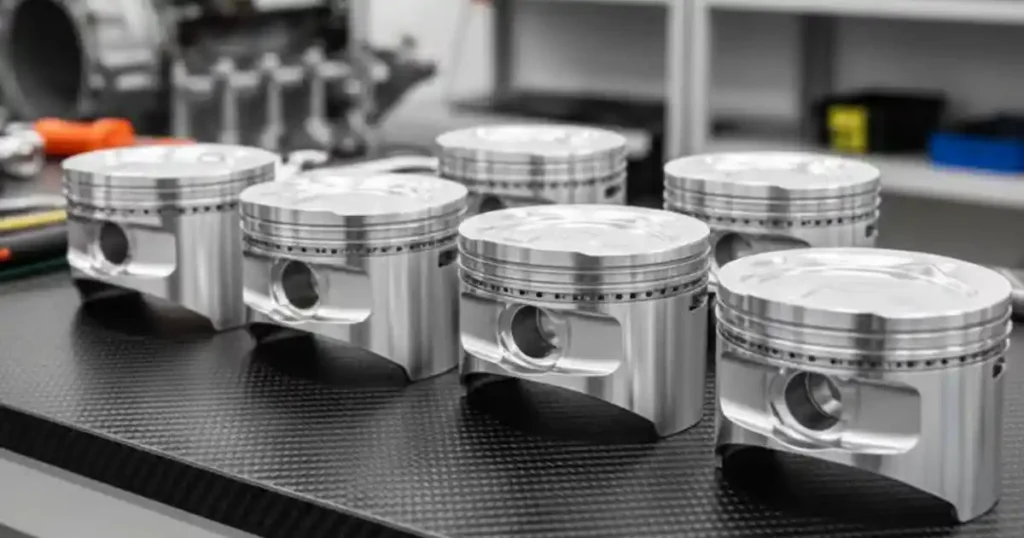
Discover how F1 teams use 3D printed pistons to bypass 2026 compression rules. Explore the technology and find automotive 3D printing services at LAVA3DP. Get a quote today!
The Formula 1 grid is no stranger to technical controversies, but as the 2026 season opener approaches, a new storm is brewing—not in the exhaust plumes, but deep within the engine blocks. At the center of this debate is a component so fundamental it is often taken for granted: the piston. However, these are not your grandfather’s pistons. They are 3D printed pistons, and they represent the latest battleground in the relentless F1 war of engineering interpretation .
Reports from the paddock suggest that top-tier teams, notably Mercedes and Red Bull, have developed a method to use additive manufacturing to circumvent the FIA’s new, stricter compression ratio rules . This isn’t just a story about cheating or loopholes; it is a masterclass in materials science, thermal dynamics, and the art of the possible when automotive 3D printing is pushed to its absolute limit.
For a motorsport division or a high-performance automotive engineer reading this, the implications extend far beyond the racetrack. The same technologies creating this F1 controversy are available for commercial applications through providers like LAVA3DP , bringing racing-grade innovation to production and prototyping.
The 2026 Regulation: A Target for Innovation
To understand the trick, one must first understand the target. For the 2026 season, the FIA implemented new power unit regulations aimed at controlling costs and attracting new manufacturers like Audi and Honda. A key change was the reduction of the maximum allowed compression ratio from 18:1 to 16:1 .
On paper, this seems simple. However, the FIA’s method of verification is where the opportunity lies. Currently, the compression ratio is checked statically. The engine is measured at ambient temperature to verify the geometric volume of the cylinder . But an F1 engine does not operate at ambient temperature. It runs at scorching temperatures where metal components undergo significant thermal expansion.
This gap between static testing and dynamic operation is the “grey area” where engineers live.
The 3D Printed Piston: Engineering a Loophole
Traditional pistons are forged or cast, processes that limit the complexity of internal geometries. 3D printing, specifically metal powder bed fusion technology used by companies like Renishaw, obliterates those design constraints .
According to technical analyses from sources like Auto Motor und Sport and Paddock GP, teams are leveraging this design freedom to create pistons that change shape when hot .
Here is how the mechanism allegedly works:
- Cold Check Compliance: When the FIA inspectors measure the engine cold, the piston geometry presents a volume that yields a compliant 16:1 compression ratio.
- Thermal Expansion Design: Once on track, the extreme heat causes the specially designed 3D printed pistons to expand in a highly controlled manner. By managing heat flow through internal lattice structures—structures only possible via additive manufacturing—the piston effectively fills more of the combustion chamber at operating temperature .
- Performance Gain: This results in an “actual” compression ratio that rises to 17:1 or even 18:1 during the race, unlocking significant horsepower without technically violating the letter of the static rule .
Some reports even suggest designs featuring tiny pockets or channels connected to the combustion chamber that only seal or fill under specific pressure and temperature conditions, further optimizing the cycle .
The Fallout: Protests and Precedents
Unsurprisingly, this interpretation has caused friction. Rival manufacturers, including Ferrari, Audi, and Honda, have reportedly asked the FIA for clarification and a potential rule change that would mandate measuring compression at operating temperature .
The situation highlights a recurring theme in F1: innovation precedes regulation. Just as the double diffuser and dual-axis steering once reshaped the competitive order, 3D printed components are now at the forefront of the technical race . The FIA is now considering updates to testing protocols, but for the 2026 season opener, the cat may already be out of the bag .
Beyond the Paddock: Additive Manufacturing in Automotive
While F1 teams use 3D printing for marginal gains measured in thousandths of a second, the same technology is driving massive growth in the broader automotive sector. The global automotive 3D printing market is projected to grow exponentially, from $4.35 billion in 2025 to an estimated $11.76 billion by 2030 .
Key applications driving this growth include:
- Rapid Prototyping: Reducing development cycles for new parts from months to days .
- Lightweighting: Producing complex geometries that reduce weight while maintaining strength—essential for electric vehicle range optimization .
- Tooling and Fixtures: Manufacturing durable, custom tools for assembly lines faster and cheaper than traditional methods .
- Spare Parts on Demand: Digitizing inventory to produce obsolete or low-volume parts without costly warehousing.
Manufacturers like Ford are already establishing dedicated 3D printing centers to support the transition to next-generation EV manufacturing, proving that what starts in the paddock eventually reaches the driveway .
Visual Data: The Rise of Automotive 3D Printing
The following chart illustrates the projected growth of the automotive 3D printing market, highlighting the rapid adoption of these technologies in the sector.
Data Source: The Business Research Company, via GII Research
Turning High-Tech Concepts into Reality with LAVA3DP
The F1 piston controversy serves as an extreme proof-of-concept. It demonstrates that with the right design and manufacturing partnership, almost any component can be optimized for performance, weight, or function. You don’t need a billion-dollar budget to benefit from these advances.
At LAVA3DP , we bridge the gap between cutting-edge innovation and practical application. Whether you are developing a one-off prototype for a classic car restoration or need a small batch of production parts with complex internal channels, our services are designed to deliver.
We utilize industrial-grade additive manufacturing systems capable of working with a wide range of materials, from high-strength metals like those used in F1 to advanced polymers and composites . Our team works closely with clients to optimize designs for manufacturability, ensuring you get the performance you need without the development headaches.
The Future is Built, Layer by Layer
The 2026 F1 season may very well be decided by the thermal expansion of a tiny piston, designed on a computer and grown in a 3D printer . It is a testament to how far additive manufacturing has come. No longer just a tool for “rapid prototyping,” it is now a strategic weapon for circumventing rules and winning championships.
For the rest of the automotive world, the message is clear: 3D printing is a mature, reliable, and essential tool for innovation. Whether you are chasing horsepower or market share, the ability to create complex, high-performance parts quickly is a competitive advantage you cannot ignore.
Explore how LAVA3DP can accelerate your next project. Visit our contact page to discuss your requirements with our additive manufacturing specialists.
Frequent Asked Questions (FAQs)
1. What types of automotive parts can be created with your 3D printing service?
Our automotive 3D printing service can produce a wide variety of parts, including functional prototypes for fit and assembly testing, lightweight brackets, custom ducting for fluid or air, jigs and fixtures for manufacturing, intake manifolds, and even end-use components for low-volume production or classic car restoration. The technology is suitable for both plastic and metal parts .
2. Which materials are available for printing automotive components?
We offer a comprehensive range of materials to meet the specific demands of the automotive industry. This includes engineering plastics like ABS and Nylon for durable prototypes, high-temperature resins, and a variety of metals such as aluminum, titanium, and stainless steel, which are ideal for strong, functional parts .
3. How does 3D printing compare to traditional manufacturing in terms of cost and time for automotive projects?
For prototyping, small batches, or complex geometries, 3D printing is significantly faster and often more cost-effective than traditional methods like CNC machining or injection molding. It eliminates the need for expensive tooling, allowing for design iterations in days instead of weeks or months. While less economical for mass production of simple parts, it is the superior choice for development, customization, and on-demand manufacturing .
4. Can you help optimize my existing design for 3D printing?
Absolutely. We encourage clients to contact our engineering team early in the design process. We provide design for additive manufacturing (DfAM) support to help you leverage the full potential of the technology, such as consolidating multiple parts into one, creating complex internal lattice structures for weight reduction, and ensuring your part is oriented correctly for optimal strength and surface finish .
5. What is the typical turnaround time for an automotive 3D printing project?
Turnaround times depend on the part’s complexity, size, and quantity. However, because additive manufacturing does not require setup for new tooling, simple prototype parts can often be shipped within a few days of approving the design. We work with you to establish a timeline that meets your project’s specific deadlines, whether for rapid iteration or scheduled production .