

Discover how aerospike rocket engine 3D printing achieves 200 kN thrust. Explore LEAP 71 & HBD’s breakthrough in additive manufacturing for aerospace. Contact LAVA3DP for your project.
The landscape of space propulsion is undergoing a profound transformation, driven by the convergence of computational engineering and industrial-scale additive manufacturing. In a landmark development reported in March 2026, Dubai-based engineering firm LEAP 71 and Chinese 3D printer manufacturer HBD have unveiled a giant, single-piece 3D printed aerospike rocket engine capable of generating 200 kN of thrust . This achievement is not merely an incremental step; it represents a paradigm shift in how we design, test, and produce hardware for the final frontier.
This article delves into the technical significance of this 200 kN aerospike engine, explores the underlying technologies that made it possible, and examines its implications for the future of space propulsion. We will also visualize the rapid progress in this field and discuss how services like those offered at LAVA3DP are making such complex manufacturing accessible.
The Aerospike Advantage: Why This Engine Architecture Matters
For decades, rocket science has been dominated by the de Laval bell nozzle. While effective, this design is inherently optimized for a single altitude, meaning its efficiency suffers as a rocket ascends through the atmosphere. The aerospike engine offers a compelling alternative. Instead of a bell, it uses a central spike (the “aerospike”) against which the exhaust expands. This design allows the exhaust plume to adapt to the surrounding atmospheric pressure, maintaining higher efficiency across a wide range of altitudes .
The theoretical benefits have been known for years: greater specific impulse from sea level to vacuum, making it ideal for single-stage-to-orbit (SSTO) concepts and reusable first stages. However, the engineering challenges, particularly in cooling the complex geometry of the spike and combustion chamber, have historically consigned it to laboratories .
This is where additive manufacturing for aerospace becomes indispensable. The conformal cooling channels and intricate internal structures required for a regeneratively cooled aerospike are nearly impossible to produce with traditional subtractive methods . As noted by Fraunhofer IWS, which has conducted successful tests on smaller 3D printed aerospike designs, additive techniques like selective laser melting are essential for implementing the necessary internal cooling solutions .
From Algorithm to Hardware: The LEAP 71 Approach
The engine unveiled by LEAP 71 and HBD is significant not only for its size but also for its origin story. It was not designed in the traditional sense, with teams of engineers drafting thousands of blueprints. Instead, it was generated by LEAP 71’s proprietary computational engineering model, Noyron .
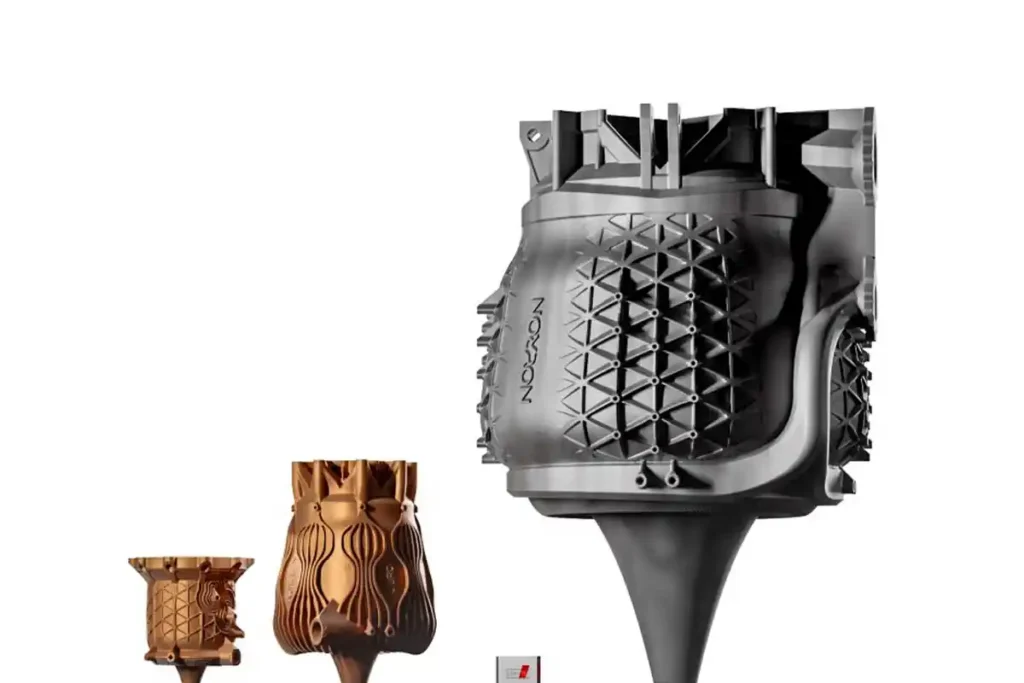
Computational engineering represents a move beyond simple CAD. Engineers input physical constraints, performance targets (like 200 kN thrust using liquid methane and liquid oxygen), and manufacturing boundaries. The algorithm then explores the design space, deriving the complete geometry, including every cooling channel and structural support, without manual intervention . This “no drawings” approach compresses development timelines dramatically. LEAP 71 had previously moved from a 5 kN concept to a 20 kN hot-fire test in a matter of weeks, a process that would traditionally take years .
Josefine Lissner, Managing Director of LEAP 71, has emphasized that this cohesive approach allows them to explore different engine architectures, like the aerospike and traditional bell nozzles, from the same “computational DNA,” enabling systematic scaling of complexity .
The Manufacturing Marvel: HBD’s Role
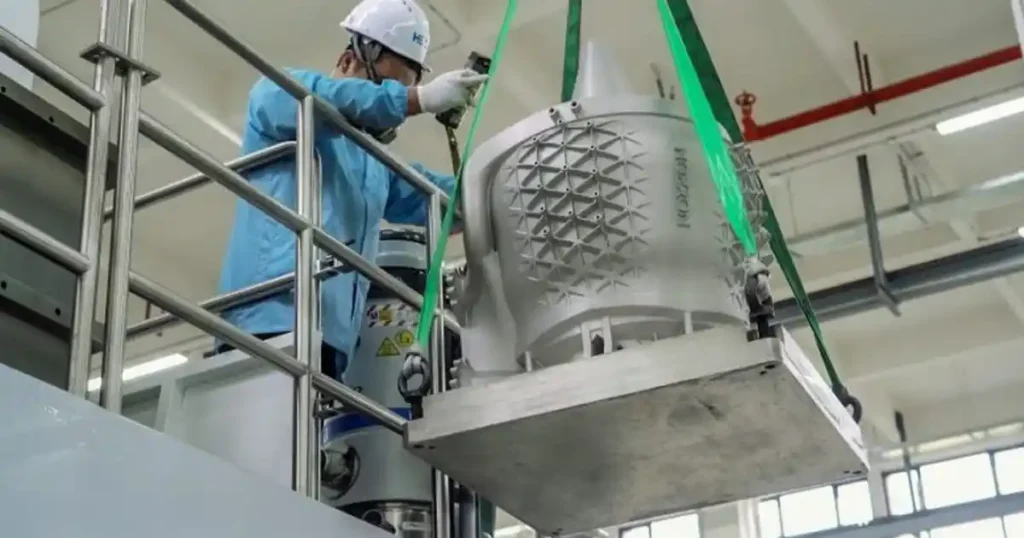
A design is only as good as its realization. To bring this 200 kN engine to life, LEAP 71 partnered with HBD, a leading Chinese manufacturer of large-format metal 3D printers. The engine, standing approximately one meter tall, is believed to be the largest 3D printed aerospike ever produced in a single piece .
HBD utilized a ten-laser, large-format machine with a build volume of 830 x 830 x 1250 mm. The engine was printed in Inconel 718, a high-temperature nickel-based superalloy commonly used in aerospace for its strength and oxidation resistance . Printing the entire engine as a single monolithic component eliminates the need for welds and flanges, which are common failure points in traditionally assembled rockets. This single-piece construction enhances structural integrity and reduces lead times for final assembly .
The following chart illustrates the remarkable scaling of LEAP 71’s aerospike engine demonstrations over a short period, showcasing the power of their AI-driven design and additive manufacturing workflow.
Challenges on the Path to Flight
While the successful additive manufacturing of this 200 kN engine is a monumental achievement, it is a manufacturing milestone, not an operational one. The path to a flight-ready engine is paved with rigorous testing. As Lin Kayser, Co-Founder of LEAP 71, pointed out, the toughest challenge remains translating computational models into real, testable hardware. Issues like material fatigue, sealing, and transient conditions during startup and shutdown can only be resolved through practical testing and iteration .
Fraunhofer IWS researchers have echoed this, noting that combustion stability, cooling performance under extreme thermal loads, and deep throttling capabilities are all aspects that require extensive validation . Furthermore, ensuring the longevity and reliability of these parts is paramount. Innovations like the “digital twin” approach for fatigue life prediction, which recently won an award at the AIAA SciTech Forum 2026, are becoming essential. This method combines nondestructive testing data with fracture mechanics to predict when and where fatigue might occur in an AM part, even during the printing process .
The Broader Market Context and the Role of LAVA3DP
This breakthrough occurs against a backdrop of explosive growth in the sector. The global aerospace 3D printing market was valued at approximately $4.13 billion in 2025 and is projected to reach $14.66 billion by 2030, growing at a compound annual growth rate (CAGR) of nearly 30% . This growth is fueled by the demand for lightweight parts, the ability to create complex geometries, and the need for on-demand production to streamline supply chains .
This demand is not limited to giant rocket engines. It spans the entire aerospace supply chain, from lattice structures for lightweight aircraft brackets to complex fuel manifolds for satellites . The Pentagon’s recent $9.8 million JAM-A IV contract, awarded to 24 companies, underscores the military’s push to qualify and field 3D-printed parts for aircraft, ships, and vehicles to improve logistics and readiness .
At LAVA3DP, we bridge the gap between these cutting-edge industrial applications and the needs of aerospace innovators. We understand that whether you are developing a small satellite thruster or a critical component for a launch vehicle, the principles are the same: design freedom, weight reduction, and reliability. We offer a range of aerospace 3D printing services tailored to meet the stringent demands of the industry.
Visualizing the Data: The Growth of Aerospace AM
To better understand the momentum behind this technology, consider the projected growth of the market. The following chart visualizes the expected trajectory, highlighting the rapid adoption of additive manufacturing across the sector.
Source: Data derived from Research and Markets “Aerospace 3D Printing Market Report 2026” .
This trajectory is supported by advancements in materials and processes. The ability to print with high-performance alloys like Inconel, titanium, and aluminum using techniques such as Laser Powder Bed Fusion (LPBF) and Directed Energy Deposition (DED) is now mature enough for flight-critical parts . Furthermore, the integration of AI and computational design, as demonstrated by LEAP 71, is unlocking new levels of performance that were previously unattainable .
Conclusion
The successful 3D printing of a 200 kN aerospike rocket engine by LEAP 71 and HBD is more than a headline; it is a validation of a new era in propulsion development. By combining computational engineering with industrial-scale additive manufacturing, we are witnessing a future where hardware is no longer constrained by the limitations of traditional tooling. This future promises faster innovation cycles, lower costs, and entirely new classes of high-performance vehicles.
As these technologies become more accessible, the ability to produce complex, reliable aerospace components is within reach for startups, research institutions, and established defense contractors alike. The key is partnering with a manufacturing service that understands the nuances of the industry.
Ready to turn your complex designs into reality? At LAVA3DP, we specialize in high-precision additive manufacturing for aerospace applications. Whether you need prototypes or production-ready parts, our team is equipped to handle your most challenging projects. [contact] us today to discuss your requirements and discover how we can help you reach new heights.
Frequently Asked Questions (FAQs)
1. What types of aerospace components can be produced with 3D printing?
A wide range of components can be manufactured using aerospace 3D printing, including complex ducting and manifolds, lightweight structural brackets, heat exchangers with conformal cooling channels, combustion chamber liners, turbine blades, and satellite parts. Additive manufacturing is particularly well-suited for producing parts with complex internal geometries, reducing part count in assemblies, and creating lightweight lattice structures that offer high strength-to-weight ratios . We also support the production of tooling, fixtures, and rapid prototypes for functional testing.
2. Which materials are available for aerospace-grade 3D printing at LAVA3DP?
We offer a selection of high-performance materials qualified for aerospace applications. This includes metal alloys such as Titanium (Ti-6Al-4V) for its strength and corrosion resistance, Inconel (625 & 718) for high-temperature environments, and Aluminum (AlSi10Mg) for lightweight structural parts. On the polymer side, we can work with high-strength thermoplastics like PEEK and ULTEM, which offer excellent flame, smoke, and toxicity (FST) ratings required for cabin interiors. Please contact us for a full material list and to discuss the best option for your specific application.
3. How do you ensure the quality and reliability of 3D printed parts for flight?
Quality assurance is paramount in aerospace. Our process at LAVA3DP follows strict protocols. We begin with material traceability and process validation. During production, we utilize in-situ monitoring where available. Post-printing, parts undergo rigorous inspection, which may include computed tomography (CT) scanning to verify internal geometries and check for porosity, coordinate measuring machine (CMM) inspections for dimensional accuracy, and mechanical testing of witness coupons. We work with you to meet the qualification and certification requirements for your specific program.
4. What are the typical lead times for aerospace 3D printing projects?
One of the key advantages of additive manufacturing is the significant reduction in lead times compared to traditional manufacturing. For prototype parts, lead times can be as short as a few days to a couple of weeks, depending on complexity. For production runs, it varies based on quantity and post-processing needs. Because 3D printing eliminates the need for tooling, it is exceptionally efficient for both rapid iteration during development and on-demand production of spare parts, helping to avoid long supply chain delays . We provide a detailed timeline upon project review.
5. Can you help with design optimization for additive manufacturing (DfAM)?
Absolutely. Our team at LAVA3DP possesses deep expertise in Design for Additive Manufacturing (DfAM). We can collaborate with your engineers to optimize your designs for weight reduction, consolidate multiple parts into a single component, and integrate complex features like internal cooling channels or organic lattice structures that are impossible to create with conventional methods . If you have a concept but need assistance translating it into a printable, high-performance design, we can provide guidance and engineering support to ensure your part is optimized for both performance and manufacturability.