

Discover how large-format 3D printing transforms marine manufacturing with one-piece boat hulls. Explore applications, materials, and get a free consultation from LAVA3DP experts today.
The maritime industry, known for its long development cycles and high material waste, is undergoing a quiet revolution. At the heart of this transformation is additive manufacturing, which is challenging the way we design and build vessels. Recent advancements, such as the development of one-piece 3D printed boat hulls by innovators like CEADS and Faber Navalis, signal a shift toward faster, more sustainable, and highly customizable boat building.
For companies like LAVA3DP, this represents not just a technological milestone, but a practical service ready to meet the demands of marine engineers, naval architects, and eco-conscious manufacturers.
The Shift from Traditional to Additive Shipbuilding
Traditional boat hull construction is a labor-intensive process. It typically involves creating a large mold (the plug), laying fiberglass or carbon fiber, and curing the composite. This subtractive process generates significant material waste and requires months of lead time.
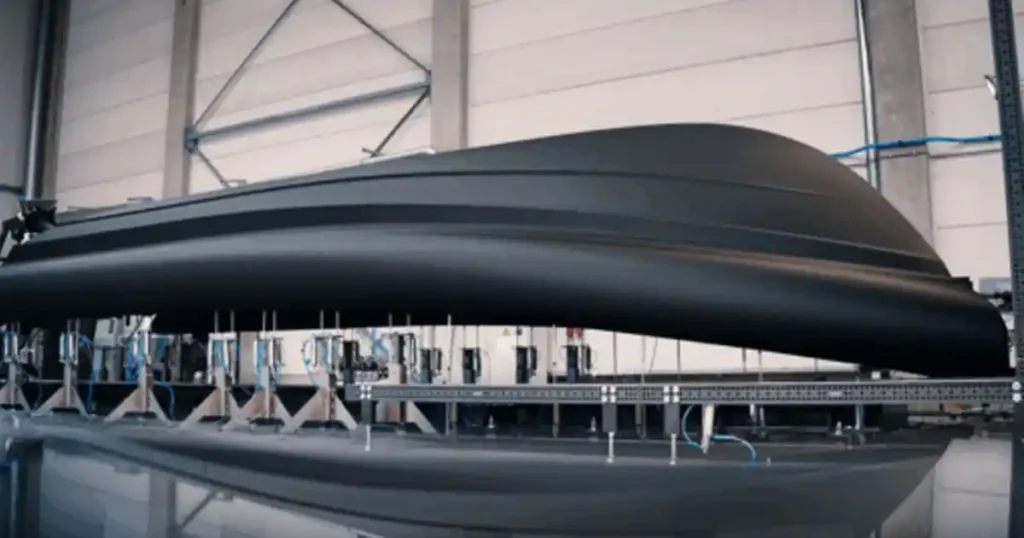
Large-format 3D printing changes this paradigm. Instead of building a mold, manufacturers print the hull directly. The “Faber Navalis” project, a collaboration between CEADS and the Italian Navy, demonstrated this by producing a 6.5-meter (21.3-foot) one-piece hull in under 24 hours of print time. This achievement highlights the shift from prototyping to full-scale production.
Key Advantages of 3D Printed Marine Vessels
The adoption of additive manufacturing in marine applications is driven by distinct advantages that align with industry goals for efficiency and performance.
1. Design Freedom and Complexity
Traditional manufacturing constraints often limit hull shapes to those that can be removed from a mold. With 3D printing, designers can create complex geometric structures—such as variable thicknesses, integrated stiffeners, and optimized hydrodynamic curves—without added cost. This results in hulls that are lighter and more efficient in the water.
2. Speed to Market
The time from design to launch is drastically reduced. The ability to print a one-piece boat hull eliminates the months-long process of mold fabrication. For custom boat builders or research institutions, this speed allows for rapid iteration and testing.
3. Material Efficiency
In conventional composite layup, waste can account for 20-30% of materials. Additive manufacturing uses a near-net-shape process, adding material only where needed. This reduction in waste directly translates to lower material costs and a smaller environmental footprint.
4. Structural Integrity
A one-piece hull lacks the seams, joints, and bonding lines present in traditionally assembled vessels. Seams are often points of failure. By printing the hull as a single continuous structure, manufacturers eliminate these weak points, creating a more durable and watertight vessel.
How Large-Scale 3D Printing Works for Hulls
The production of a one-piece 3D printed boat hull requires industrial-scale systems. The process generally follows these steps:
- Design: Naval architects create a 3D model, often using computational fluid dynamics (CFD) to optimize the hull form.
- Slicing: The model is sliced into layers, and the printing path is generated.
- Printing: Using a robotic arm or gantry system, a thermoplastic composite (such as carbon fiber reinforced acrylonitrile styrene acrylate (ASA) ) is extruded layer by layer. The printers used for the Faber Navalis project, for instance, utilize a pellet-fed extrusion system for high throughput.
- Post-Processing: Depending on the application, the printed hull may be sanded, coated with a marine-grade epoxy for UV protection, or fitted with reinforcements for high-load areas.
Materials Driving the Marine Revolution
The choice of material is crucial for marine applications, which demand UV stability, water resistance, and structural strength. The most common materials used for 3D printed boat hulls include:
- ASA (Acrylonitrile Styrene Acrylate): Preferred for its high UV resistance and weatherability. It serves as an excellent base material.
- Carbon Fiber Reinforced Polymers (CFRP): Short-fiber carbon filaments increase stiffness and reduce weight, essential for performance vessels.
- Polypropylene (PP): Known for its chemical resistance and fatigue endurance, suitable for smaller watercraft and components.
- PETG: A cost-effective option with good impact resistance and ease of printing.
LAVA3DP utilizes a range of industrial-grade thermoplastics and composites to ensure that every one-piece hull meets the rigorous demands of the marine environment.
Sustainability and Circular Economy
The maritime industry faces increasing pressure to reduce its environmental impact. Large-format 3D printing addresses this in several ways:
- Waste Reduction: As noted, additive processes generate minimal waste compared to subtractive methods.
- Local Manufacturing: Printing hulls near the point of use reduces the carbon footprint associated with transporting large molds or finished vessels.
- Recyclability: Thermoplastic materials used in Fused Granulate Fabrication (FGF) can, in many cases, be reground and reused. Research is ongoing into closed-loop recycling systems for end-of-life vessels.
Overcoming Challenges: Certification and Scale
Despite the progress, the adoption of 3D printed marine vessels is not without hurdles. The primary challenges include:
- Certification: Marine classification societies like RINA (Registro Italiano Navale) and DNV require rigorous testing. The Faber Navalis project, for example, underwent extensive structural analysis and sea trials to validate the printed hull’s performance against traditional materials. These certifications are essential for commercial adoption.
- Scale: While printing a 6.5-meter hull is impressive, printing larger yachts (over 15 meters) requires even larger print volumes or modular printing strategies.
- Surface Finish: The layer-by-layer nature of 3D printing can result in a textured surface that requires post-processing to achieve the smooth finish expected in marine aesthetics.
Future Trends in Marine Additive Manufacturing
Looking ahead, several trends will shape the future of one-piece 3D printed boat hulls:
- Multi-Material Printing: The ability to print a hull with a flexible core and rigid outer skin in a single process.
- Integrated Sensor Embedding: Printing sensors directly into the hull for real-time structural health monitoring.
- On-Demand Production: Shipyards using additive manufacturing to produce hulls, spare parts, and tooling on-site, reducing inventory costs.
Conclusion
The development of one-piece 3D printed boat hulls by pioneers like CEADS and Faber Navalis marks a significant milestone for marine manufacturing. It demonstrates that additive manufacturing is ready for primary structural applications, not just prototyping. By offering unmatched design freedom, reduced lead times, and improved material efficiency, this technology empowers shipbuilders, designers, and fleet operators to innovate without traditional constraints.
For businesses looking to explore this technology, partnering with an experienced service provider is key. LAVA3DP offers specialized large-format 3D printing services tailored to the marine industry, from design consultation to post-processing and certification support.
Ready to explore the possibilities of large-format 3D printing for your next marine project?
Contact the LAVA3DP team today for a consultation. Our engineers are ready to help you bring your design to life with precision and efficiency.
Frequent Asked Questions (FAQs)
1. What are the key benefits of using a one-piece 3D printed boat hull over traditional fiberglass construction?
A one-piece 3D printed boat hull eliminates seams and joints, reducing potential points of failure and improving structural integrity. This process also shortens production lead times from months to days, reduces material waste, and allows for complex hydrodynamic designs that are difficult or impossible to achieve with traditional mold-based manufacturing.
2. What materials does LAVA3DP use for marine 3D printing applications?
LAVA3DP utilizes industrial-grade thermoplastics and composites suitable for the marine environment. Our primary materials include carbon fiber reinforced ASA for high stiffness and UV resistance, polypropylene for chemical resistance, and PETG for cost-effective, durable components. We select materials based on the specific structural and environmental requirements of your project.
3. Can you 3D print a full-sized boat hull that meets marine certification standards?
Yes. LAVA3DP specializes in large-format additive manufacturing capable of producing full-scale hulls. We work with materials and processes that can meet the requirements of major classification societies. We collaborate with clients to ensure design, material selection, and testing align with the necessary certification pathways, whether for commercial, research, or recreational vessels.
4. How does the cost of a 3D printed boat hull compare to traditional manufacturing?
For custom or low-to-medium volume production, 3D printing a boat hull can be more cost-effective than traditional methods. While material costs per kilogram may be higher, the elimination of expensive mold tooling, reduced labor for layup, and faster production times significantly lower the total project cost. We provide detailed cost analysis to help you determine the most economical approach for your specific project.
5. What is the maximum size for a one-piece 3D printed hull that LAVA3DP can produce?
LAVA3DP operates industrial-scale printing systems with a build volume capable of producing hulls up to [Insert Size, e.g., 10 meters in length] as a single, continuous piece. For larger vessels, we can employ modular printing strategies to print sections that are seamlessly joined, maintaining structural integrity while accommodating nearly any vessel size. Contact us to discuss your specific dimensional requirements.