
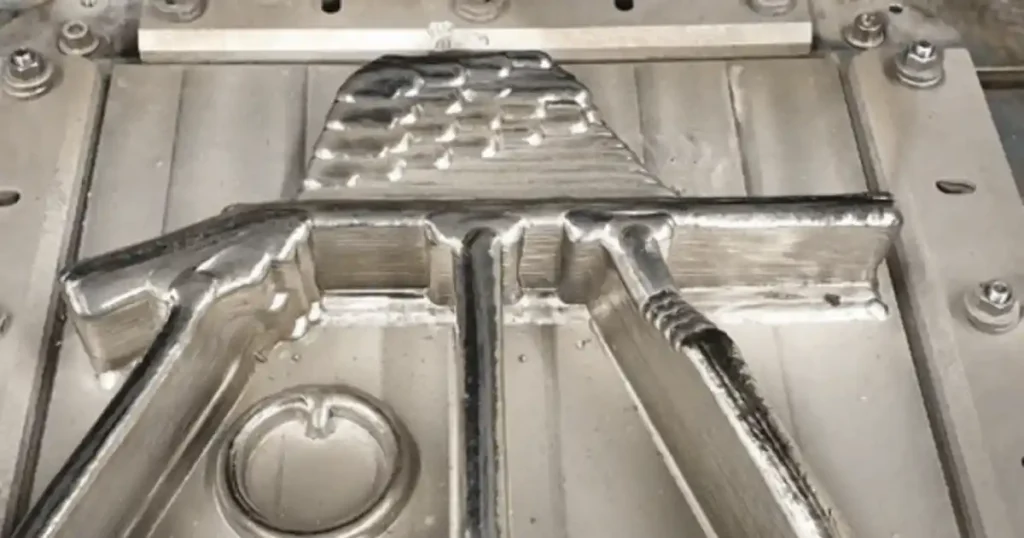
Explore how Airbus scales titanium 3D printing for aircraft parts using Wire-Directed Energy Deposition. Learn about benefits for aerospace manufacturing and how LAVA3DP delivers precision additive manufacturing services. Contact us for your project needs.
The aerospace industry is witnessing a fundamental shift in how critical aircraft components are made. For decades, manufacturing structural titanium parts meant starting with a massive forged block and carving away up to 95% of the material. Today, Airbus is pioneering a different approach: titanium 3D printing using Wire-Directed Energy Deposition (w-DED), a process that builds large-scale components layer by layer from a spool of wire.
This transition from subtractive to additive manufacturing is not merely an incremental improvement. It represents a rethinking of design freedom, material efficiency, and supply chain resilience. For companies like LAVA3DP, which specialize in industrial 3D printing services, these developments signal a growing demand for expertise in high-performance metal additive technologies.
The Technology Behind the Scale: Wire-Directed Energy Deposition
Traditional manufacturing of titanium aerospace structures relies on forging or machining from solid billets. This approach is material-intensive and limits geometric complexity. w-DED, the process Airbus is scaling, operates on a different principle.
A multi-axis robotic arm feeds titanium wire into a focused energy source—such as plasma, laser, or electron beam. The energy source melts the wire as it is deposited, following a digital 3D model to build the component layer by layer. The result is a “near net shaped” blank that requires only minimal final machining. According to engineers at Airbus, this approach allows the company “to move from carving metal away to growing parts intelligently. That shift changes how we think about size, waste, and design freedom.
Breaking the Size Barrier
While metal 3D printing has been used in aerospace for roughly a decade, it has largely been confined to small, complex parts produced with powder-bed fusion systems. These systems offer high precision but are limited in build volume. w-DED removes that constraint. Airbus reports the ability to produce structural titanium components up to seven meters in length with deposition rates of several kilograms per hour—an order-of-magnitude increase over earlier methods.
This scale is important for aerospace applications. Structural components like wing ribs, fuselage frames, and door surrounds require both size and strength. With w-DED, these parts can now be produced as single, optimized structures rather than assemblies of smaller pieces.
Why Titanium? Material Advantages in Aerospace
Titanium is a material of choice in aircraft manufacturing for several reasons:
- High strength-to-weight ratio: Titanium alloys offer strength comparable to steel at approximately 60% of the weight.
- Corrosion resistance: Titanium withstands harsh environmental conditions without protective coatings.
- Thermal stability: The material maintains mechanical properties at elevated temperatures.
- Compatibility with composites: Titanium’s coefficient of thermal expansion aligns well with carbon fiber composites, reducing stress in hybrid structures.
However, titanium is also expensive—both in raw material cost and in the complexity of traditional processing. The buy-to-fly ratio, which measures the weight of raw material versus the weight of the final part, can reach 20:1 in conventional forging. With w-DED, that ratio approaches 1.2:1, meaning nearly all the material ends up in the final component.
Serial Production: The A350 Cargo Door Surround
Airbus has already moved beyond experimentation. The company has begun serial integration of w-DED-produced titanium components into the A350 Cargo Door Surround—a structural element that demands both strength and precision.
This marks an important milestone for additive manufacturing in aviation. Certification requirements for flight-critical components are stringent, requiring extensive material property validation and process control. Airbus’s ability to certify w-DED parts for serial production demonstrates the maturity of the technology.
Economic and Sustainability Implications
The shift to titanium 3D printing carries significant economic and environmental benefits.
Material Efficiency
Traditional manufacturing of titanium parts can generate substantial waste. Titanium swarf and machining scrap require energy-intensive recycling processes. By reducing waste from the outset, w-DED lowers both material costs and the associated carbon footprint. Airbus engineers note, “Growing parts close to their final shape means we’re no longer recycling the majority of what we buy.”
Supply Chain Resilience
Aerospace supply chains have historically relied on long lead times for forgings and castings. Additive manufacturing enables distributed production and shorter lead times. A component that might require months for tooling and forging can now be produced in weeks.
Design Optimization
Perhaps the most significant long-term benefit is design freedom. When parts are grown rather than machined, internal geometries, organic shapes, and topological optimization become feasible. Airbus is already exploring components “designed for DED”—printed as single, integrated parts rather than assemblies of dozens of individual pieces.
The Path Forward: Next-Generation Aircraft
Airbus positions w-DED as a foundational technology for next-generation aircraft. The ability to produce large, optimized titanium structures opens new possibilities for airframe design. Weight reduction, part consolidation, and simplified assembly all contribute to more efficient aircraft.
As Airbus and its partners continue testing energy sources and production strategies, w-DED is evolving from a specialized tool to a core manufacturing capability. The company’s investment in this technology reflects a broader industry trend toward industrial additive manufacturing for production—not just prototyping.
How LAVA3DP Supports Aerospace Additive Manufacturing
For companies seeking to leverage 3D printing for aerospace applications, expertise in material science, process control, and post-processing is essential. LAVA3DP provides additive manufacturing services tailored to the stringent requirements of the aerospace sector.
Our capabilities include:
- Large-format metal 3D printing with wire-based and powder-based systems
- Titanium alloy processing with certified material properties
- Post-processing solutions including heat treatment, machining, and surface finishing
- Quality management aligned with aerospace industry standards
Whether you are developing flight hardware, tooling, or prototype components, LAVA3DP offers the technical expertise and production capacity to support your project.
Contact LAVA3DP to discuss your aerospace 3D printing requirements.
Frequent Asked Questions (FAQs)
1. What types of titanium alloys can LAVA3DP process for aerospace applications?
LAVA3DP works with a range of titanium alloys commonly specified in aerospace, including Ti-6Al-4V (Grade 5) and Ti-6Al-4V ELI (Grade 23). These materials offer the high strength-to-weight ratio, corrosion resistance, and fatigue performance required for flight-critical components. Our process parameters are developed to meet aerospace material specifications, and we provide full material traceability and mechanical property testing upon request.
2. What is the maximum part size LAVA3DP can produce for aerospace components?
Using wire-Directed Energy Deposition (w-DED) systems, LAVA3DP can produce titanium components up to seven meters in length with near-net shape accuracy. For powder-bed fusion requirements, our build envelopes accommodate parts up to 500 mm in key dimensions. We evaluate each project to recommend the most suitable technology based on part geometry, material requirements, and production volume.
3. Does LAVA3DP offer certification support for aerospace 3D printed parts?
Yes. LAVA3DP supports customers through the certification process by providing comprehensive documentation, including material batch records, process parameter logs, in-process monitoring data, and mechanical test results. We work with customers to align with ASTM, AS9100, and applicable aerospace original equipment manufacturer (OEM) standards. Our quality management system is structured to support both prototype and serial production requirements.
4. How does the lead time for 3D printed titanium parts compare to traditional forging?
Additive manufacturing with LAVA3DP typically reduces lead times by 40–60% compared to conventional forging and machining. Forging often requires long-lead tooling and minimum order quantities, while additive processes can begin production directly from a 3D model. Complex assemblies may be consolidated into single printed components, further reducing assembly time and supply chain coordination.
5. What post-processing capabilities does LAVA3DP offer for aerospace 3D printed parts?
LAVA3DP provides a complete suite of post-processing services including stress-relief and solution heat treatment, hot isostatic pressing (HIP) for porosity elimination, CNC machining to final tolerances, and surface finishing. These steps are essential for achieving the mechanical properties, dimensional accuracy, and surface quality required for aerospace applications. We coordinate post-processing to ensure traceability and compliance with engineering specifications.