
- 1.Introduction: Beyond the Limits of Electroplating
- 2.What is Electroless Nickel (EN)?
- 3.The Competitive Advantages of EN Plating
- 4.Materials Compatible with Electroless Nickel
- 5.Applications Across Industries
- 6.Technical Data & Visual Analysis
- 7.The LAVA3DP Process: From Concept to Coated Component
- 8.Conclusion
- 9.Frequently Asked Questions (FAQs)
- 9.1. What is the maximum thickness I can apply with Electroless Nickel on my custom parts?
- 9.2. How do I choose between Low, Medium, and High Phosphorus Electroless Nickel for my project?
- 9.3. Can Electroless Nickel be applied to 3D printed metal parts (Additive Manufacturing)?
- 9.4. Will Electroless Nickel plating affect the dimensional tolerances of my precision parts?
- 9.5. Does LAVA3DP offer Electroless Nickel plating for existing parts I have already machined elsewhere?
Electroless Nickel plating offers superior corrosion resistance and uniform hardness for custom parts. Discover how LAVA3DP delivers precision EN plating globally. Request a quote today!
1.Introduction: Beyond the Limits of Electroplating
In the world of custom manufacturing, surface finish is not merely an aesthetic consideration; it is a critical determinant of a component’s lifespan, performance, and reliability. While traditional electroplating has served industries for decades, it suffers from a fundamental flaw: non-uniform deposition. When dealing with complex geometries, internal threads, or deep recesses, electroplating often leaves areas with thin—or non-existent—coverage.
Enter Electroless Nickel (EN) . Unlike its electrolytic counterpart, EN is an autocatalytic chemical reaction that deposits a nickel-phosphorus alloy onto a substrate without the use of an external electric current. This process results in a coating with unparalleled uniformity, exceptional hardness, and superior corrosion resistance.
At LAVA3DP, we specialize in bridging the gap between advanced additive manufacturing and high-performance finishing. By integrating Electroless Nickel plating into our service portfolio, we provide engineers, product developers, and industries—from aerospace to oil and gas—with components that meet the most demanding specifications.
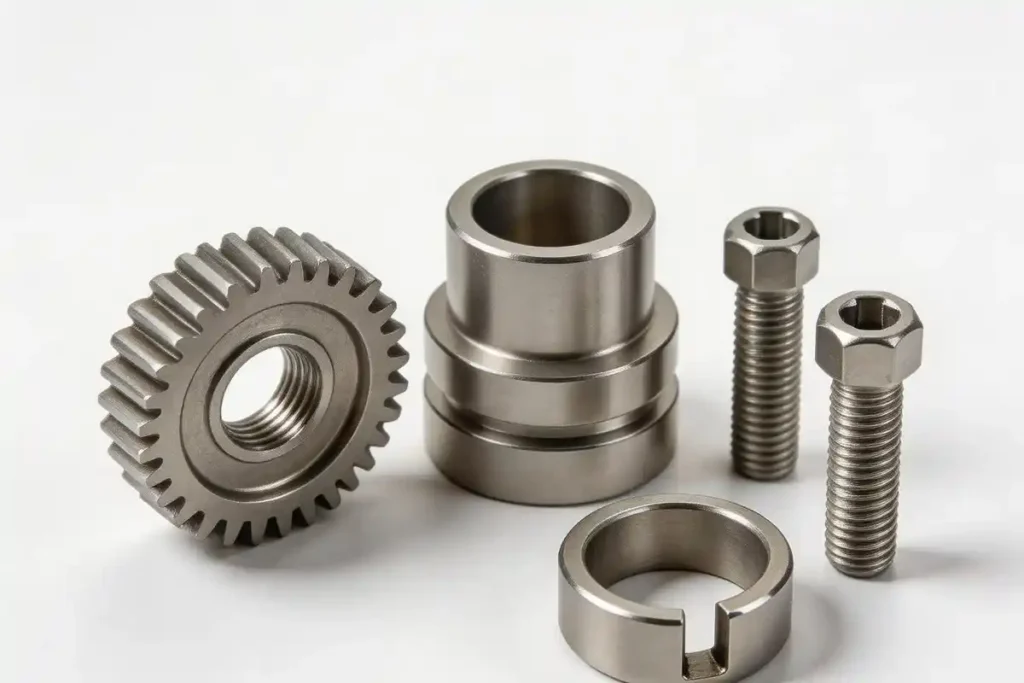
In this guide, we will explore the science, advantages, applications, and technical data behind Electroless Nickel, illustrating why it is the gold standard for surface engineering in custom parts fabrication.
2.What is Electroless Nickel (EN)?
Electroless Nickel plating is a controlled, autocatalytic process where a nickel-phosphorus (Ni-P) alloy is deposited onto a solid substrate. The process relies on a chemical reducing agent—typically sodium hypophosphite—within the plating bath. When the part is immersed, the hypophosphite reacts with nickel ions, depositing nickel and phosphorus onto the catalytic surface. Once the initial layer is deposited, the reaction continues on itself, allowing for precise thickness control.
Unlike electroplating, where the current density dictates the deposition rate, EN ensures that the coating thickness is virtually identical on all surfaces, regardless of shape, size, or complexity.
The Three Main Types of Electroless Nickel
The properties of the final coating are dictated by the phosphorus content. Typically, EN is categorized into three ranges:
- Low Phosphorus (1-4% P): Provides the highest hardness and excellent wear resistance but offers slightly less corrosion resistance than its high-phosphorus counterpart.
- Medium Phosphorus (5-9% P): The most common type used in general industry. It offers a balanced combination of hardness, ductility, and corrosion resistance.
- High Phosphorus (10-13% P): Provides the highest corrosion resistance, including resistance to acidic environments. It is also non-magnetic and often used in the electronics and chemical processing industries.
3.The Competitive Advantages of EN Plating
For clients using LAVA3DP to produce custom parts—whether CNC machined, metal 3D printed, or cast—the choice of finish is crucial. Here are the distinct advantages of choosing Electroless Nickel over traditional electroplating or other coatings.
3.1. Uniformity (Throwing Power)
The most significant advantage of EN is its ability to deposit a uniform layer. On a complex part with sharp corners, deep grooves, or blind holes, electroplating tends to build up more material on edges (dog-boning) and very little in recesses. EN, being chemically driven, provides a consistent thickness (±10%) across the entire geometry. For additive manufacturing parts with intricate internal lattice structures, this uniformity is indispensable.
3.2. Exceptional Corrosion Resistance
High-phosphorus Electroless Nickel acts as a barrier coating. Because it is amorphous (non-crystalline), it lacks grain boundaries, which are common initiation points for corrosion in crystalline coatings. It can withstand salt spray tests (ASTM B117) for hundreds of hours without red rust, making it ideal for marine, oil & gas, and chemical processing applications.
3.3. Superior Hardness and Wear Resistance
As-plated, EN typically measures between 45 and 52 HRC (Rockwell C). However, a unique advantage of EN is its ability to undergo heat treatment. After baking at 400°C (750°F) for one hour, the coating transforms to a crystalline structure, achieving hardness levels of 65–70 HRC, rivaling hard chrome plating without the environmental toxicity associated with hexavalent chromium.
3.4. Lubricity
EN coatings have a natural lubricity due to their self-sacrificing nature and low coefficient of friction (0.3 to 0.4 against steel). This reduces galling and seizing in moving assemblies, such as hydraulic cylinders, gears, and automotive components.
3.5. Environmental Compliance
Traditional hard chrome plating utilizes hexavalent chromium, a known carcinogen and environmental hazard. EN is a much greener alternative. Modern EN processes are RoHS and WEEE compliant, offering a safer profile for manufacturers and end-users alike.
4.Materials Compatible with Electroless Nickel
One of the most versatile aspects of EN is its ability to bond to a wide variety of substrates. At LAVA3DP, we utilize EN primarily for:
- Steel and Stainless Steel: Provides a barrier against corrosion and increases surface hardness. It is particularly effective on 300 and 400 series stainless steel to prevent galling.
- Aluminum Alloys: EN is one of the best coatings for aluminum (6061, 7075, etc.). It prevents oxidation, allows for soldering, and provides a hard, wear-resistant surface on lightweight components.
- Copper and Copper Alloys: EN prevents copper from oxidizing and provides a hard, ductile layer suitable for electronic connectors and heat exchangers.
- Titanium: EN is used to improve the wear resistance of titanium parts, which are typically soft and prone to galling.
- Additive Manufactured Metals: For 3D printed metals like Inconel or 17-4 PH stainless steel, EN fills surface irregularities (porosity) and enhances the aesthetic finish while boosting corrosion resistance.
5.Applications Across Industries
Electroless Nickel is ubiquitous across high-performance industries. Here is how different sectors utilize EN plating on custom parts fabricated by LAVA3DP:
- Aerospace: Used for hydraulic systems, landing gear components, and fuel system parts. EN meets strict specifications such as AMS 2404 and AMS 2405, ensuring resistance to hydraulic fluids and high-altitude corrosion.
- Oil & Gas: Downhole tools, valves, and pumps require extreme corrosion resistance to hydrogen sulfide (H2S) and saltwater. High-phosphorus EN is a standard requirement for components operating in sour gas environments (NACE MR0175).
- Automotive: Performance vehicles use EN for shock absorbers, fuel injectors, brake pistons, and transmission components to reduce friction and increase fatigue life.
- Electronics: The non-magnetic properties of high-phosphorus EN make it ideal for hard disk drive components, electromagnetic shielding, and microelectronic connectors.
- Medical: EN is used for surgical instruments, dental tools, and orthopedic implants where biocompatibility, hardness, and sterilization resistance are required.
6.Technical Data & Visual Analysis
To quantify the performance of Electroless Nickel, we rely on standardized testing data. The chart below illustrates the comparative Hardness vs. Heat Treatment for different phosphorus levels, alongside Corrosion Resistance metrics.
Figure 1: Electroless Nickel Performance Matrix
| Property | Low Phosphorus (1-4%) | Medium Phosphorus (5-9%) | High Phosphorus (10-13%) |
|---|---|---|---|
| As-Plated Hardness (HV) | 650 – 750 | 550 – 650 | 500 – 550 |
| Heat Treated Hardness (HV) (400°C/1hr) | 850 – 950 | 800 – 900 | 800 – 900 |
| Salt Spray Resistance (ASTM B117, 50µm) | 24 – 72 hrs | 100 – 200 hrs | 500 – 1000+ hrs |
| Magnetic Properties | Magnetic | Slightly Magnetic | Non-Magnetic |
| Melting Point | 1,380°C | 1,150°C | 890°C |
Data aggregated from ASM International, Vol. 5: Surface Engineering, and ASTM International standards¹ ² ³.
7.The LAVA3DP Process: From Concept to Coated Component
When you choose LAVA3DP for your custom parts, you are not just getting a manufacturer; you are getting a partner in precision engineering. Our integration of Electroless Nickel plating ensures a seamless workflow:
- Fabrication: We manufacture your parts using CNC machining, metal 3D printing (SLM/DMLS), or urethane casting.
- Pre-Treatment: Surface preparation is critical. We employ rigorous cleaning, degreasing, and acid etching to ensure absolute adhesion. For aluminum, we utilize a zincate process to eliminate the native oxide layer.
- Plating: The parts are submerged in a precisely controlled autocatalytic bath. We monitor pH levels (typically 4.5-6.0) and temperature (85°C – 95°C) to ensure consistent phosphorus content and deposition rates of approximately 20-25 microns per hour.
- Post-Treatment: Depending on the application, we perform heat treatment to achieve maximum hardness (hardening) or apply a chromate conversion coating (trivalent chromium) to further enhance corrosion resistance.
8.Conclusion
Electroless Nickel plating represents the intersection of durability, precision, and versatility. For industries demanding components that withstand extreme environments, resist wear, and maintain dimensional stability, EN is the definitive solution.
At LAVA3DP, we combine cutting-edge fabrication technologies with world-class finishing capabilities. Whether you require a complex 3D-printed manifold with uniform internal coating or a CNC-machined valve body resistant to offshore corrosion, our expertise ensures that your custom parts meet global quality standards.
Ready to elevate the performance of your custom parts?
Contact LAVA3DP today to discuss your project specifications and receive a free engineering consultation.
9.Frequently Asked Questions (FAQs)
9.1. What is the maximum thickness I can apply with Electroless Nickel on my custom parts?
Unlike electroplating, Electroless Nickel does not suffer from “burning” at high thicknesses. We can typically apply coatings ranging from 5 microns (0.0002 inches) for precision electronic components up to 100 microns (0.004 inches) or more for heavy-duty industrial parts requiring extensive wear protection. Thickness is uniform across all surfaces.
9.2. How do I choose between Low, Medium, and High Phosphorus Electroless Nickel for my project?
The choice depends on your performance needs:
- Low Phosphorus: Best for wear resistance and applications requiring maximum hardness (post heat treat).
- Medium Phosphorus: The “general purpose” standard, offering a balanced combination of lubricity, hardness, and cost-effectiveness.
- High Phosphorus: Essential for applications requiring maximum corrosion resistance (e.g., marine, chemical exposure) and non-magnetic properties.
If you are unsure, contact LAVA3DP and our engineers can recommend the optimal grade based on your operating environment.
9.3. Can Electroless Nickel be applied to 3D printed metal parts (Additive Manufacturing)?
Yes. This is one of our specialties at LAVA3DP. EN plating is highly effective on additively manufactured metals like Aluminum AlSi10Mg, Stainless Steel 316L, and Inconel 718. The plating process helps seal micro-porosity inherent in some 3D printed surfaces, improves corrosion resistance, and provides a smooth, functional finish that is often required for fluid handling or aesthetic consumer products.
9.4. Will Electroless Nickel plating affect the dimensional tolerances of my precision parts?
Yes, but because EN plates uniformly, it is predictable. We control the deposition thickness to a tight tolerance (typically ±2 microns). If you require a final part with a specific outer diameter, we recommend accounting for the build-up in your initial design or machining phase. We also offer post-plating grinding or lapping services to achieve critical tolerances while retaining the coating’s surface properties.
9.5. Does LAVA3DP offer Electroless Nickel plating for existing parts I have already machined elsewhere?
Absolutely. While we love to handle end-to-end manufacturing, our finishing services are available for customer-supplied parts. We accept CNC machined, cast, or fabricated components from third parties for Electroless Nickel plating. We conduct a thorough incoming inspection to ensure the substrate quality is suitable for plating, ensuring you receive the same high-quality finish as our internally fabricated parts.