
Gantry Milling delivers high-precision machining for large, complex parts. Explore its advantages, materials, and applications. Get an instant quote for your custom project at LAVA3DP today!
Introduction
In the world of precision manufacturing, size and complexity often present significant challenges. When a part is too large, too heavy, or too intricate for standard CNC machines, manufacturers turn to a robust solution: Gantry Milling. This advanced machining process is the backbone of industries ranging from aerospace to energy, enabling the production of massive components with microscopic tolerances.
At LAVA3DP, we have integrated state-of-the-art gantry milling capabilities into our online custom parts fabrication service to meet the growing global demand for large-scale, high-precision components. Whether you need a monolithic aluminum bulkhead for an aircraft or a heavy-duty mold for industrial machinery, understanding the power of gantry milling is the first step toward bringing your most ambitious designs to life.
This comprehensive guide will explore what gantry milling is, its distinct advantages, the materials it can handle, its wide range of applications, and why it is an indispensable part of modern manufacturing. For your specific project needs, do not hesitate to contact our engineering team.
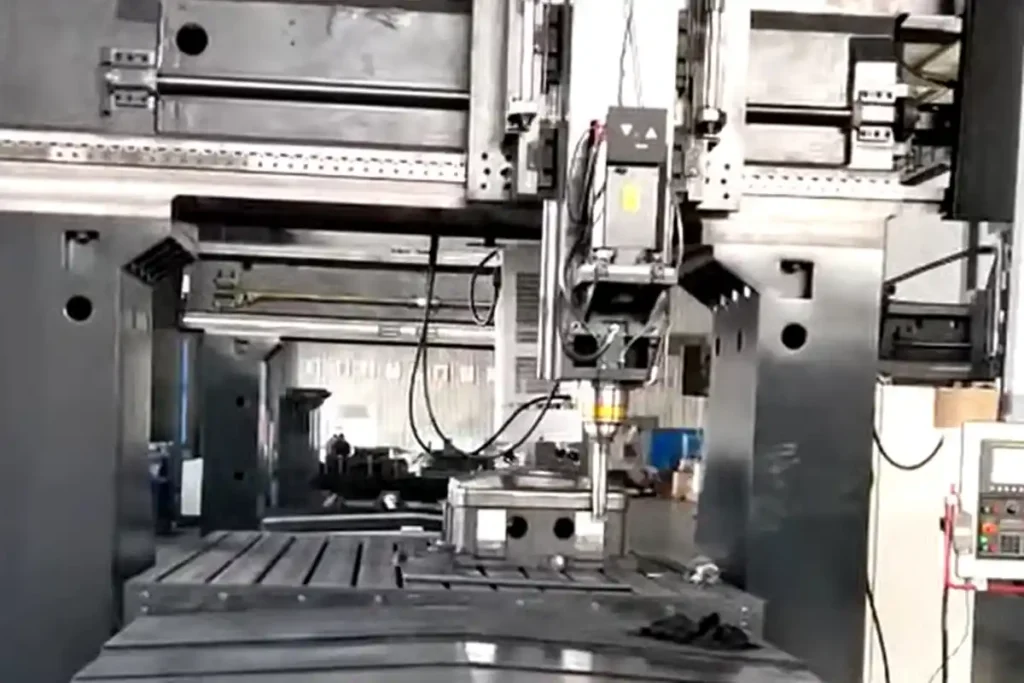
What is Gantry Milling?
Gantry milling refers to a machining process where the cutting tool is mounted on a overhead bridge-like structure—the gantry—that spans across a stationary workpiece . Unlike traditional machining centers where the part moves on a table, the gantry structure moves along rails to position the spindle over the work area. This fundamental design offers two critical benefits: unlimited workpiece size potential and exceptional rigidity .
The configuration of a gantry milling machine typically includes a bed, two upright supports (columns), and a crossbeam (bridge) that travels across the columns. This design allows for the machining of parts that are significantly larger, heavier, and more complex than those possible on conventional CNC mills .
Types of Gantry Machines
While often used interchangeably, there are subtle distinctions in machine configurations:
- Gantry Mills: The gantry itself moves to position the tool over a stationary workpiece. This is ideal for extremely heavy parts .
- Bridge Mills: Similar to gantry mills, but the bridge is fixed, and the table moves the workpiece underneath the tool .
- Portal Mills: A term often synonymous with large-scale gantry machines used in heavy engineering.
Key Advantages of Gantry Milling in Custom Manufacturing
Choosing gantry milling for your custom parts offers a host of manufacturing advantages that directly impact quality, cost, and lead time.
1. Unparalleled Size and Weight Capacity
The most obvious advantage is the ability to handle massive workpieces. Machines like the Fooke ENDURA® series offer X-axis travels of up to 60,000 mm, capable of machining entire aircraft wing sections or railway car sidewalls in a single setup . Similarly, modern service providers can accommodate parts up to 34 feet long, supported by overhead crane capacities exceeding 60 tons . This eliminates the need to section large parts, preserving structural integrity.
2. Exceptional Rigidity and Stability
The bridge-type structure of a gantry milling machine provides immense structural rigidity . This rigidity is crucial for dampening vibration during heavy cutting operations, especially when working with tough materials like titanium or Inconel . The result is superior surface finishes, longer tool life, and the ability to maintain tight tolerances across the entire part .
3. High Precision and Accuracy
Modern gantry milling centers are engineered for extreme accuracy. With advanced linear drive technology and thermal stabilization features (like FOOKE’s Thermo Guard), these machines can achieve positioning tolerances in the range of ±0.01 mm, even on parts spanning several meters . This precision is critical for components that must interface perfectly in large assemblies, such as in aerospace fuselage sections .
4. Versatility in Machining
Gantry milling centers are not one-trick ponies. They are often equipped with 5-axis heads that allow for complex 3D contouring, undercutting, and drilling at multiple angles in a single setup . This “done-in-one” capability reduces errors from multiple fixture setups and dramatically shortens production cycles .
5. Cost-Effectiveness for Large Parts
While the hourly rate for a large gantry machine might be higher than a standard mill, the overall project cost is often lower. By machining large parts in a single operation, you save on setup labor, avoid fixturing costs for multiple setups, and eliminate the need for joining smaller parts together, which improves the final part’s strength .
6. Automation and Industry 4.0 Integration
Today’s gantry milling systems are fully integrated with CNC automation. They feature automatic tool changers (with magazines holding up to 120 tools), pallet systems for continuous operation, and IoT-enabled monitoring for predictive maintenance . This allows for “lights-out” manufacturing, where machines run unattended overnight, boosting productivity .
Materials Suitable for Gantry Milling
The robust nature of gantry milling allows it to cut a wide spectrum of materials, from soft foams to the hardest superalloys. At LAVA3DP, our gantry centers are equipped to handle:
- Aluminum and Alloys: The most common material for aerospace and automotive applications due to its excellent strength-to-weight ratio and machinability .
- Stainless Steel and Tool Steel: Used for industrial machinery, molds, and energy sector components requiring corrosion resistance and hardness .
- Titanium Alloys: A staple in aerospace (like the TA15m alloy) and medical industries. Its high strength at temperature and corrosion resistance make it desirable, though challenging, to machine .
- Engineering Plastics and Composites: Including CFRP (Carbon Fiber Reinforced Polymer) and GFRP (Glass Fiber Reinforced Polymer) , widely used in lightweight structural applications and prototyping .
- Cast Iron: Common in heavy machinery bases, engine blocks, and large-scale tooling due to its excellent vibration damping characteristics .
- Copper and Bronze: Utilized in electrical components, heat exchangers, and marine hardware .
- Modeling Materials (Ureol, Foams, Wood) : Essential for the design and prototyping phase in the automotive industry for creating full-scale clay models and masters .
The following chart illustrates the comparative machinability of common materials used in gantry milling:
Primary Applications Across Industries
The unique capabilities of gantry milling make it the process of choice for critical applications across a variety of high-tech industries.
Aerospace
The aerospace industry is perhaps the largest beneficiary of gantry milling technology. Manufacturers use it to machine:
- Structural Airframe Parts: Fuselage frames, wing ribs, and spars from monolithic aluminum or titanium plates to reduce weight and increase strength .
- Thin-Walled Skin Panels: Highly dynamic gantry milling with linear drives can achieve productivity increases of up to 35% when milling complex 3D surfaces on outer skin panels .
- Landing Gear Components: High-strength steel and titanium parts that demand absolute reliability .
Automotive and e-Mobility
From prototyping to production, gantry milling plays a vital role.
- Full-Scale Clay Models: Automotive designers rely on large gantry machines to mill 1:1 design models with perfect surface quality .
- Mold and Die Making: Creating large dies for stamping body panels. Gantry milling can increase mold milling efficiency by up to 40% .
- EV Components: High-precision machining of electric drive unit housings and structural battery trays, as seen in Ford’s Halewood plant using gantry systems .
Energy Generation and Heavy Machinery
The energy sector demands large, durable components.
- Wind Turbine Housings: Machining the massive hubs and nacelle components for wind turbines .
- Turbine Frames: Creating casings and frames for gas and steam turbines used in power generation .
- Large Valves and Pumps: For oil and gas exploration and processing.
Shipbuilding and Marine
On-site or in-facility gantry milling is essential for shipbuilding.
- Engine Mounts and Propulsion Components: Machining large, complex parts that are integral to a ship’s structure and function .
- Deck Machinery: Fabricating winches, capstans, and other heavy deck equipment.
Railway and Heavy Transport
The production of rail vehicles relies heavily on gantry machines.
- Chassis and Bogie Components: High-strength steel parts that ensure safety and performance.
- Aluminum Profile Machining: Gantry milling is the market leader for machining large aluminum profiles for sidewalls, roofs, and floor assemblies of trains, with machines capable of X-travels up to 90 meters .
Technical Specifications and Tolerances
When designing a part for gantry milling, understanding the machine’s capabilities is essential. Modern gantry milling centers offer impressive specifications:
- Spindle Power: Drive capacities can reach up to 100 kW, providing the torque necessary to push large cutters through tough materials at high removal rates .
- Spindle Speed: For finishing operations in aluminum and composites, spindles can achieve speeds up to 24,000 rpm .
- Feed Rates: Rapid traverse rates can reach 50,000 mm/min (approximately 2,000 inches/min), reducing non-cutting time and boosting productivity .
- Tolerances: While it depends on part size, high-precision gantry milling can routinely achieve tolerances of ±0.007 inches for larger features and H7 tolerances for precision bores . The line boring of a 17mm diameter over a 990mm length, achieving a concentricity of less than 0.05 mm, is a prime example of this precision .
The Future of Gantry Milling
The technology behind gantry milling continues to evolve, driven by the needs of Industry 4.0 and advanced manufacturing.
- Hybrid Manufacturing: The integration of additive manufacturing heads with subtractive gantry milling allows for the creation of near-net shape parts through 3D printing, which are then finish-machined to tight tolerances on the same machine .
- Advanced Simulation and Digital Twins: CAM software now creates a “digital twin” of the machining process, simulating tool paths to detect collisions and optimize cycle times before a chip is ever cut .
- Sustainability: Newer gantry systems are designed for energy-efficient operation, with optimized movement paths and coolant management strategies to reduce environmental impact .
Why Choose LAVA3DP for Your Gantry Milling Needs?
At LAVA3DP, we bridge the gap between complex engineering requirements and accessible online manufacturing. Our gantry milling services are tailored for a global clientele seeking precision, reliability, and speed. By leveraging advanced CNC technology and a network of vetted manufacturing partners, we ensure that your large-format parts are produced to the highest standards.
Our platform simplifies the custom parts procurement process. You simply upload your CAD file, and our team of experts evaluates it for manufacturability on our gantry milling centers. We provide transparent pricing and rapid lead times, some as fast as 10 days for select parts .
Ready to start your next project? Visit our contact page to discuss your requirements with our engineering staff. Whether you need a single prototype or a full production run of complex, large-scale components, LAVA3DP is your partner in precision manufacturing.
Frequently Asked Questions (FAQ)
Here are five common questions we receive about our gantry milling capabilities, designed to help you make informed decisions for your custom parts.
1. What is the maximum part size you can handle with your gantry milling services?
At LAVA3DP, our network of gantry milling centers can accommodate a wide range of part sizes. Depending on the specific machine configuration, we can handle parts with X-axis travels exceeding 30,000 mm and widths up to 4,500 mm . For extremely large components, such as those used in rail or aerospace, we have access to machines with unlimited table lengths thanks to modular bed systems . To get a feasibility check on your specific part dimensions, please upload your CAD file or contact our support team.
2. What tolerances can you achieve with gantry milling?
Precision is paramount in custom manufacturing. Our gantry milling services are capable of achieving tight tolerances, typically in the range of ±0.01 mm to ±0.05 mm for standard machining operations . For specific features like precision bores, we can hold H7 tolerances with exceptional concentricity over long distances, leveraging advanced techniques like line boring . The final achievable tolerance depends on the material, part geometry, and size, but we always work to meet or exceed your specified requirements.
3. Which industries commonly use gantry milling for their custom parts?
Gantry milling is essential for industries that require large, complex, and high-precision components. We regularly serve clients in:
- Aerospace: For fuselage sections, wing spars, and bulkheads .
- Automotive: For full-scale design models, large molds, and EV components .
- Energy: For wind turbine hubs, large valves, and generator housings .
- Railway: For chassis components and large aluminum profiles .
- Heavy Machinery & Shipbuilding: For structural frames and engine mounts .
If your project falls into any of these categories, LAVA3DP has the expertise to deliver.
4. Can you machine exotic materials like titanium or Inconel on your gantry mills?
Absolutely. The robust construction and high-power spindles of our gantry milling centers are perfectly suited for difficult-to-machine materials. We have extensive experience machining titanium alloys (including aerospace-grade materials), Inconel, and other high-temperature superalloys . We also specialize in composites like CFRP and GFRP . Our tooling strategies and machining parameters are optimized to handle these materials efficiently while maintaining tool life and part quality.
5. How do I get a quote for a gantry-milled part, and what information do you need?
Getting a quote from LAVA3DP is simple. Visit our website and submit your request through our contact page or engineering support email. To provide you with an accurate and timely quote, please include:
- A 3D CAD file (STEP, IGES, or native formats preferred).
- A 2D drawing with critical tolerances, surface finish requirements, and material specifications.
- The quantity needed (prototype vs. production run).
- Any specific lead time requirements.
Our engineering team will review your project and provide a comprehensive quote, including design for manufacturability (DFM) feedback, to ensure your part is produced perfectly.