
- Introduction: Beyond the Cutting Edge
- What is Sinker EDM? Understanding the Spark Erosion Process
- Key Advantages of Sinker EDM in Custom Fabrication
- Materials: What Can Be Machined with Sinker EDM?
- Applications: Where Sinker EDM is Indispensable
- Sinker EDM vs. Wire EDM: What's the Difference?
- Why Choose LAVA3DP for Your Sinker EDM Needs?
- Conclusion: Unlock New Design Possibilities
- Frequent Asked Questions(FAQs)
- 1. What file formats do you accept for custom Sinker EDM parts?
- 2. What is the typical turnaround time for a Sinker EDM project?
- 3. How does the cost of Sinker EDM compare to CNC machining?
- 4. What is the maximum part size and depth you can accommodate for Sinker EDM?
- 5. Can you achieve a mirror finish directly from the Sinker EDM process?
Sinker EDM technology delivers unmatched precision for complex geometries in hardened materials. Explore LAVA3DP’s advanced Sinker EDM services for custom parts. Get an instant quote today!
Introduction: Beyond the Cutting Edge
In the fast-paced world of custom manufacturing, the ability to produce intricate, high-precision components from the hardest materials is not just an advantage—it is a necessity. Traditional machining methods, such as milling and turning, rely on mechanical shear to cut away material. However, these processes have inherent limitations: they struggle with extreme hardness, induce mechanical stress, and often cannot create the complex internal geometries required by modern engineering .
Enter Sinker Electrical Discharge Machining (EDM) , also known as ram EDM or die-sinking EDM. This non-traditional manufacturing process has revolutionized the tool and die industry, aerospace engineering, and medical device fabrication. By using controlled electrical sparks to erode material, Sinker EDM achieves tolerances and finishes that conventional methods simply cannot match .
At LAVA3DP, we have integrated state-of-the-art Sinker EDM technology into our online custom parts fabrication service. Whether you need a complex mold cavity or a delicate aerospace component, our capabilities ensure that your designs become reality with absolute fidelity. This comprehensive guide will explore the intricacies of Sinker EDM, its advantages, compatible materials, and how it can elevate your next project.
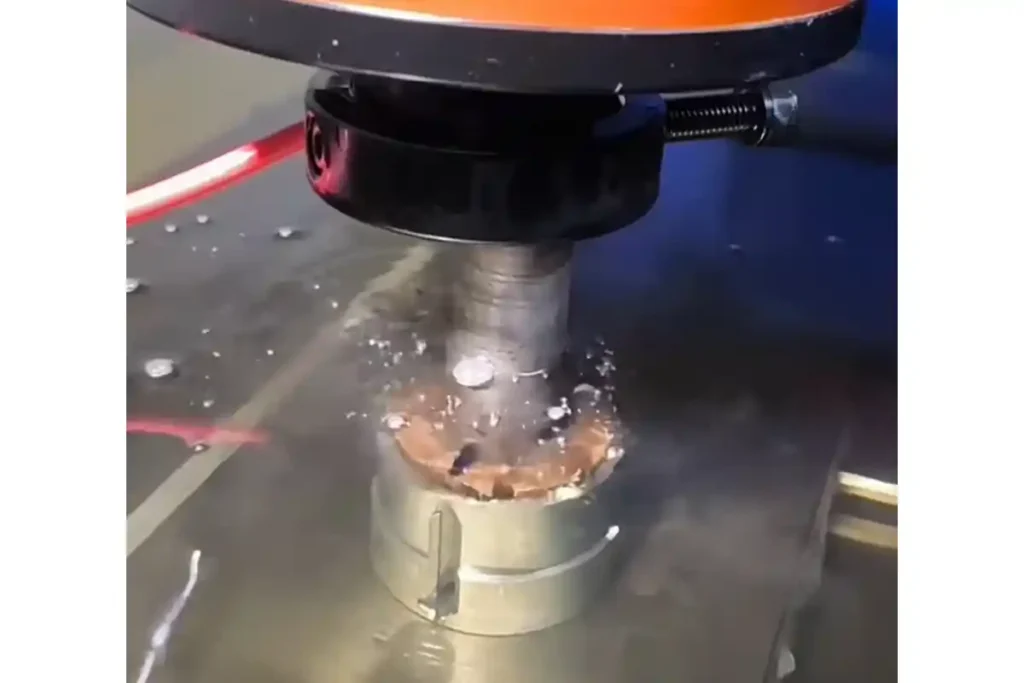
What is Sinker EDM? Understanding the Spark Erosion Process
Sinker EDM is a precision machining process that uses electrical discharges (sparks) to remove material from a conductive workpiece. Unlike conventional cutting, there is no physical contact between the tool and the part. Instead, a custom-shaped electrode (usually made of graphite or copper) is slowly fed into the workpiece while both are submerged in a dielectric fluid .
How It Works
- The Setup: A machinist creates an electrode that is the positive image of the desired cavity or feature. This electrode is mounted on a servo-controlled ram within the EDM machine.
- The Environment: The workpiece and electrode are submerged in a bath of dielectric fluid (typically hydrocarbon oil). This fluid acts as an insulator, a coolant, and a flushing agent .
- The Spark: A high-voltage charge is applied across the gap between the electrode and the workpiece. When the voltage reaches a critical point, the dielectric fluid ionizes, creating a conductive channel. A controlled spark jumps across the gap, generating intense localized heat (up to 8,000°C to 12,000°C) .
- Erosion and Flushing: This extreme heat melts and vaporizes a microscopic particle of the workpiece. The spark collapses, and the dielectric fluid rushes in to flush away the debris (chips) and cool the area. This cycle repeats thousands of times per second, gradually “sinking” the shape of the electrode into the workpiece .
Key Advantages of Sinker EDM in Custom Fabrication
Why choose Sinker EDM over advanced CNC milling? The answer lies in its unique physical principles. Because it is a thermal, non-contact process, it offers distinct benefits that solve the most challenging manufacturing problems.
1. Unrivaled Precision for Complex Geometries
Sinker EDM excels where traditional cutters cannot reach. It can produce deep, narrow cavities, blind slots, and complex 3D contours with sharp internal corners. Milling tools have a radius, but an EDM electrode can be shaped to leave a perfect 90-degree internal corner in the workpiece . Dimensional accuracy can be held to tolerances as tight as ±0.0001 inches (0.0025 mm) .
2. Material Hardness Independence
Once a part is heat-treated, it becomes difficult to machine conventionally without damaging the tool or the part. Sinker EDM cuts hardness, not the tool. It can effortlessly machine hardened tool steels (up to 70 HRC), tungsten carbide, and superalloys like Inconel without distortion or changes to the material’s metallurgical properties .
3. Stress-Free Machining
Since the electrode never touches the workpiece, there are zero mechanical cutting forces involved. This makes Sinker EDM ideal for delicate, thin-walled, or fragile components that would break or deform under the stress of conventional machining .
4. Superior Surface Finishes
Modern Sinker EDM machines can achieve exceptional surface finishes directly from the process. While roughing passes prioritize speed, finishing passes can produce mirror-like surfaces down to 0.4 Ra (µm) or better, often eliminating the need for secondary polishing operations .
Materials: What Can Be Machined with Sinker EDM?
The primary requirement for Sinker EDM is that the workpiece material must be electrically conductive. This opens up a vast range of metals and alloys used in high-performance industries.
Workpiece Materials
- Tool Steels: A2, D2, O1, S7, and H13 are commonly machined for molds and dies .
- Stainless Steels: 304, 316, and 17-4 PH for medical and food-grade applications.
- Superalloys: Inconel, Hastelloy, and Monel, which are notoriously difficult to machine via traditional methods .
- Carbides: Tungsten carbide for wear-resistant tooling and dies .
- Titanium: Ideal for aerospace and medical implants due to its strength-to-weight ratio .
- Non-Ferrous: Copper, brass, and aluminum alloys .
Electrode Materials
The electrode is the “tool” that forms the cavity. It must be conductive and resistant to the erosive heat of the sparks. The two most common materials are:
- Graphite: The most popular choice due to its excellent wear resistance, high melting point, and low cost. It is easy to machine and provides good stability .
- Copper: Offers better surface finish capabilities and is often used for fine-finish work or when machining carbide. However, it has a higher wear rate than graphite .
At LAVA3DP, our expertise in electrode design and selection ensures optimal material removal rates and minimal tool wear for your specific project.
Applications: Where Sinker EDM is Indispensable
Because of its unique capabilities, Sinker EDM is the go-to solution for specific applications across various sectors.
Tool and Die Making
This is the heartland of Sinker EDM. It is used to create injection molds, die-casting dies, forging dies, and stamping tools. The process accurately reproduces complex cavity shapes with the necessary draft angles and surface finishes required for plastic and metal forming .
Aerospace and Defense
The aerospace industry relies heavily on Sinker EDM to machine high-strength alloys. A prime example is the creation of “seal slots” in turbine engine nozzle guide vanes (NGVs). These slots require sharp corners, precise depths, and fine finishes in difficult materials like nickel alloys, a task virtually impossible without EDM .
Medical Devices
For surgical instruments, implants, and orthopedic devices, precision and material integrity are paramount. Sinker EDM can produce small, intricate features in titanium and stainless steel without inducing micro-cracks or burrs .
Electronics and Automotive
From connectors and detailed circuitry elements to complex gear profiles and engine components, Sinker EDM provides the precision required for reliable, high-performance parts .<figure> <img src=”https://via.placeholder.com/800×400?text=Chart:+Comparative+Analysis:+Sinker+EDM+vs.+Conventional+Machining” alt=”Bar chart comparing Sinker EDM and conventional milling on factors like complexity, hardness capability, and stress.”> <figcaption>Figure 2: Sinker EDM surpasses conventional machining in handling complex geometries and hard materials.</figcaption> </figure>
Sinker EDM vs. Wire EDM: What’s the Difference?
Customers often confuse Sinker EDM with Wire EDM. While both use electrical discharge to erode material, their applications are distinct.
- Electrode: Sinker EDM uses a custom-shaped, three-dimensional electrode that plunges into the workpiece to create a cavity. Wire EDM uses a continuously moving, thin brass or copper wire as an electrode .
- Cut Path: Sinker EDM is primarily used for blind cavities, pockets, and through-features with complex 3D forms. Wire EDM is used to cut through parts like a bandsaw, creating 2D profiles, precision gears, and extrusions .
- Dielectric: Sinker EDM typically uses hydrocarbon oil, while Wire EDM uses deionized water .
In short, if you need a shaped hole or cavity, you choose Sinker EDM. If you need to cut a precise contour through a plate, you choose Wire EDM. LAVA3DP offers both capabilities, ensuring you get the right process for your design.
Why Choose LAVA3DP for Your Sinker EDM Needs?
Integrating Sinker EDM into your supply chain requires a partner with technical expertise and modern equipment. At LAVA3DP, we bridge the gap between complex designs and manufacturable reality.
Advanced Technology
We utilize leading EDM machinery, similar to the Sodick and Mitsubishi systems renowned in the industry for their linear motor technology and adaptive control. This ensures consistent accuracy, reduced electrode wear, and reliable unattended operation for both prototypes and production runs .
Design for Manufacturing (DFM) Expertise
Our engineering team understands the nuances of the process, including overcut, electrode design, and flushing strategies. We partner with you to optimize your designs for the Sinker EDM process, ensuring cost-effectiveness and manufacturability without compromising functionality .
Comprehensive Quality Control
From electrode fabrication to final inspection, every step is monitored. We provide detailed quality reports, ensuring that every part meets your specified tolerances and surface finish requirements. Our process controls guarantee repeatability, whether you need one part or ten thousand .
Conclusion: Unlock New Design Possibilities
Sinker EDM is more than just a machining process; it is an enabler of innovation. By removing the barriers of material hardness and geometric complexity, it allows engineers to design parts for optimal performance rather than for the limitations of a cutting tool.
At LAVA3DP, we are committed to providing global clients with the highest quality custom parts. Our Sinker EDM services are ready to tackle your most challenging projects. From intricate mold cavities to robust aerospace components, we have the technology and expertise to deliver precision you can trust.
Ready to start your project? Contact our engineering team today to discuss your requirements, or upload your CAD file to our website for an instant, competitive quote. Let LAVA3DP bring your most complex designs to life.
Frequent Asked Questions(FAQs)
1. What file formats do you accept for custom Sinker EDM parts?
We accept all major CAD file formats, including STEP, IGES, STL, and native files from SolidWorks and AutoCAD. For the best results, ensure your model clearly defines the cavity or feature geometry. If you have a 2D drawing with specific tolerance callouts, please upload it alongside your 3D model. You can submit your files directly through our LAVA3DP quote portal.
2. What is the typical turnaround time for a Sinker EDM project?
Turnaround time depends on the complexity of the electrode required and the depth of the cavity. Simple geometries can ship in as little as 3-5 business days. More complex, multi-cavity projects with tight tolerances may take longer. During the quoting process, we provide an estimated lead time based on your specific project scope. For urgent needs, please contact us to discuss expedited options.
3. How does the cost of Sinker EDM compare to CNC machining?
While Sinker EDM can have a higher per-unit cost for simple parts due to the need to fabricate a custom electrode, it is often the only cost-effective way to produce parts with specific features (like sharp internal corners or deep slots in hardened steel). For complex cavities in hard materials, it eliminates the need for secondary operations and prevents tool breakage, making it the most economical choice overall. Request a quote from LAVA3DP to compare.
4. What is the maximum part size and depth you can accommodate for Sinker EDM?
Our Sinker EDM work envelope is substantial, capable of handling workpieces up to significant sizes and weights. While exact dimensions are best confirmed with your specific part geometry, we can accommodate parts requiring deep cavity work with high aspect ratios. For detailed specifications or to discuss a large-format part, please contact our support team.
5. Can you achieve a mirror finish directly from the Sinker EDM process?
Yes, depending on the material and application. By utilizing fine finishing parameters and appropriate electrode materials (like copper or fine-grain graphite), we can achieve surface finishes below 0.4 Ra (µm). This often eliminates the need for manual polishing, especially in mold applications. Be sure to specify your surface finish requirements on your drawing so we can plan the appropriate finishing strategy.