

DMLS (Direct Metal Laser Sintering)
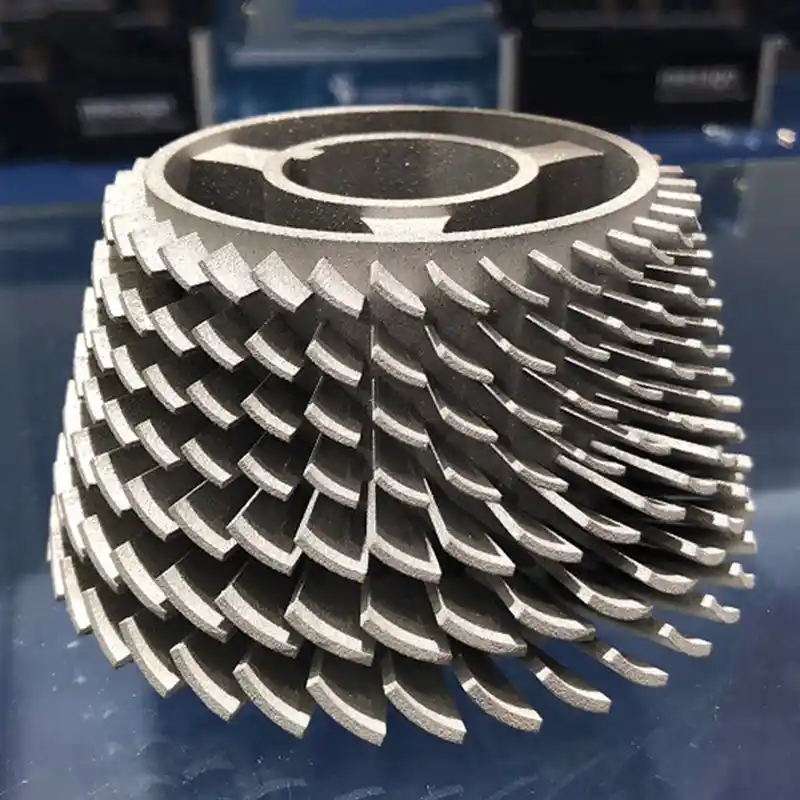
How Direct Metal Laser Sintering (DMLS) Works
DMLS builds metal parts inside a sealed chamber filled with inert gas – typically argon or nitrogen – to prevent oxidation. A thin layer of metal powder spreads across a build platform. A high-power fiber laser (200 W to 1000 W) scans the powder bed, following the cross-section of a 3D model. The laser raises the temperature of the powder particles to just below their melting point. The particles fuse together at the atomic level through solid-state diffusion, creating a solid layer approximately 30 to 60 microns thick. This metal powder bed fusion process forms the foundation of modern Direct Metal Laser Sintering (DMLS) and metal additive manufacturing services.
After the laser finishes one layer, the build platform lowers by the same thickness. A recoater blade or roller pushes fresh powder from a supply reservoir across the previously sintered layer. The laser scans the next cross-section, bonding the new layer to the one below. The process repeats – thousands of times – until the complete part forms inside the powder bed. This advanced additive manufacturing workflow enables high precision metal printing for industrial applications.
The unsintered powder remains loose and acts as natural support for overhanging features. Once printing finishes, the operator removes the build plate from the machine, brushes off excess powder, and extracts the part. The part then undergoes stress-relief heat treatment to remove residual thermal stresses. Supports (thin lattice structures added during design) are cut off manually or by wire EDM. The final component reaches 99.5% to 99.9% of theoretical density with mechanical properties similar to wrought metal, making it ideal for production-ready metal parts and end-use metal components.
Get an Instant QuoteKey Benefits of DMLS for Custom Metal Parts
Mechanical Performance Comparable to Wrought Metals
DMLS parts pass tensile, fatigue, and hardness tests that match or exceed cast equivalents. For example, DMLS Ti6Al4V achieves an ultimate tensile strength of over 1000 MPa – the same as mill-annealed titanium bar stock. Post-process heat treatment closes any remaining micro-porosity. This performance makes Titanium Ti-6Al-4V a preferred material in industrial metal 3D printing applications.
Many engineers hesitate because they think “printed metal equals weak metal.” That assumption is wrong. Independent tests show DMLS 316L stainless steel reaching 550–650 MPa yield strength, which sits well within ASTM specifications for wrought 316L. These results demonstrate the reliability of stainless steel DMLS printing and engineering-grade DMLS solutions.
Design Freedom Without Tooling Costs
Tooling locks you into straight walls, uniform thickness, and draft angles. DMLS ignores all those constraints. You can print zero-degree draft, variable wall thickness from 0.3 mm to 20 mm, and lattice structure design features that reduce weight without sacrificing strength.
Custom parts often need one specific feature – a non-standard thread, an odd-shaped bracket, or a fitting that no catalog stocks. With DMLS, you upload the STEP file and get the part. No minimum order quantity, no tooling amortization. This flexibility supports custom DMLS parts, rapid metal prototyping using DMLS technology, and low-volume metal production.
Material Efficiency and Near-Net Shape
CNC machining removes 80% to 90% of the starting block as chips. DMLS uses only the powder that becomes the part. Unused powder gets sieved and reused. Material waste drops to under 5%.
For expensive alloys like Inconel 718 additive manufacturing materials or cobalt chrome, this makes DMLS the most cost-effective production method, especially for small batches. You pay for the part, not for the mountain of scrap. This efficiency benefits metal prototype manufacturing and metal additive production.
DMLS Materials: Titanium, Steel, Inconel & More
Not every metal works. The powder must flow like liquid, absorb laser energy evenly, and resist oxidation during printing. Below are the most reliable DMLS materials available at LAVA3DP.
Table 1: Common DMLS Materials and Their Key Properties
| Material | Tensile Strength (MPa) | Hardness (HRC) | Best For |
|---|---|---|---|
| Stainless Steel 316L | 550–650 | 80–85 (HRB) | Corrosion-resistant parts, fluid handling, marine hardware |
| Aluminum AlSi10Mg | 330–380 | 115–125 (HBW) | Lightweight brackets, drone frames, heat exchangers |
| Titanium Ti6Al4V | 1000–1150 | 32–38 | Aerospace brackets, medical implants, high-performance automotive |
| Inconel 718 | 1100–1300 | 35–42 | Turbine blades, rocket nozzles, high-temperature tooling |
| Cobalt Chrome (CoCr) | 1050–1250 | 40–48 | Dental crowns, knee replacements, wear-resistant inserts |
| Maraging Steel (1.2709) | 1800–2100 | 50–55 | Injection mold cores, high-strength structural parts |
Actionable tip: Pick AlSi10Mg for any part where weight matters more than absolute strength. Pick Inconel when your operating temperature exceeds 600°C. For general-purpose custom parts, start with 316L – it machines easily after printing and resists rust better than 17-4 PH.
Industrial Applications of DMLS Across Key Sectors
Aerospace & Defense
Weight reduction pays for itself in fuel savings. DMLS produces topology optimized parts that weigh 40% less than milled equivalents while passing vibration and load tests. Airbus and SpaceX use DMLS for secondary structures, fuel nozzles, and even combustion chambers. These are key examples of DMLS applications in aerospace and aerospace quality metal printing.
Custom parts in this sector often involve legacy aircraft with discontinued castings. Instead of paying $20,000 for a new mold, engineers reverse-engineer the bracket and DMLS-print a small batch. This approach supports custom DMLS metal parts for aerospace.
Medical & Dental
Patient-specific implants require geometry that matches MRI or CT scans. No standard implant fits every acetabular cup or cranial plate. DMLS prints each one from titanium or CoCr, with porous surfaces that encourage bone ingrowth.
Dental labs print crowns, bridges, and partial denture frameworks in CoCr. The fit accuracy falls within 50 microns – far better than lost-wax casting. DMLS is increasingly used for titanium DMLS printing for medical components and patient-specific manufacturing.
Automotive & Motorsport
Formula 1 teams use DMLS for cooling ducts, uprights, and gearbox housings. The ability to print internal conformal cooling channels reduces die-cast cycle times by 30% to 50% for injection molds.
Custom tooling inserts with conformal cooling represent one of the highest-ROI applications. A mold that previously took 90 seconds to cool now takes 55 seconds. Over 100,000 shots, that adds up to weeks of saved production time. These functional metal prototypes are a growing area in DMLS rapid prototyping.
Industrial Tooling & Molds
Injection molders need hard, wear-resistant cores and cavities. Maraging steel from DMLS hits 50+ HRC after heat treatment. It also prints with internal cooling channels that curve to follow the part’s contour. Conventional drilling cannot make those channels.
Actionable tip: If your current plastic injection mold has a cycle time over 40 seconds, ask LAVA3DP for a DMLS insert design. Expect to cut cooling time by at least 25%. This is one example of DFAM engineering support and precision engineered components in action.
How to Order Custom DMLS Parts from Lava3DP
Ordering a custom DMLS part follows a straightforward workflow. No special software or PhD required.
Step 1: Prepare your 3D model
Export as STEP or STL. Minimum wall thickness: 0.4 mm for small parts, 0.8 mm for structural components. Avoid sharp internal corners – fillet them to R0.5 mm or larger to reduce stress concentration. Following DMLS design guidelines improves manufacturability and CAD to metal manufacturing efficiency.
Step 2: Select material
Use Table 1 as a starting point. If uncertain, contact LAVA3DP’s application engineers. They will recommend a material based on operating temperature, corrosion exposure, and load type. Proper DMLS material selection ensures better long-term performance.
Step 3: Upload and quote
Upload your file to LAVA3DP. The automated quoting engine calculates volume, laser time, and support structure requirements. You receive a price and lead time in seconds through an online DMLS 3D printing service with instant quote and DMLS quote online workflow.
Step 4: Design for DMLS review
LAVA3DP checks your part for overhangs (angles below 30° need supports), hole sizes (minimum 0.5 mm diameter), and aspect ratios. They provide a free DFAM (Design for Additive Manufacturing) report suggesting geometry changes that cut costs.
Step 5: Printing and post-processing
Parts print on a 400 W or 1000 W fiber laser system. After printing, they go through stress-relief annealing, DMLS post processing, support structure removal, and surface finishing (as-sintered, bead-blasted, or CNC-machined). Final inspection uses CMM or CT scanning.
Step 6: Ship or secondary options
You get the part with a material certificate and inspection report. Optional secondary operations include tapping threads, reaming holes, and heat treating to specific hardness. This quality controlled metal production process helps deliver industrial-grade metal parts.
DMLS Cost, Lead Times & Production Factors
DMLS is not the cheapest process for a simple block with six holes. But for complex custom parts, it beats machining on total cost – especially when you factor in setup time, tooling, and scrap.
Table 2: Typical Cost Drivers and Lead Times for DMLS Custom Parts
| Factor | Impact on Cost | Typical Range |
|---|---|---|
| Part volume (cm³) | High – powder cost is $2–8 per cm³ | $10–500 per part |
| Support structure volume | Medium – adds material and removal time | +15–40% of base cost |
| Surface finish requirement | Medium – bead blasting cheap, CNC finish expensive | +$20–200 per part |
| Heat treatment | Low – standard stress relief included | $10–50 per build |
| Lead time (prototype, 1–5 parts) | Fixed – setup dominates | 3–7 business days |
| Lead time (production, 50–200 parts) | Per-part – optimized nesting | 10–15 business days |
Actionable tip: Combine multiple small parts into one build plate. LAVA3DP nests parts automatically, and you only pay for the volume your parts occupy – not the entire plate. Splitting a 50-part order across two builds doubles the setup cost.
For high-volume custom parts (over 500 pieces per year), DMLS often loses to investment casting. But for quantities between one and 200, and for any part requiring internal complexity, DMLS wins.
Get an Instant Quote