

E-Coating
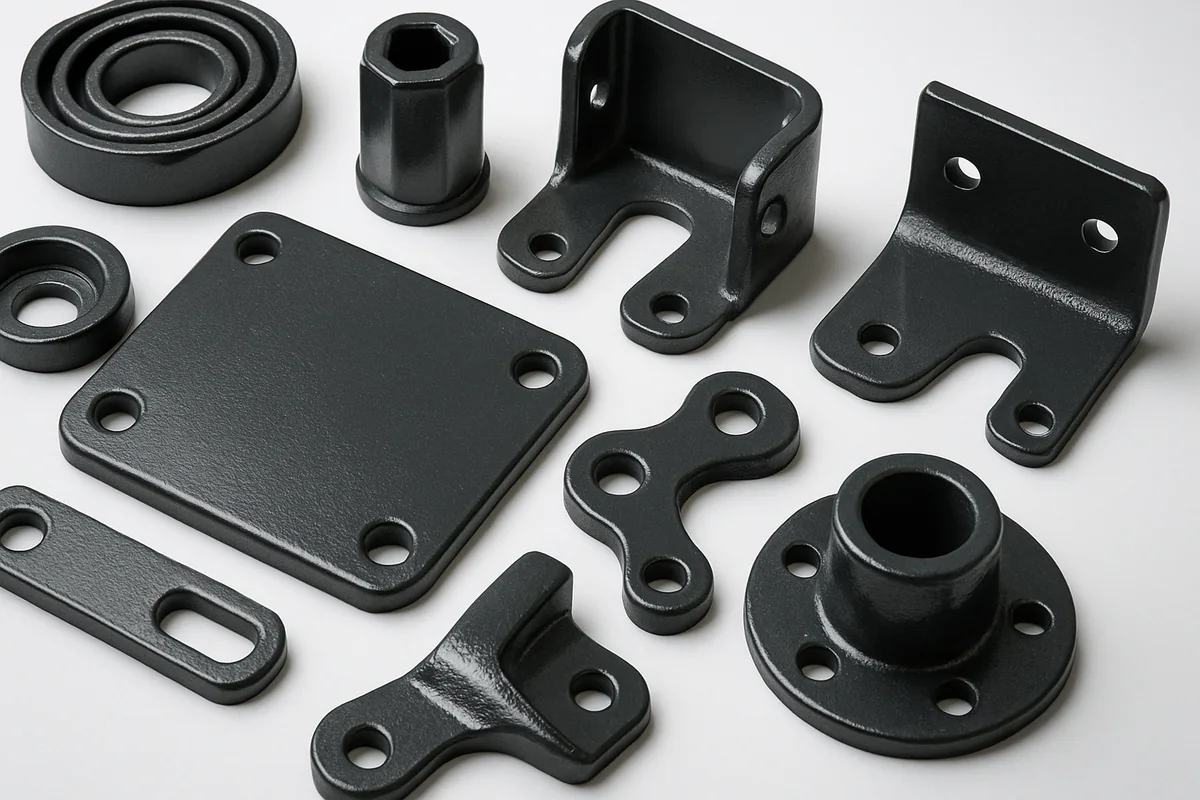
Introduction to E-Coating in Custom Manufacturing
When your project demands consistent, corrosion-resistant finishes on complex metal geometries, e-coating (electrophoretic deposition) stands out as a superior choice. Unlike traditional spray painting or powder coating, e-coating uses electrical current to deposit paint particles uniformly onto conductive surfaces. This process reaches every recess, edge, and cavity, making it ideal for custom parts fabricated at LAVA3DP.
For engineers and product designers seeking reliable surface protection, e-coating delivers exceptional edge coverage, thickness uniformity, and environmental compliance. At LAVA3DP, we integrate e-coating into our custom parts fabrication workflow, serving global clients across automotive, aerospace, medical, and industrial equipment sectors.
E-coating delivers uniform corrosion resistance for custom metal parts. LAVA3DP offers high-volume e-coating services with precise thickness control. Get a quote today for durable finishes.
Get an Instant QuoteHow E-Coating Works: The Electrochemical Advantage
The e-coating process involves four main stages, each critical to achieving a flawless finish:
- Pretreatment – Parts are cleaned, rinsed, and phosphated to remove oils, rust, and contaminants. This step ensures adhesion and corrosion resistance.
- Electrocoating Bath – Parts are submerged in a water-based paint bath containing charged resin particles. A direct current (typically 50–400 volts) is applied, causing paint particles to migrate toward the oppositely charged part.
- Post-Rinsing – Excess paint is rinsed off using ultrafiltrate, recovering nearly 98% of paint solids for reuse.
- Curing – Coated parts are baked at 350–400°F (175–205°C), cross-linking the resin into a hard, durable film.
Cathodic vs. Anodic E-Coating
Two primary e-coating technologies exist:
| Property | Cathodic E-Coating | Anodic E-Coating |
|---|---|---|
| Particle charge | Positive | Negative |
| Part polarity | Cathode (negative) | Anode (positive) |
| Corrosion resistance | Excellent (500–1000+ hrs salt spray) | Moderate (200–400 hrs) |
| Metal ion dissolution | None | Iron/zinc ions leach into bath |
| Typical applications | Automotive bodies, fasteners, outdoor hardware | Interior parts, decorative items |
At LAVA3DP, we exclusively use cathodic e-coating for its superior corrosion protection and bath stability.
Key Advantages of E-Coating for Custom Fabricated Parts
Why choose e-coating over powder coating, liquid spraying, or plating? Here are the quantifiable benefits:
100% Coverage on Complex Geometries
E-coating’s electrical attraction drives paint into blind holes, sharp internal corners, and threaded features. With spray methods, Faraday cage effects leave uncoated areas. E-coating eliminates this risk.
Precise Film Thickness Control
Typical e-coat thickness ranges from 15 to 35 microns (0.6–1.4 mils), with tolerances of ±2 microns across a single part. This consistency prevents fit issues on precision-machined components.
| Coating Method | Thickness Range (microns) | Uniformity (±) |
|---|---|---|
| E-coating | 15–35 | 2–3 microns |
| Powder coating | 50–150 | 25–50 microns |
| Wet spray | 25–75 | 10–20 microns |
Superior Corrosion Resistance
Cathodic epoxy e-coats routinely achieve 500–1,000+ hours of neutral salt spray resistance (ASTM B117) without underfilm corrosion. For comparison, high-quality spray paints typically last 200–300 hours.
Environmental Compliance
E-coating systems recycle rinse water and paint solids, releasing near-zero volatile organic compounds (VOCs). Over 90% of paint solids adhere to parts, versus 40–60% for spray methods. This reduces waste and meets global regulations like RoHS and REACH.
Edge Protection
Sharp edges naturally attract more paint particles, resulting in slightly thicker coating on corners – exactly where corrosion starts. Spray coatings thin out over edges, creating failure points.
Compatible Materials for E-Coating
E-coating requires conductive substrates. At LAVA3DP, we apply e-coating to the following custom parts:
- Steel (hot-rolled, cold-rolled, high-strength low-alloy)
- Stainless steel (300 and 400 series – note that 300 series requires specialized pretreatment)
- Aluminum (with zinc phosphate or zirconium pretreatment)
- Zinc die cast (common for small precision components)
- Copper and brass (decorative or functional coatings)
Note: Non-conductive materials like plastics, ceramics, or composites cannot be e-coated directly. However, electroless nickel plating can render plastic surfaces conductive prior to e-coating – contact LAVA3DP for hybrid solutions.
Common Applications Across Industries
E-coating serves diverse sectors due to its versatility and reliability:
Automotive & Heavy Equipment
- Chassis components, brake calipers, suspension arms
- Engine brackets, fuel system parts
- Fasteners (bolts, nuts, washers) – e-coating prevents thread galling
Medical Devices
- Surgical instrument trays (autoclavable e-coat formulations)
- Hospital bed frames and wheelchairs
- Implantable device housings (biocompatible grades available)
Industrial Machinery
- Gearboxes, pump housings, hydraulic manifolds
- Conveyor rollers, agricultural implements
- Electrical enclosures (NEMA-rated corrosion protection)
Consumer Goods
- Appliance exteriors (washer drums, refrigerator shelves)
- Power tool housings, lawn mower decks
- Furniture frames and shelving systems
Aerospace & Defense
- Brackets, fittings, and structural components (meeting MIL-PRF-85582 and MIL-DTL-53072 specifications)
E-Coating vs. Alternative Finishes: A Data-Driven Comparison
To help you select the right finish, here is a quantitative comparison:
| Property | E-Coating | Powder Coating | Wet Spray Paint | Zinc Plating |
|---|---|---|---|---|
| Typical thickness (µm) | 15–35 | 50–150 | 25–75 | 5–15 |
| Salt spray resistance (hours) | 500–1000+ | 300–800 | 200–400 | 96–200 |
| Edge coverage | Excellent | Poor | Fair | Good |
| Hardness (pencil) | 2H–4H | 2H–3H | HB–2H | Not applicable |
| VOC emissions (g/m²) | <10 | <5 (powder has zero) | 80–200 | 0 (but uses toxic chemicals) |
| Typical cure temp (°C) | 175–205 | 180–200 | Room temp–80 | Room temp |
| Cost per part (relative) | Medium | Medium-High | Low-Medium | Low |
Design Guidelines for E-Coating at LAVA3DP
To achieve optimal results on your custom parts, follow these recommendations:
Drainage and Venting
Avoid closed pockets or cup-shaped features that trap pretreatment chemicals. Add drain holes (minimum 3 mm diameter) or slots to allow bath circulation.
Hanging Points
Designate non-critical surfaces (e.g., hidden flanges or mounting holes) for rack contact. Each part needs electrical connectivity.
Thread Protection
For internal threads, e-coating adds 15–35 microns per surface, reducing minor diameter. Use thread plugs or specify thread tolerances (e.g., 6H/6g with coating allowance). For external threads, e-coating adds thickness to crests and roots – consider roll-formed threads for better consistency.
Masking Requirements
Surfaces that must remain uncoated (press-fit diameters, electrical contact areas, sealing faces) can be masked with tapes, plugs, or silicone caps. LAVA3DP provides precision laser-cut masking for high-volume orders.
Why Choose LAVA3DP for E-Coating Services?
As a global custom parts fabrication platform, LAVA3DP integrates e-coating into a seamless digital manufacturing workflow:
- Instant quoting – Upload your 3D CAD file (STEP, IGES, STL) and select e-coating as the finish. Receive pricing and lead time within hours.
- Material verification – Our engineers check substrate compatibility and recommend pretreatment adjustments.
- Batch traceability – Each part receives a unique identifier for quality tracking from pretreatment to curing.
- Quality assurance – We test coating thickness (ISO 2360), cross-hatch adhesion (ASTM D3359), and salt spray performance (ASTM B117) on sample coupons per batch.
- Global shipping – Parts are packed with anti-tarnish paper and shipped via DHL, FedEx, or UPS to any country.
Getting Started with Your E-Coated Parts
Ready to protect your custom components with high-performance e-coating? Follow these steps:
- Design for manufacturing – Apply the design guidelines above.
- Upload your CAD file to LAVA3DP and choose “E-Coating (Cathodic Epoxy)” under surface finishes.
- Select color – Standard black or gray. Custom RAL colors available for volumes above 500 pieces.
- Review DFM feedback – Our system will flag potential coating issues (e.g., blind holes) and suggest remedies.
- Approve production – We’ll machine or 3D print your parts, then send them to our e-coating line.
- Receive finished parts – Typically 5–7 business days for machining + coating.
For prototypes or low-volume runs (1–100 pieces), e-coating remains cost-effective because we batch parts from multiple clients. No minimum order quantity required.
Get an Instant Quote