

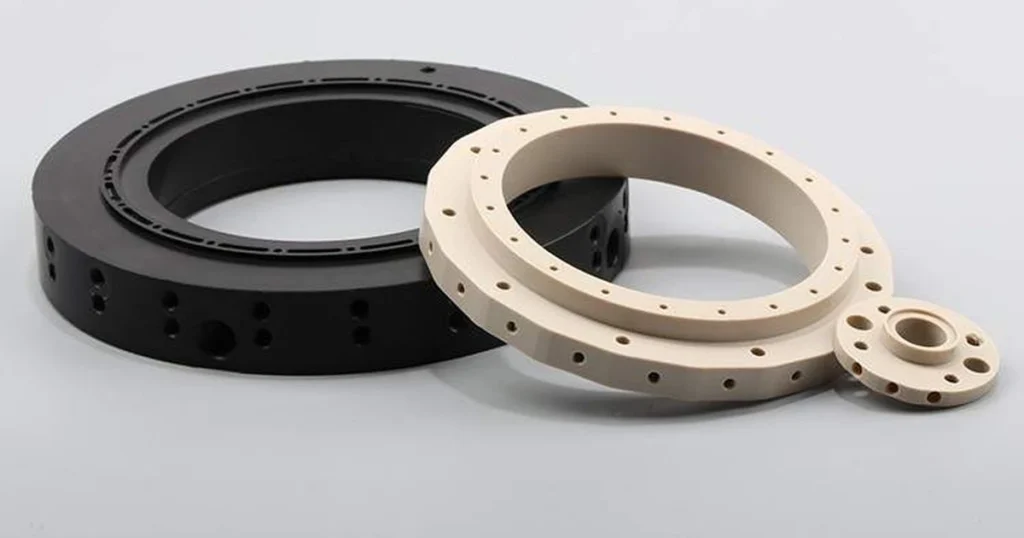
Looking for precision CNC plastic machining ? Read our expert engineering guide covering material selection, tolerances, design tips, costs, and applications. Request your instant quote from Lava3DP today!
Polymer components have largely replaced traditional metals across aerospace, medical, automotive, and industrial machinery sectors. Achieving structural integrity in polymer components requires specialized tooling, controlled thermal management, and tailored geometric strategies. While metals yield predictable chips and dissipate heat directly through swarf, polymers present distinct engineering challenges: high thermal expansion rates, internal stress relief issues, and low softening temperatures.
Understanding how to navigate these material behaviors forms the foundation of reliable production. This comprehensive guide covers key technical parameters, material trade-offs, Design for Manufacturability (DFM) rules, cost drivers, and production methods for custom CNC plastic parts.
What Is CNC Plastic Machining?
CNC plastic machining is a subtractive manufacturing process that uses computer-controlled rotating cutting tools or lathes to selectively remove material from a solid plastic block, rod, or sheet. Unlike thermal processing methods like injection molding or 3D printing, plastic CNC machining operates entirely mechanically without melting the raw stock.
This subtractive approach preserves the intrinsic mechanical, thermal, and chemical properties of engineered polymers. As a result, engineers rely on plastic machining services to produce tight-tolerance components that demand isotropic strength, high surface purity, and structural reliability.
How Does CNC Machining Plastic Work?
Understanding how does CNC plastic machining work requires looking closely at tool geometry, spindle speed, and chip formation:
- CAD Model Preparation: Engineers design a 3D solid model in CAD software, converting physical geometries into precise vector paths.
- CAM Programming: Computer-Aided Manufacturing (CAM) software generates toolpaths, setting feed rates, cutting speeds, stepovers, and depth-of-cut based on the chosen polymer’s physical properties.
- Machine Setup: Operators clamp raw plastic stock into specialized workholding fixtures, using soft jaws or vacuum plates to prevent stock deformation under clamping pressure.
- Subtractive Execution: High-speed spindles drive single-flute or double-flute end mills to carve out the part profile. Specialized chip-breaker geometries extract long, continuous plastic ribbons to prevent heat buildup.
- Quality Verification: In-process coordinate measuring machines (CMM) verify dimensional accuracy against engineering drawings.
CNC Milling vs. CNC Turning for Plastic Parts
| Process Attribute | CNC Milling | CNC Turning |
|---|---|---|
| Primary Motion | Rotating multi-point cutting tool against stationary workpiece | Rotating workpiece against stationary single-point tool |
| Ideal Geometries | Prismatic profiles, pockets, complex 3D surfaces, off-center holes | Cylindrical shafts, bushings, threaded fittings, concentric rings |
| Tooling Consideration | Requires single or double-flute upcut end mills for chip clearance | Requires sharp, polished carbide inserts with high top rake angles |
| Stress Distribution | Intermittent cutting forces; risks surface chatter on thin walls | Continuous cutting force; risks part deflection on slender rods |
Why Choose CNC Machining for Custom Plastic Parts?
- No Tooling Investment: Avoids the upfront steel mold costs ($5,000 to $50,000+) associated with injection molding.
- Tight Tolerances: Achieves dimensional precision down to ±0.001 inches (±0.025 mm), far exceeding 3D printing capabilities.
- Isotropic Material Properties: Uses extruded or compression-molded stock, avoiding layer-adhesion weaknesses inherent in additive manufacturing.
- Rapid Iteration: CAD modifications translate immediately into updated CAM toolpaths, reducing engineering revision cycles.
CNC Plastic Machining Materials
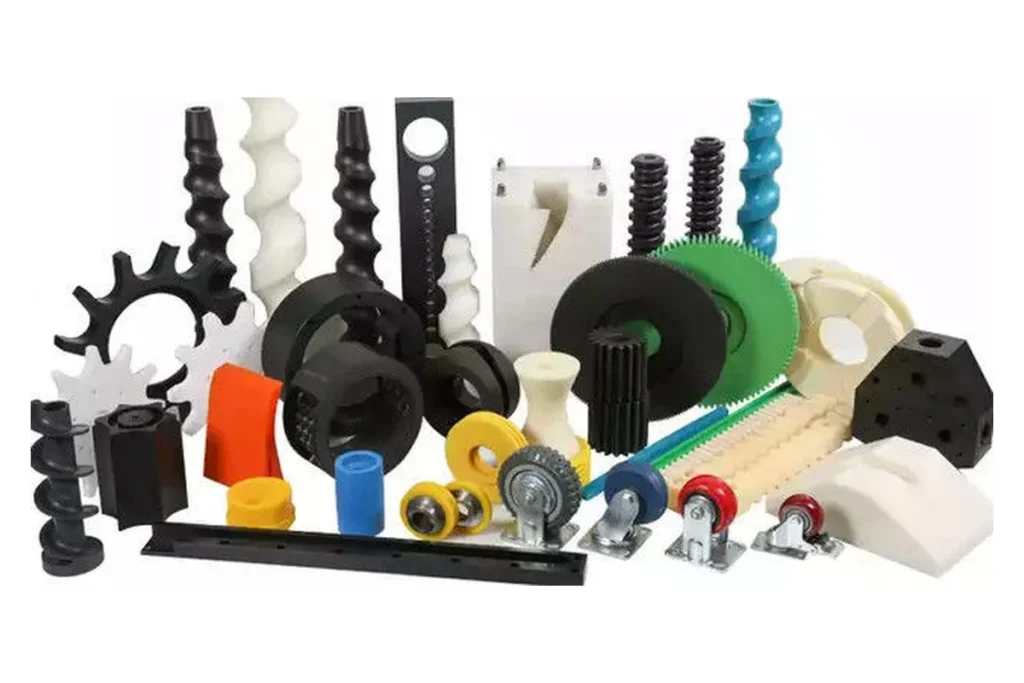
Selecting the correct resin determines wear performance, chemical resistance, electrical insulation, and structural stability. When selecting CNC machining plastic materials, engineers must balance mechanical performance with machinability.
POM (Delrin/Acetal)
Polyoxymethylene (POM), commonly known as Delrin or Acetal, serves as a premier benchmark for precision plastic machining. It features minimal moisture absorption, excellent dimensional stability, and zero internal stress when properly annealed. CNC machining Delrin yields crisp edge retention and burr-free surface finishes, making it ideal for precision gears, bearings, and snap-fit housings.
Nylon (PA)
Polyamide (Nylon) provides exceptional wear resistance, high tensile strength, and impact damping. However, Nylon is highly hygroscopic; it absorbs atmospheric moisture, expanding dimensionally over time. Engineers specifying CNC machining nylon must account for environmental humidity during post-machining operations and avoid using water-based coolants during cutting.
PEEK
Polyetheretherketone (PEEK) represents the top tier of CNC machined engineering plastics. Offering continuous operating temperatures up to 260°C (500°F), outstanding chemical resistance, and high strength-to-weight ratios, CNC machining PEEK is widely specified for aerospace valve seats, medical implants, and semiconductor handling fixtures. Due to its high cost, precise toolpath management is essential to minimize material scrap.
PTFE (Teflon)
Polytetrafluoroethylene (PTFE) offers extreme chemical inertness, high temperature tolerance, and an extremely low coefficient of friction. However, CNC machining PTFE presents distinct challenges: its low modulus of elasticity causes the material to yield easily under cutting tool pressure, and its high thermal expansion rate requires temperature-controlled machining environments.
ABS
Acrylonitrile Butadiene Styrene (ABS) is a cost-effective, versatile resin offering high impact strength, good machinability, and easy post-processing adhesion. CNC machining ABS is extensively used for structural enclosures, automotive interior trim prototypes, and electronic bezels that require painting or chrome plating.
Polycarbonate (PC)
Polycarbonate provides optical clarity alongside high impact resistance. CNC machining polycarbonate requires sharp, highly polished carbide tools to prevent surface clouding and micro-crazing. Post-machining vapor polishing restores internal light transmission, making PC popular for fluidic manifolds, sight glasses, and protective guards.
Acrylic (PMMA)
Polymethyl Methacrylate (PMMA), or Acrylic, offers superior optical transparency and scratch resistance compared to Polycarbonate. However, Acrylic is brittle and prone to chipping under high tool pressure. CNC machining acrylic requires light cut depths, high spindle speeds, and sharp tool edges to yield clean, polished surfaces.
HDPE and Polypropylene (PP)
High-Density Polyethylene (HDPE) and Polypropylene (PP) provide low friction, exceptional chemical resistance, and virtually zero moisture absorption. However, both resins exhibit low heat distortion temperatures and high ductile behavior during cutting. CNC machining HDPE and CNC machining polypropylene require high feed rates and chip-evacuation strategies to prevent heat buildup and material melting around the tool bit.
Related: Casting vs CNC Machining: Cost, Tolerance, Materials, Lead Time & Which Is Better? (2026)
CNC Plastic Machining Tolerances & Accuracy
Achieving sub-thou precision on polymers requires a different operational approach than machining metals. Plastics exhibit low thermal conductivity and low elastic moduli, meaning cutting forces can deflect the workpiece easily if workholding and tool geometries are not carefully controlled.
Standard Tolerances for CNC Plastic Parts
Under ambient room conditions (20°C / 68°F), standard plastic CNC machining tolerance ranges are classified as follows:
| Tolerance Level | Tolerance Range (Inches) | Tolerance Range (Metric) |
| Standard Commercial Tolerance | ±0.005″ | ±0.125 mm |
| Fine Commercial Tolerance | ±0.002″ | ±0.050 mm |
| Precision CNC Plastic Tolerance | ±0.001″ | ±0.025 mm |
What Factors Affect Plastic Machining Accuracy?
- Tool Sharpness: Dull tools exert pushing forces rather than shearing forces, causing material deflection and dimensional drift.
- Clamping Force: Over-tightening vice jaws distorts soft polymers during machining; the part spring-backs into a warped shape once released.
- Cutting Heat Generation: Elevated temperatures cause local thermal expansion, leading to undersized dimensions once the part cools.
- Internal Stress: Extruded stock contains residual manufacturing stress that releases during material removal, causing bow or twist.
Thermal Expansion, Moisture & Material Stability
The Coefficient of Thermal Expansion (CTE) for polymers is roughly 5 to 10 times higher than that of steel or aluminum. A 10°C ambient shift in a shop floor environment can throw tight-tolerance CNC machined plastic tolerances completely out of specification.
| Material | Coefficient of Thermal Expansion (CTE) (10−6 m/m/∘C) |
| Aluminum 6061 | 23 |
| PEEK | 45 |
| Nylon 6,6 | 80 |
| Delrin (POM) | 85 |
| PTFE | 135 |
Additionally, hygroscopic materials like Nylon 6,6 absorb water from ambient humidity, swelling dimensionally up to 1.5% over time. Engineers must specify pre-machining conditioning or select non-hygroscopic alternatives like POM or PEEK when tight environmental tolerances are required.
Tight-Tolerance CNC Plastic Machining
To achieve high precision plastic machining down to ±0.0005 inches (±0.012 mm), shops employ temperature-controlled cleanrooms, stress-relief annealing cycles mid-machining, custom vacuum chucking, and sharp single-crystal diamond or uncoated carbide tooling.
CNC Plastic Machining Design Guidelines
Wall Thickness and Thin-Wall Plastic Parts
Maintain uniform wall thicknesses throughout the component. Minimum wall thickness recommendations vary by material rigidity:
- Rigid Plastics (PEEK, POM, PC): Minimum 0.040 inches (1.0 mm)
- Flexible Plastics (PTFE, HDPE, PP): Minimum 0.060 inches (1.5 mm)
Thin walls deflect away from cutting tools, resulting in chatter marks, wall taper, or material breakthrough.
Internal Corners and Tool Radius
CNC milling tools are cylindrical; they cannot cut sharp 90-degree internal vertical corners. Always incorporate generous internal radii in your CAD model. For instance, if using a 0.250-inch diameter end mill, specify an internal corner radius of at least 0.156 inches (3.96 mm). This design choice allows the tool to sweep smoothly through corners without pausing, preventing localized heat buildup and chatter.
Holes, Threads and Deep Features
- Hole Depths: Keep hole depths within 8 times the drill diameter to ensure proper chip evacuation.
- Threading: Avoid micro-threads smaller than M3 or 4-40 in soft plastics. Use brass thread-inserts or Helicoils when parts require frequent disassembly to prevent thread stripping.
- Deep Pockets: Limit deep pocket depth to 4 times the pocket width to avoid using long, slender tools prone to deflection.
How to Design Plastic Parts for CNC Machining
- Design for Single-Setup Machining: Keep complex features on a single face to minimize repositioning time and datum errors.
- Avoid Undercuts: Special tooling for undercuts increases cycle time and labor costs.
- Provide Reference Surfaces: Design flat parallel surfaces to ensure stable, reliable workholding.
CNC Plastic Machining Cost
Managing project budgets requires a clear understanding of the main cost drivers in plastic machining services.
What Factors Affect CNC Plastic Machining Cost?
When calculating how much does CNC plastic machining cost, machine shop pricing models rely on three primary components:
Material, Part Complexity & Machining Time
How to Reduce CNC Plastic Machining Costs
- Standardize Radii: Use uniform internal fillet sizes across the entire CAD model to minimize tool changes.
- Relax Tolerances: Apply tight tolerances (±0.001″) only to critical functional interfaces, using standard tolerances (±0.005″) everywhere else.
- Optimize Stock Yield: Size raw dimensions to match standard extruded sheet or rod stock sizes to reduce waste.
- Leverage Scale: Transition from single-digit prototypes to low volume plastic CNC machining (50–500 units) to amortize setup costs across the entire run.
Related: CNC Milling vs CNC Turning: Differences, Cost, Tolerances, Applications & Which Is Better? (2026)
CNC Machined Plastic Parts: Surface Finishes & Post-Processing
Post-processing options enhance aesthetic appeal, optical clarity, and surface sealability on custom plastic CNC machining components.
As-Machined Plastic Finish
Fresh off the mill or lathe, an as-machined finish exhibits visible tool mark paths with a surface roughness ranging from Ra 1.6 µm to 3.2 µm (63–125 µin). While functional for non-visible internal brackets, tool paths can harbor fluid contaminants in medical or food-processing applications.
Polishing and Surface Finishing
- Vapor Polishing: Chemical vapor (such as Weld-On 4 or MEK) melts the outer surface layer of Polycarbonate or Acrylic components, yielding optical transparency without physical abrasive contact.
- Mechanical Polishing: Manual buffing compounds smooth out surface tool marks on POM, ABS, and PEEK components.
- Flame Polishing: An oxy-hydrogen flame sweeps across Acrylic edges to rapidly smooth out micro-scratches.
Painting and Other Available Finishing Options
- Bead Blasting: Light glass-bead blasting creates a uniform, matte satin finish that hides minor tool marks on dark resins like ABS or Nylon.
- Texture Coating & Painting: Specialty polyurethane paint systems provide UV protection, soft-touch tactile feel, or custom color matching for visible housing enclosures.
Applications of CNC Plastic Machining
From spaceflight guidance systems to sterile surgical rooms, precision CNC plastic parts deliver reliable mechanical performance across challenging industries.
Automotive & Transportation Components
Automotive engineers select lightweight polymers to reduce vehicle curb weight and improve energy efficiency. Key parts include fuel system bushings, light housing prototypes, sensor brackets, and high-wear suspension wear-pads.
Medical & Healthcare Parts
Biocompatible resins like PEEK, Radel, and UHMWPE withstand repeated autoclave sterilization cycles. Applications range from surgical drill guides and fluidic diagnostic manifolds to implantable trial components.
Electronics & Electrical Components
Plastics offer excellent dielectric properties, thermal insulation, and electromagnetic transparency. Machined components include IC test sockets, semiconductor handling trays, insulator blocks, and high-voltage transformer covers.
Robotics & Automation Parts
Automation equipment requires low rotational inertia and high wear resistance. End-of-arm tooling, vacuum gripper blocks, timing belt pulleys, and protective chain guides are frequently carved from POM and Nylon stock.
Industrial Machinery, Jigs & Fixtures
Lightweight, non-marring plastic fixtures protect delicate metallic workpieces during assembly operations. Assembly jigs, star-wheels, conveyor guides, and wear strips use UHMWPE and Delrin to minimize friction and prevent surface scratching.
Prototypes and Low-Volume Production Parts
Using plastic CNC machining for prototypes enables engineering teams to validate form, fit, and mechanical function prior to committing capital to expensive injection molds.
CNC Plastic Machining vs. Other Manufacturing Methods
Selecting the best production process depends on production batch size, required dimensional tolerances, and structural performance criteria.
CNC Machining vs. 3D Printing
While 3D printing (FDM, SLA, SLS) offers high design freedom for complex internal lattice structures, CNC plastic machining vs 3D printing yields higher mechanical strength, smoother surface finishes, and tighter dimensional tolerances.
| Feature | CNC Plastic Machining | 3D Printing (Additive) |
| Material Strength | Fully isotropic (solid molded stock) | Anisotropic (weak layer-to-layer bond) |
| Tolerance Limits | Tight (up to ±0.001 in / ±0.025 mm) | Moderate (±0.005 to ±0.015 in) |
| Surface Finish | Smooth (Ra 1.6 µm as-machined) | Stepped layer lines visible |
| Production Speed | Fast for medium quantities (1–500) | Fast for single organic shapes |
CNC Machining vs. Injection Molding
When evaluating CNC plastic machining vs injection molding, order volume is the primary deciding factor:
| Production Volume | Preferred Process | Primary Cost Driver |
| Low Volume (1–500 parts) | CNC Plastic Machining | Lower total cost (Zero mold tooling fees) |
| High Volume (5,000+ parts) | Injection Molding | Lower unit cost (Fast cycle times amortize mold cost) |
CNC Machining vs. Vacuum Casting
Vacuum casting (urethane casting) uses 3D-printed master patterns and silicone molds to produce 10 to 50 polyurethane replicas. While vacuum casting offers low initial tooling costs for aesthetic prototypes, CNC machining delivers true engineering-grade resin properties and superior dimensional accuracy for load-bearing parts.
How to Choose the Right Plastic for CNC Machining
Balancing operational environment constraints against raw material costs ensures optimal part performance without over-engineering the material spec.
Strength, Stiffness & Impact Resistance
- High Structural Stiffness: Select PEEK, Ultem (PEI), or glass-filled POM.
- High Impact Strength: Select Polycarbonate (PC), ABS, or UHMWPE.
Temperature & Chemical Resistance
- High Thermal Environments (>150°C): Specify PEEK, PTFE, or Ultem.
- Aggressive Chemical Exposure: Specify PTFE, PEEK, or HDPE to resist harsh acids, bases, and solvents.
Wear, Friction & Lubricity
- Dynamic Sliding Wear: Specify POM (Delrin), Nylon, or UHMWPE. These self-lubricating resins reduce friction and eliminate external lubrication requirements in mechanical assemblies.
Dimensional Stability & Environmental Conditions
- Moisture-Exposed Environments: Avoid Nylon; select POM, PEEK, or PET-P to prevent dimensional swelling and structural softening over time.
CNC Plastic Machining Quality Control & Inspection
Quality control protocols ensure custom plastic parts meet rigid engineering specifications.
Dimensional Inspection & Tolerance Verification
Technicians measure key features using multi-axis Coordinate Measuring Machines (CMM), optical comparators, and calibrated digital micrometers. Probing pressures are reduced on flexible polymers to avoid surface compression during measurement.
Material Verification
Material certificates of compliance (CoC) track raw resin lot numbers back to the resin synthesis factory. Polymer density testing and FTIR spectroscopy verify resin purity and rule out counterfeit materials.
Surface Finish & Visual Inspection
Profilometers measure surface roughness parameters across critical sealing faces. Optical microscopes check for internal micro-cracks, surface burrs, stress crazing, or thermal discoloration caused by cutting tool heat.
Quality Requirements for Precision Plastic Parts
Precision plastic production requires strict compliance with international manufacturing certifications, including:
- ISO 9001:2015: Quality management standard ensuring consistent process controls.
- ISO 13485: Medical device manufacturing standard for critical medical plastic parts.
- AS9100D: Aerospace quality standard for flight-ready polymer components.
Custom CNC Plastic Machining Services from Lava3DP
Lava3DP provides custom plastic CNC machining services engineered to meet demanding technical specifications. By combining multi-axis CNC milling and turning centers with deep material expertise, Lava3DP delivers precision plastic machining components tailored to your application needs.
Upload Your CAD File for a Fast Quote
Streamline your procurement process by uploading your STEP, IGES, or SolidWorks files directly to the Lava3DP online quoting platform. The automated system analyzes geometry, calculates machining toolpaths, and generates a clear cost breakdown within hours.
Material Selection & DFM Support
Not sure which resin best fits your operating environment? The Lava3DP engineering team conducts Design for Manufacturability (DFM) reviews on every project, identifying wall thickness issues, deep pocket constraints, and cost-saving material alternatives before production starts.
Precision CNC Machining for Prototypes and Production
Whether you need a single functional prototype or low volume plastic CNC machining up to 10,000 components, Lava3DP utilizes temperature-stabilized 3-axis, 4-axis, and 5-axis CNC machines to maintain tight tolerances across every production batch.
Global Manufacturing & Shipping
Lava3DP ships inspected, quality-certified custom plastic parts worldwide, providing fully traceable CMM inspection reports, material certifications, and reliable door-to-door delivery. Contact Lava3DP today to discuss your precision plastic machining requirements.
Ready to Manufacturing with LAVA3dp?
Upload your CAD file today and receive instant pricing, expert engineering support, fast production, and worldwide delivery.
Get an Instant Quote →Frequently Asked Questions About CNC Plastic Machining
What plastics can be CNC machined?
Nearly all engineering-grade polymers can be CNC machined. Popular choices include POM (Delrin), PEEK, Nylon, PTFE (Teflon), Polycarbonate, ABS, Acrylic, UHMWPE, HDPE, Polypropylene, and PVC.
What tolerances can CNC plastic machining achieve?
Standard production tolerances range from ±0.005 inches (±0.125 mm). Precision CNC machining setups operating in climate-controlled environments can achieve tight tolerances down to ±0.001 inches (±0.025 mm) or better, depending on material stability.
How much does CNC plastic machining cost?
Costs depend on material choice, part geometry complexity, setup time, and batch size. Simple ABS or Delrin prototypes start around $30 to $100 per part, whereas complex PEEK components requiring 5-axis machining can cost significantly more due to higher raw material fees and extended cycle times.
Is CNC machining better than 3D printing for plastic parts?
CNC machining offers superior mechanical strength, isotropic structural properties, tighter tolerances, and better surface finishes than 3D printing. However, 3D printing is often more cost-effective for single-unit organic shapes or highly complex internal geometries.
Is CNC plastic machining suitable for prototypes and low-volume production?
Yes, CNC machining is ideal for prototypes and low-volume production (1 to 1,000 units) because it requires no upfront mold tooling investment. It allows engineers to quickly test parts made from production-grade resins.
What is the best plastic for CNC machining?
POM (Delrin/Acetal) is widely considered the best overall plastic for CNC machining due to its excellent stiffness, low friction, superior dimensional stability, and clean, burr-free chip formation.