

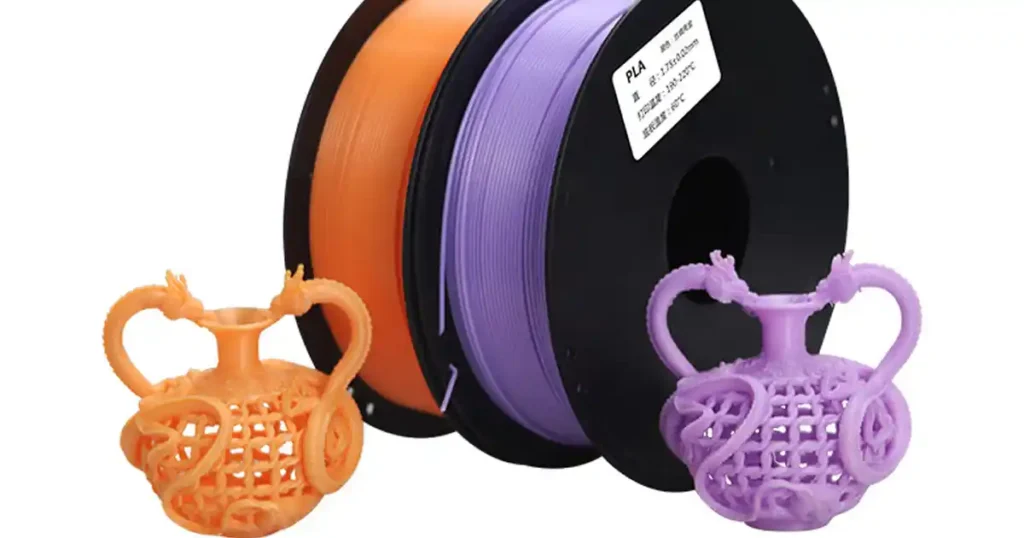
Thermal color change material for 3D printing enables dynamic, temperature-responsive parts. Explore custom fabrication at LAVA3DP. Order your smart prototypes today!
- 1. Introduction to Thermal Color Change Materials
- 2. How Thermal Color Change Material Works
- 3. Advantages of Thermal Color Change Material in 3D Printing
- 4. Available Thermal Color Change Materials for 3D Printing
- 5. Applications Across Industries
- 6. Design Guidelines for 3D Printing with Thermochromic Filaments
- 7. Why Choose LAVA3DP for Thermochromic 3D Printing?
- 8. Future Trends in Smart Thermochromic Additives
- 9. Getting Started with Your Thermochromic Project
- 10. Frequent Asked Questions (FAQs)
- 10.1 What is the typical lifespan of a 3D printed part made from thermal color change material?
- 10.2 Can I order parts with multiple activation temperatures in a single print?
- 10.3 Are thermochromic 3D printed parts food-safe or biocompatible?
- 10.4 How quickly does the color change occur, and does it return to the original color exactly?
- 10.5 What file formats and order quantities do you accept for custom thermochromic parts?
1. Introduction to Thermal Color Change Materials
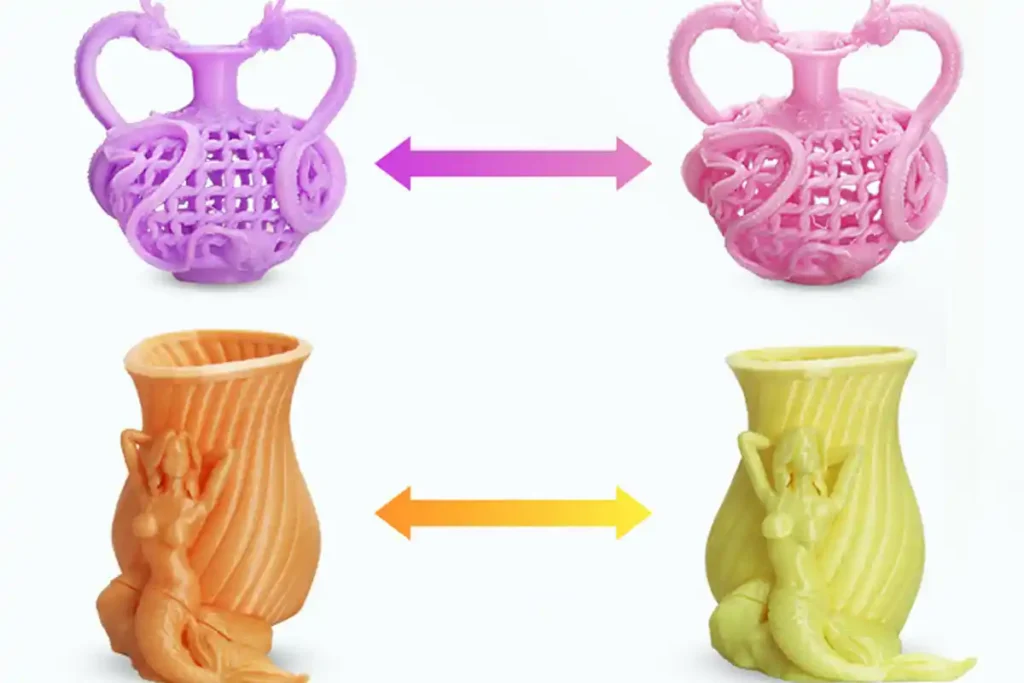
Imagine a component that shifts from deep blue to bright white when it detects overheating. Or a consumer product that visually signals when it has reached the perfect temperature. This is not science fiction—it is the reality of thermal color change material, also known as thermochromic material. These intelligent substances react to temperature variations by altering their molecular structure, which in turn changes how they absorb and reflect light. The result is a reversible color transformation that can be engineered for countless applications.
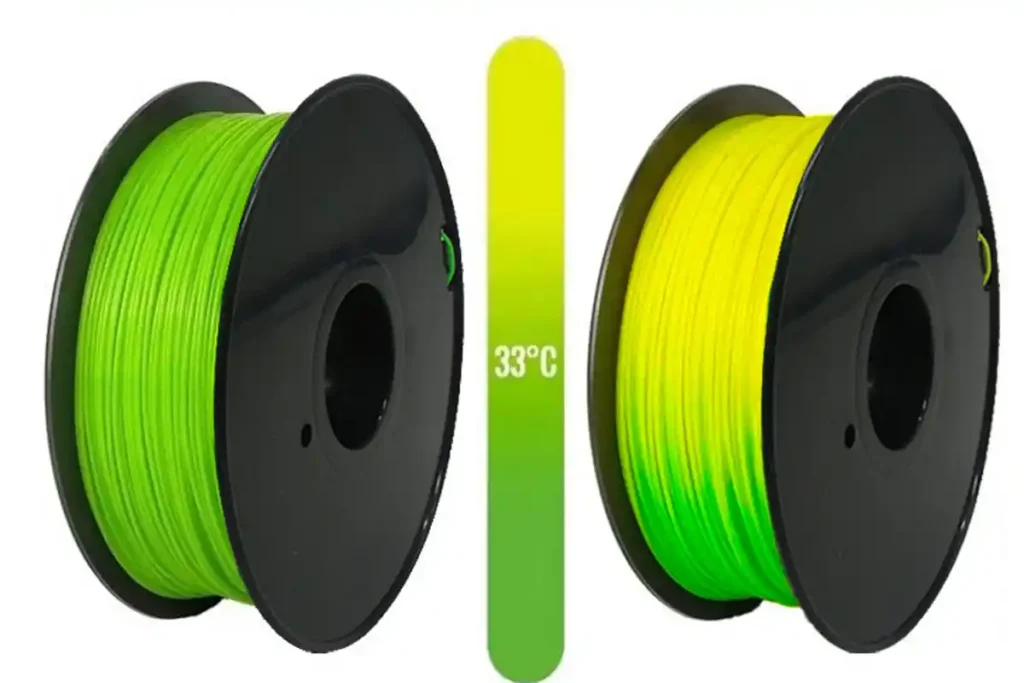
For businesses and innovators seeking custom parts fabrication, integrating thermochromic properties into 3D printed components opens a new dimension of functionality. At LAVA3DP, we specialize in on-demand additive manufacturing using advanced thermal color change material specifically formulated for 3D printing. This article explores the science, advantages, material options, and real-world uses of these smart polymers, along with technical data to guide your next project.
2. How Thermal Color Change Material Works
The mechanism behind thermochromism involves organic compounds such as leuco dyes, liquid crystals, or inorganic pigments embedded in a polymer matrix. At a predetermined activation temperature, these molecules undergo a reversible phase change or structural rearrangement. For leuco dye-based systems—the most common type for 3D printing—the dye exists in a colored state when the polymer is below the threshold. Once heated past the activation point, the dye’s lactone ring opens or the developer dissociates, rendering the material colorless or shifting to a different hue.
Key performance parameters include:
- Activation temperature range: Typically from -15°C to +70°C for commercial thermochromic 3D printing filaments.
- Color transition hysteresis: The difference between heating and cooling transition points, usually 3–10°C.
- Reversibility cycles: High-quality materials withstand over 10,000 cycles without significant degradation.
- Response time: Seconds to minutes depending on part thickness and thermal conductivity.
Below is a chart summarizing typical activation temperatures and color transitions for common thermal color change material grades used in additive manufacturing.
| Material Grade | Cold State Color | Hot State Color | Activation Temp (°C) | Recommended Application |
|---|---|---|---|---|
| Low-Temp Red | Red | Colorless | 31 | Touch indicators, toys |
| Mid-Temp Blue | Blue | White | 43 | Safety labels, electronics |
| High-Temp Green | Green | Yellow | 58 | Industrial monitoring |
| Multi-Stage | Black | Red then Yellow | 35 (red) / 50 (yellow) | Advanced UX feedback |
Table 1: Common thermochromic 3D printing material formulations. Transition sharpness varies with heating rate.
3. Advantages of Thermal Color Change Material in 3D Printing
When compared to traditional manufacturing methods like injection molding, 3D printing with thermochromic filaments offers unique benefits for custom parts fabrication.
3.1 Rapid Prototyping of Functional Designs
You can iterate smart components within hours. Test different activation temperatures by varying the filament blend without retooling. This agility reduces development cycles for products like temperature indicators embedded directly into housings.
3.2 Complex Geometries with Embedded Sensing
Thermochromic material does not require wiring, batteries, or sensors. The entire part becomes the indicator. With LAVA3DP‘s additive manufacturing capabilities, you can print lattice structures, conformal cooling channels, and overhangs that would be impossible with subtractive methods—all while retaining the thermochromic effect.
3.3 Customizable Activation Windows
We adjust the transition temperature from below freezing to above boiling (using different pigment systems). For medical devices, a 37°C activation can signal fever. For automotive under-hood components, a 70°C threshold warns of overheating.
3.4 Cost-Effective Small Batches
Unlike injection molding requiring expensive steel molds, custom parts fabrication with thermochromic 3D printing has zero tooling costs. Quantities from one to thousands remain economical.
3.5 Material Combinations
Thermochromic masterbatch can be blended with standard polymers like PLA, ABS, TPU, or PETG. This allows tuning of mechanical properties—flexibility, impact resistance, or heat deflection—while preserving color-changing behavior.
4. Available Thermal Color Change Materials for 3D Printing
At LAVA3DP, we offer a curated selection of thermal color change material in filament and pellet form, compatible with FDM and pellet-based 3D printers. Each type has distinct characteristics.
4.1 Type A: Leuco Dye in PLA Matrix
- Activation temperatures: 31°C, 43°C, 50°C
- Color options: Red→Colorless, Blue→White, Black→Colorless, Green→Yellow
- Best for: Indoor consumer goods, educational models, decorative lighting
- Printing temperature: 190–220°C
- Impact strength: Moderate (similar to standard PLA)
4.2 Type B: Liquid Crystal Microcapsules in TPU
- Activation range: 25–35°C (rainbow progression)
- Color options: Red→Green→Blue across temperature gradient
- Best for: Wearables, grip surfaces, medical simulators
- Printing temperature: 210–230°C
- Flexibility: Shore 85A to 95A
4.3 Type C: Inorganic Thermochromic in ABS
- Activation temperature: 60°C, 80°C, 110°C
- Color options: Orange→Tan, Gray→White
- Best for: Automotive, industrial machinery, electronics enclosures
- Printing temperature: 240–260°C
- Heat deflection: 98°C @ 0.45 MPa
4.4 Type D: Reversible Multi-Stage Blend (Proprietary)
- Activation steps: 35°C (color A to B), 50°C (B to C)
- Color options: Black→Red→Yellow, Green→Blue→White
- Best for: Advanced user interfaces, safety layers
- Printing temperature: 215–235°C
- UV stability: Enhanced with stabilizers
Table 2: Mechanical properties comparison (values for as-printed test specimens per ASTM D638).*
| Material Type | Tensile Strength (MPa) | Elongation at Break (%) | Flexural Modulus (MPa) | Activation Stability (cycles) |
|---|---|---|---|---|
| PLA + Leuco | 52 | 6 | 3600 | 8,000 |
| TPU + Liquid Crystal | 18 | 450 | 70 | 3,000 |
| ABS + Inorganic | 41 | 15 | 2200 | 20,000+ |
| Multi-Stage Blend | 48 | 8 | 3100 | 5,000 |
5. Applications Across Industries
The versatility of thermal color change material has spurred adoption in diverse sectors. Below are prominent use cases for custom 3D printed parts.
5.1 Consumer Electronics and IoT
- Laptop heat vents: Color shifts from gray to red when internal fans are overwhelmed.
- Phone cases: Patterns that reveal hidden messages when the device warms during charging.
- Smart home sensors: Passive temperature monitors that require no battery.
5.2 Medical and Healthcare
- Fever indicator patches: 3D printed wearable clips that change color at 38°C.
- Surgical tool handles: Thermochromic grips warn of sterilization cycle completion.
- Physical therapy aids: Color-coded bands for hot/cold therapy compliance.
5.3 Automotive and Aerospace
- Dashboard vents: Blue to white transition indicating cabin reaching set temperature.
- Engine bay clips: Permanent overheating history markers (one-way irreversible versions available).
- Cabin interior trim: Interactive surfaces that respond to touch warmth.
5.4 Safety and Industrial Monitoring
- Overheat labels on motors: Replaceable 3D printed tags with 80°C threshold.
- Pipe coupling indicators: Leak detection via localized cooling effects.
- Electrical busbar covers: Visual warning before ignition risk.
5.5 Education and Consumer Products
- Science teaching kits: Demonstrating phase change and thermodynamics.
- Coffee cup sleeves: Logo appears when hot beverage is poured.
- Baby feeding spoons: Color change from blue to white at safe food temperature (40°C).
6. Design Guidelines for 3D Printing with Thermochromic Filaments
To achieve reliable performance from thermal color change material in custom parts fabrication, follow these best practices.
6.1 Wall Thickness and Response Speed
Thinner walls (0.8–1.2 mm) change color faster because heat penetrates quickly. For parts requiring slow, even transitions, design walls above 2.5 mm. Use infill patterns like gyroid or honeycomb at 15–25% to balance strength and thermal diffusion.
6.2 Activation Temperature Placement
The color change threshold is measured at the surface. For internal monitoring, consider printing with dual extrusion—a thermochromic outer layer over a structural core. This maintains mechanical integrity while preserving sensing function.
6.3 Post-Processing Limitations
Avoid annealing or heat treatments above the activation temperature of your thermochromic pigment. Many leuco dyes degrade permanently above 150°C. For smoothing, use chemical vapor smoothing only with compatible materials (e.g., ABS with acetone in cold vapor process below 30°C).
6.4 Environmental Resistance
Most thermal color change material for 3D printing is UV-sensitive. For outdoor applications, request UV-stabilized grades or apply a clear coat with UV blockers. Humidity above 70% can accelerate dye degradation in non-encapsulated systems.
7. Why Choose LAVA3DP for Thermochromic 3D Printing?
LAVA3DP provides end-to-end custom parts fabrication using thermal color change materials. Our digital manufacturing platform handles everything from DFM analysis to quality inspection. Key differentiators include:
- Material library: Over 15 thermochromic formulations with activation temperatures from 25°C to 110°C.
- Precision printing: Layer resolution down to 50 microns ensures sharp color boundaries.
- Rapid turnaround: Standard parts ship within 5 business days; expedited options available.
- Global compliance: Materials meet RoHS, REACH, and FDA food-contact standards where applicable.
- Engineering support: Our team assists with material selection and design optimization.
Whether you need a single functional prototype or 10,000 production parts, LAVA3DP delivers consistent, reversible color-changing components. Upload your CAD file, choose your activation temperature, and receive a part that communicates thermal conditions at a glance.
8. Future Trends in Smart Thermochromic Additives
Research into thermal color change material continues to advance. Emerging developments include:
- Narrow-hysteresis pigments (<2°C difference) for precision medical applications.
- Thermochromic conductive composites that change color and electrical resistance simultaneously.
- Biobased thermochromic polymers from renewable sources with full recyclability.
- Multi-spectral materials shifting in both visible and infrared ranges for camouflage.
As additive manufacturing evolves, LAVA3DP remains at the forefront, testing and qualifying next-generation smart materials for our customers.
9. Getting Started with Your Thermochromic Project
Ready to integrate temperature-responsive intelligence into your designs? Follow these steps:
- Define requirements: Desired activation temperature(s), color pair, mechanical loads, and environmental exposure.
- Request a quote: Upload 3D models (STEP, STL, or 3MF) to LAVA3DP.
- Material selection: Our engineers recommend the optimal thermal color change material from our library.
- Prototype and validate: Receive test samples within days.
- Scale to production: Seamless transition from prototyping to batch manufacturing.
For technical consultations or to discuss custom pigment development, contact our smart materials team today.
10. Frequent Asked Questions (FAQs)
10.1 What is the typical lifespan of a 3D printed part made from thermal color change material?
The lifespan depends on the material type and usage conditions. Leuco dye-based thermochromic filaments (e.g., PLA blends) typically maintain reliable color change for 8,000 to 10,000 cycles under normal indoor conditions. Inorganic pigment systems (e.g., ABS blends) exceed 20,000 cycles. Exposure to UV light, high humidity, or temperatures above 80°C accelerates degradation. For long-term outdoor applications, LAVA3DP recommends UV-stabilized grades with a protective clear coating.
10.2 Can I order parts with multiple activation temperatures in a single print?
Yes. Using multi-extrusion 3D printing, LAVA3DP can fabricate parts with different thermal color change material formulations in distinct zones. For example, a medical device could have a 37°C indicator on one surface and a 45°C warning on another. Alternatively, our proprietary multi-stage material changes color twice—for instance, black→red at 35°C and red→yellow at 50°C—within the same homogeneous part. Discuss your requirements during the design review.
10.3 Are thermochromic 3D printed parts food-safe or biocompatible?
Select formulations meet FDA food-contact standards (21 CFR) and ISO 10993 biocompatibility for skin contact. However, standard thermal color change material contains leuco dyes and developers that are not rated for ingestion or prolonged internal implantation. For food applications such as reusable spoons or coffee sleeves, specify “food-contact grade” when ordering. LAVA3DP provides certificates of compliance upon request. Always validate with your specific use case.
10.4 How quickly does the color change occur, and does it return to the original color exactly?
Response time depends on part thickness and thermal conductivity. A 1 mm thick wall changes color in 2–5 seconds when placed on a 50°C surface. Cooling back to the original color takes 10–30 seconds in room-temperature air. Reversibility is excellent—over 95% of original color intensity returns after each cycle, though slight fading (less than 5% per 1,000 cycles) occurs in leuco dye systems. The transition is not perfectly sharp; expect a 3–5°C range where color shifts gradually.
10.5 What file formats and order quantities do you accept for custom thermochromic parts?
LAVA3DP accepts STEP, IGES, STL, OBJ, and 3MF files. Minimum order quantity is one piece—ideal for prototyping. For production runs, we offer volume discounts starting at 50 units. Maximum part dimensions are 500 x 500 x 500 mm for FDM printing with thermochromic filaments. Larger assemblies can be printed in segments and bonded. Upload your design through our contact page or directly on the website to receive an instant quote and design for manufacturability feedback.