

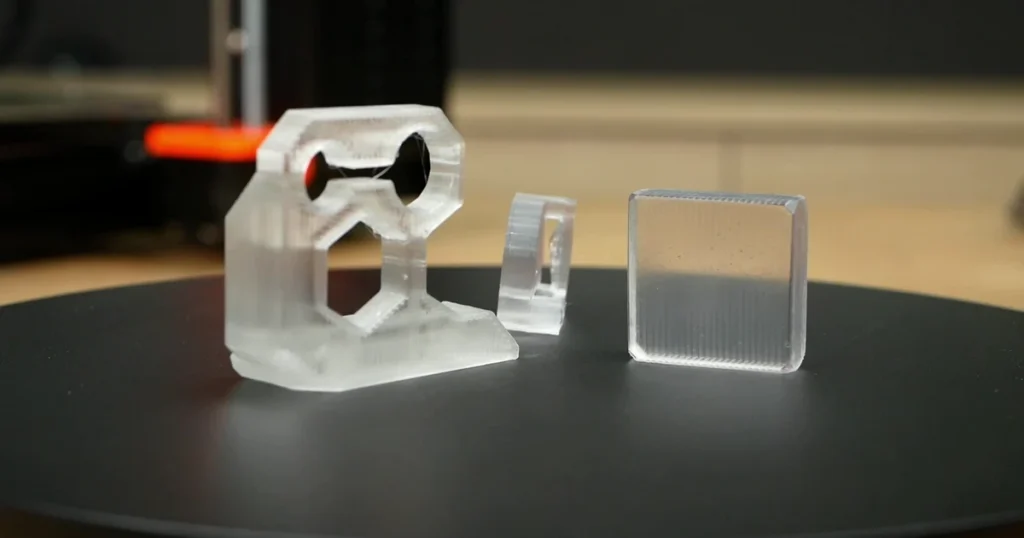
Additive manufacturing transforms CAD models into physical plastic parts within hours. Achieving true visual transparency in printed parts presents specific engineering challenges. Light traveling through a 3D print encounters internal boundaries, micro-voids, and surface roughness. These features scatter light rays and turn transparent resins or filaments milky white.
Engineers and product designers frequently need transparent 3D printing service options to evaluate clear enclosures, fluidic channels, or light pipes before committing to injection molding tooling. Understanding how technology selection, resin chemistry, layer bonding, and post-processing alter light transmission helps you obtain production-grade clarity on your custom parts.
What Is Transparent 3D Printing?
Transparent 3D printing refers to additive fabrication processes that create components capable of transmitting light without significant scattering. Achieving this state requires controlling the internal structure and surface finish of the printed part.
Transparency vs. Translucency in Printed Parts
Distinguish visual transparency from translucency when setting part specifications:
- Transparent 3D printed parts permit light to pass through with minimal deflection. Objects behind a transparent resin 3D printing part remain clearly visible, sharp, and recognizable.
- Translucent parts allow light transmission but diffuse the rays as they pass through the material. Objects behind a translucent part appear blurred or obscured.
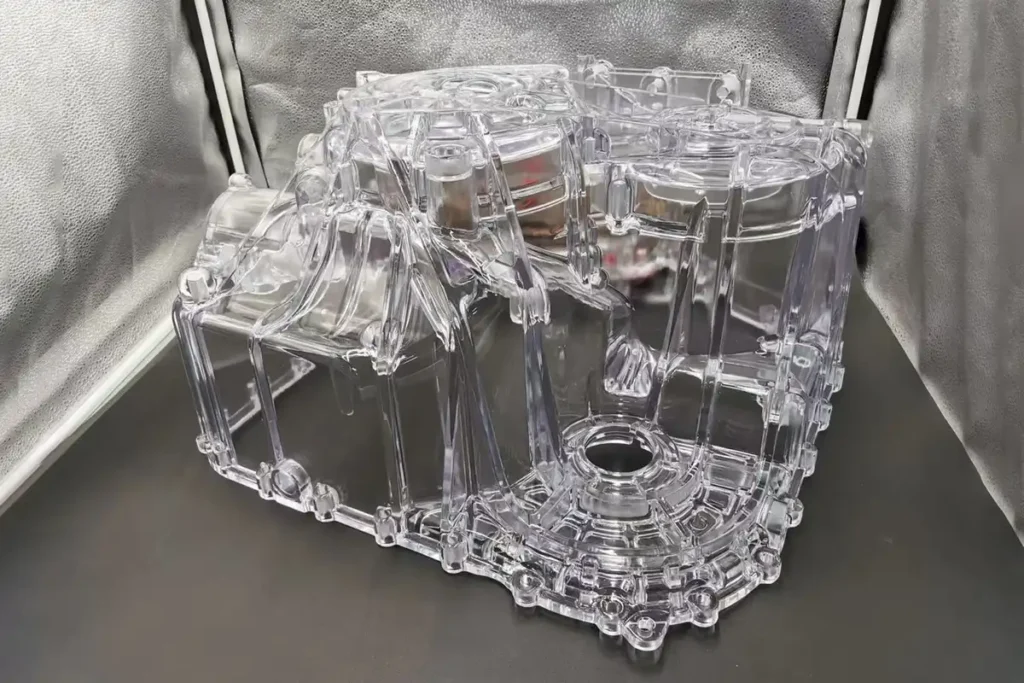
Standard FDM output using clear filaments produces translucent parts due to internal layer boundary reflections. SLA transparent 3D printing achieves true optical clarity when paired with complete post-processing workflows.
Factors Affecting Light Transmission
Material chemistry and printing mechanics dictate the final light transmission 3D printed parts achieve. Refractive index variations across the bulk material create internal diffusion. When light passes through alternating layers of resin or melted polymer, subtle density differences at the interfaces bend light rays.
Microscopic air pockets trapped between toolpath lines scatter incoming light. Surface roughness acts as millions of tiny prisms on the exterior walls. Eliminating both internal voids and external surface imperfections remains essential to remove cloudiness from clear 3D prints.
Visual Clarity vs. Optical-Grade Performance
A clear 3D printed prototype polished to visual clarity looks identical to acrylic or glass on a desktop. Visual clarity allows inspectability of internal mechanical features, fluid movement, or internal LED illumination.
Visual transparency differs from true optical clarity 3D printing standards required for precision lenses or imaging systems. Additive layers leave microscopic refractive boundaries inside the core geometry. These internal features introduce slight wave-front distortions and chromatic aberration. Clear prints serve exceptionally well for light guides, sight glasses, cover lenses, and fluidic blocks, but high-precision imaging optics still require cast acrylic or polished glass.
Related: Micro SLA 3D Printing: Technology, Materials, Accuracy, Applications & Cost Guide
Can You 3D Print Transparent Parts?
Yes, you can 3D print transparent plastic components that approach the clarity of polished acrylic. Modern additive systems yield parts with exceptional transparency when you match the right technology with disciplined post-processing.
What Modern Additive Manufacturing Achieves
Photopolymer resin systems produce dense, isotropic structures with near-zero internal voiding. SLA 3D printing produces parts with complete internal homogeneity. When you apply clear resin 3D printing to flat or smooth geometries, light passes directly through the part body. FDM printers yield lower clarity due to layer interface geometry, though PETG and PC filaments offer functional translucency for light-diffusing covers.
Why Parts Look Cloudy Right Out of the Printer
Freshly printed SLA parts appear cloudy, frosted, or milky straight off the build platform. This cloudiness stems from two specific phenomena:
- Micro-roughness on the surface: SLA lasers cure resin in discrete step layers (typically 25 to 100 microns). These micro-steps refract incoming light at unpredictable angles.
- Residual liquid resin: Uncured photopolymer clinging to the surface scatters light before it enters the cured structure.
FDM prints display extreme cloudiness because air gaps between adjacent filament tracks create thousands of internal refraction surfaces.
Setting Expectations for Clarity and Finish
Achieving crystal-clear results requires realistic expectations regarding part geometry and manual finishing steps. Complex internal channels, deep recesses, and intricate lattice structures resist mechanical polishing and clear coating. Exterior flat or convex surfaces polish to full optical transparency rapidly. Complex geometries maintain functional light transmission while retaining slight translucency in hard-to-reach internal cavities.
Related: PolyJet 3D Printing Technology for High-Precision, Multi-Material Prototypes
Best Materials for Clear 3D Printing
Selecting appropriate transparent 3D printing materials depends on required optical clarity, temperature resistance, impact strength, and mechanical loads.
Clear Resin for SLA 3D Printing
Clear photopolymer resin represents the best resin for transparent 3D printing when visual transparency forms the primary design goal. SLA clear photopolymer resin cures into a solid, isotropic mass without internal layer gaps.
- Surface Detail: SLA resins capture feature details down to 0.05 mm, making them perfect for precise mating surfaces and clear enclosures.
- Clarity Potential: Offers the highest transparency among all 3D printing materials. Fully polished clear resin matches acrylic (PMMA) clarity.
- Applications: Fluidic devices, visual demonstration models, clear housings, light pipes, and prototype lenses.
- Finishing Requirements: Requires IPA washing, UV post-curing, progressive wet sanding, and clear acrylic spray application or high-speed buffing.
Clear PLA and PETG Filaments
FDM process users rely on clear PLA 3D printing and clear PETG 3D printing for functional prototypes requiring basic light pass-through.
- Clear PLA: Easy to print with minimal warping. Offers high stiffness but lower thermal stability. Clear PLA prints appear translucent or frosted due to layer boundaries.
- Clear PETG: Excellent chemical resistance and higher impact strength than PLA. Clear PETG 3D printing delivers superior optical clarity compared to PLA when printed with thick layer heights, high extrusion temperatures, and zero cooling fan speeds.
- Limitations: FDM toolpaths leave visible internal layer lines that block direct line-of-sight transparency.
Other Light-Transmitting Materials
High-performance applications utilize specialized filaments and resins:
- Polycarbonate (PC): High heat resistance and extreme impact strength. Yields tough translucent covers but requires high-temperature extruders.
- Polypropylene (PP): Excellent chemical inertness for laboratory fluid contact, yielding flexible translucent containers.
- Acrylic (PMMA) Injection Molding / CNC: When applications demand zero internal wave-front distortion, perfect optical performance, or certified safety-critical structural properties, traditional CNC machining from acrylic blocks outpaces additive methods.
Material Comparison Table
| Material | Optical Clarity Potential | Surface Finish | Durability & Toughness | Typical Applications | Finishing Requirements |
|---|---|---|---|---|---|
| SLA Clear Resin | Exceptional (Crystal Clear) | Ultra-Smooth (Post-finished) | Moderate / Rigid | Lenses, light guides, transparent 3D printed enclosures | Washing, UV cure, wet sanding, clear coat / polishing |
| Clear PETG (FDM) | Moderate (Translucent) | Visible Layer Lines | High Impact & Chemical Resistance | Diffusers, protective shields, fluid containers | Heat treatment, resin dipping, minimal sanding |
| Clear PLA (FDM) | Low to Moderate (Frosted) | Rigid / Layered | Brittle / Low Thermal | Low-cost prototype housings, display models | Light sanding, clear spray coating |
| Polycarbonate (FDM) | Low to Moderate (Translucent) | Industrial / Rough | Superior Toughness & Thermal Resistance | High-temp light covers, impact guards | Heavy mechanical post-processing |
Best 3D Printing Technologies for Transparent Parts
Choosing between SLA vs FDM transparent 3D printing processes determines your workflow, turnaround time, and final part transparency.
SLA 3D Printing for Clear Prototypes
Stereolithography (SLA) uses a UV laser or digital projector to cure liquid photopolymer resin layer by layer. Can SLA 3D printing produce clear parts? Absolutely. SLA stands as the premier additive choice for custom clear resin prototypes.
Because liquid resin cures into a fully dense solid, SLA prints lack the internal void networks inherent to extruded thermoplastic filaments. Light passes directly through the part volume without internal reflection walls scattering the beam. SLA 3D printing handles thin walls, tight tolerances, and smooth outer skins with precision, serving as the foundation for custom transparent 3D printed parts.
FDM 3D Printing for Translucent Parts
Fused Deposition Modeling (FDM) extrudes molten thermoplastic through a heated nozzle. As the nozzle deposits individual round tracks of plastic, microscopic air gaps form between adjacent lines and stacked layers.
These micro-voids act as light-scattering barriers throughout the body of the print. While clear PETG vs clear PLA testing shows PETG produces clear prints when over-extruded at high temperatures, FDM output remains translucent rather than optically clear. FDM suits budget-friendly enclosures, light diffusers, and mechanical prototypes where internal visibility takes precedence over visual perfection.
Process Selection Matrix
Evaluate trade-offs across key design constraints:
- Transparency Requirements: SLA yields crystal-clear transparency. FDM delivers frosted, translucent light transmission.
- Geometry Constraints: SLA supports complex internal channels and fine exterior detail. FDM struggles with delicate features and thin vertical clear walls.
- Mechanical & Environmental Demands: FDM thermoplastics (PETG, PC) offer higher impact strength and temperature resistance than standard photopolymer resins.
- Cost vs. Finish Time: Raw FDM printing costs less per part but requires extensive work to achieve basic clarity. SLA clear resin 3D printing price points reflect higher material expenses but yield immediate visual quality after standard clear resin polishing and coating steps.
Related: Continuous Fiber 3D Printing: Reinforced Additive Manufacturing (2026)
How to Make 3D Prints Clearer
Achieving crystal clarity on transparent prints requires structured post-processing. Learning how to make resin 3D prints transparent and how to make 3D prints clear relies on eliminating exterior surface scattering.
Sanding and Polishing
Surface rough spots bend light rays entering and exiting your component. Progressive wet sanding removes layer steps and flattens the outer face:
- Start with 400-grit wet sandpaper: Remove visible layer lines and support tags while keeping the part wet to prevent deep scratches.
- Progress through finer grits: Move sequentially through 600, 800, 1000, 1500, and 2000-grit wet sandpaper. Flush away slurry between stages.
- Apply polishing compounds: Use a micro-abrasive acrylic polishing paste with a soft microfiber cloth or high-speed rotary buffing wheel to buff out microscopic scratches.
This sequence details how to polish clear resin 3D prints to achieve a high-gloss, optically transparent surface.
Clear Coatings and Resin Coating
When manual polishing proves difficult on complex geometries, clear coatings offer a fast path toward visual clarity:
- Clear Spray Coating: Spraying 2–3 light coats of high-gloss UV-resistant acrylic or polyurethane clear spray fills surface micro-scratches instantly. The clear lacquer matches the refractive index of cured photopolymers, smoothing the outer boundary.
- Resin Dipping / Coating: Dip the cleaned part into liquid clear photopolymer resin, let excess resin drain off, and cure under UV light. This fills surface valleys and creates a smooth outer shell. Ensure coating thickness does not compromise tight dimensional tolerances.
Washing, Curing, and Surface Preparation
Proper chemical cleaning prevents surface clouding:
- Isopropyl Alcohol (IPA) Wash: Wash SLA prints in clean 99% IPA for short intervals. Prolonged soaking in dirty IPA leaves dissolved resin residue that creates a sticky white film upon drying.
- Controlled UV Curing: Under-cured resin remains soft and cloud-prone. Over-curing under intense UV light causes yellowing in clear resins. Follow exact cure times recommended by material manufacturers to preserve clarity.
Related: Laser Cutting Services: Process, Materials, Tolerances, Design Guide, Applications & Cost (2026)
Applications of Transparent 3D Printed Parts
Additive manufacturing enables specialized applications for clear components across product design and engineering validation.
Enclosures and Housings
Engineers create transparent 3D printed enclosures and custom 3D printed transparent enclosure components to inspect internal gear alignments, PCB fitting, indicator lights, and mechanical clearances without removing protective covers.
Light Guides and Optical Components
Custom 3D printed light guides redirect light from internal LEDs to exterior control panels. A polished 3D printed transparent lens or light pipe channels illumination across product assemblies efficiently.
Microfluidic Devices and Manifolds
A 3D printed fluidic channels manifold allows researchers and hydraulic engineers to observe fluid flow paths, air bubble accumulation, and valve operation in real time. Clear SLA resin seals internal chambers against high-pressure leaks.
Product Development Prototypes
Leveraging transparent 3D printing for product development lets design teams present clear 3D printed prototype models to stakeholders, verifying aesthetic appeal and internal functional layouts before investing in mass production tooling.
Optical Testing Validation Notice
While prototype lenses and transparent components serve visual inspection and testing needs, safety-critical optical systems (such as automotive headlight lenses or medical endoscopes) require application-specific mechanical, thermal, and optical validation to verify long-term resistance to environmental stress and UV degradation.
How Much Does Transparent 3D Printing Cost?
Understanding transparent 3D printing cost structures helps you allocate prototyping budgets effectively while optimizing CAD geometry for manufacturing.
Primary Cost Drivers
- Part Dimensions and Material Volume: Liquid clear photopolymer resins cost more per liter than standard opaque resins. Conserving volume through shell modeling or hollow cores lowers raw resin expenses.
- Geometry and Print Orientation: Complex overhangs require support structures. Orienting parts to minimize support touchpoints on critical optical faces preserves visual quality and reduces post-processing labor.
- Material Selection: Standard clear resin pricing remains affordable. High-temp or optical-grade specialty resins increase material expense.
- Post-Processing Labor: Manual wet sanding, diamond polishing, and multi-stage clear coating drive labor hours. Simple clear-sprayed parts cost substantially less than hand-polished optical components.
- Production Lead Time: Expedited turnaround schedules require prioritized printer queue scheduling and dedicated hand-finishing stations.
Obtaining Accurate Project Pricing
Because manual finishing requirements vary based on surface roughness standards and complex geometries, static price calculators provide incomplete estimates. Requesting an instant quote with your actual CAD geometry ensures precise price calculation based on part volume, orientation, and finishing tiers.
Custom Transparent 3D Printing Services from Lava3DP
Outsourcing production to a dedicated clear resin 3D printing service provides access to industrial-grade SLA machinery, optimized material formulations, and expert finishing technicians.
Advantages of Professional Clear-Part Manufacturing
Internal desktop printers often struggle with air bubbles, yellowing during UV curing, and labor-intensive manual polishing. Lava3DP utilizes industrial SLA 3D printing platforms to manufacture high-precision custom transparent 3D printed parts featuring tight dimensional tolerances and uniform clarity.
Material Capabilities and Instant Quoting
Lava3DP’s specialized SLA production facility handles high-clarity clear resins designed for visual transparency, fluid testing, and clear housings. By uploading your 3D CAD files to the automated platform, you receive instant pricing, material recommendations, and customizable finishing selections. Explore available 3D printing materials.
Order Custom Clear Resin Parts
Whether you require a single clear 3D printed prototype for design review or small-batch custom clear resin prototypes for field testing, professional manufacturing ensures reliable optical results. Submit your CAD geometry to Lava3DP today to evaluate material suitability, review finishing options, and order clear resin 3D prints tailored to your engineering specifications.
Ready to Manufacturing with LAVA3dp?
Upload your CAD file today and receive instant pricing, expert engineering support, fast production, and worldwide delivery.
Get an Instant Quote →Conclusion
Achieving visual clarity in additive manufacturing relies on combining SLA technology with proper post-processing techniques. Selecting clear resin over extruded thermoplastics eliminates internal void scattering, while progressive sanding and high-gloss clear coatings eliminate exterior surface refraction. Matching your part geometry to the right post-processing workflow unlocks crystal-clear prototypes for testing and visual demonstration.
Frequently Asked Questions
Can you 3D print transparent objects?
Yes, you can 3D print transparent plastic components using SLA printing with clear photopolymer resin. When fully wet-sanded and polished or clear-coated, these parts achieve visual transparency comparable to acrylic.
What is the best material for transparent 3D printing?
Clear photopolymer resin used in SLA printing represents the best material for high transparency. For lower-cost functional parts where translucency is acceptable, clear PETG filament offers strong mechanical toughness.
Why are my clear 3D prints cloudy?
Clear 3D prints appear cloudy due to surface micro-roughness from layer lines and light scattering from microscopic internal air gaps. Applying proper wet sanding, polishing, or a clear spray coat restores visual clarity.
How do you make resin 3D prints transparent?
To make resin prints transparent, wash the un-cured resin thoroughly in clean IPA, cure the part under UV light, wet-sand the surface progressively up to 2000-grit, and apply a gloss acrylic clear coat or polishing compound.
Is SLA or FDM better for transparent 3D printing?
SLA is significantly better for transparent parts because liquid resin cures into a solid, gap-free structure. FDM prints retain internal air voids between extrusion tracks, rendering parts translucent rather than transparent.
Can you 3D print clear plastic?
Yes. SLA printing uses clear acrylic-based liquid resins, while FDM printing utilizes clear plastic filaments like PETG, PLA, and Polycarbonate to create clear or light-transmitting components.
How much does transparent 3D printing cost?
Pricing depends on part size, resin volume, geometric complexity, and the level of post-processing required. Simple clear-coated SLA parts cost slightly more than standard resin prints, while hand-polished optical components incur additional labor fees.
Can 3D printed transparent parts be used for lenses?
Transparent 3D printed parts function well as light diffusers, cover lenses, and prototype light pipes. Precision optical imaging lenses generally require cast acrylic or polished optical glass to prevent wavefront distortion.
What are transparent 3D printed parts used for?
Transparent prints are used for clear electronic housings, light guides, fluidic manifolds, sight glasses, anatomical models, and functional prototypes where internal visibility is required.
Can I order custom transparent 3D printed parts from Lava3DP?
Yes, Lava3DP provides custom clear resin 3D printing services. You can upload your CAD file to their online quoting platform to check material compatibility, select surface finishes, and place your order.