

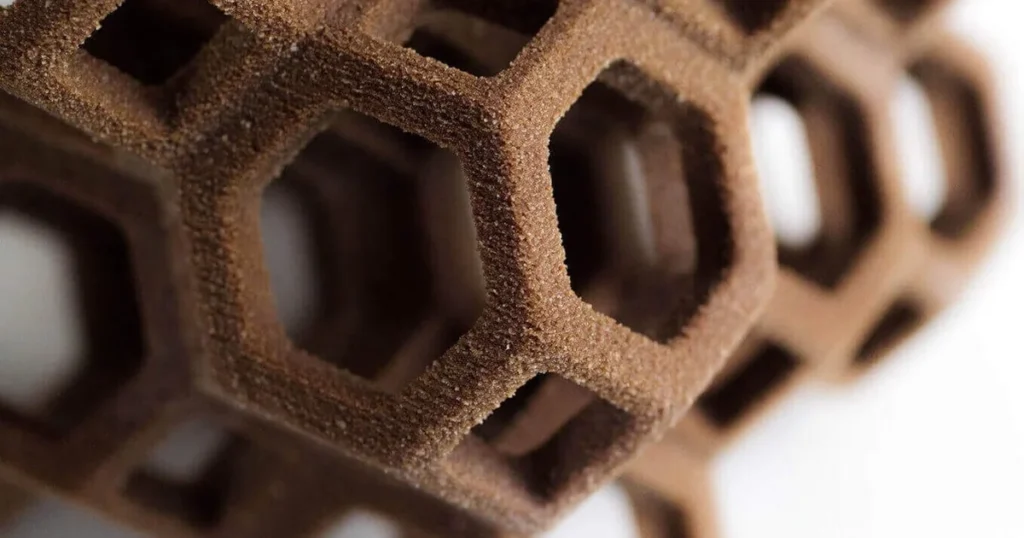
Master chocolate 3D printing with our engineering guide. Learn tempering science, hardware specs, software workflows, and printer costs before buying. Contact Lava3DP today to request an instant quote for your custom edible prototyping project!
Traditional confectioners spend years mastering the art of tempering, pouring, and hand-carving cocoa creations. Modern additive manufacturing changes the game completely. With a specialized chocolate 3d printer, bakeries, commercial food labs, and industrial confectioners transform complex digital CAD models into intricate, edible structures that physical molds simply cannot replicate.
Whether you plan to scale up personalized confection manufacturing or add custom edible graphics to high-end restaurant desserts, buying a chocolate 3d printer requires a clear understanding of rheology, thermal dynamics, and mechanical hardware. This guide breaks down everything you need to know about chocolate 3d printing before investing in a machine or outsourcing your production.
What Is Chocolate 3D Printing?
How a Chocolate 3D Printer Works
At its core, chocolate 3d printing relies on paste-based liquid deposition, a specialized offshoot of additive manufacturing. Unlike traditional plastic extruders that melt solid filaments, a specialized machine loads liquid paste into a temperature-controlled cartridge. A stepper motor or pneumatic pump applies direct pressure to extrude fine traces of tempered paste onto a build plate. The material deposits layer by layer, solidifying rapidly through precise ambient cooling to build complex three-dimensional objects.
Chocolate 3D Printing vs Traditional Chocolate Molding
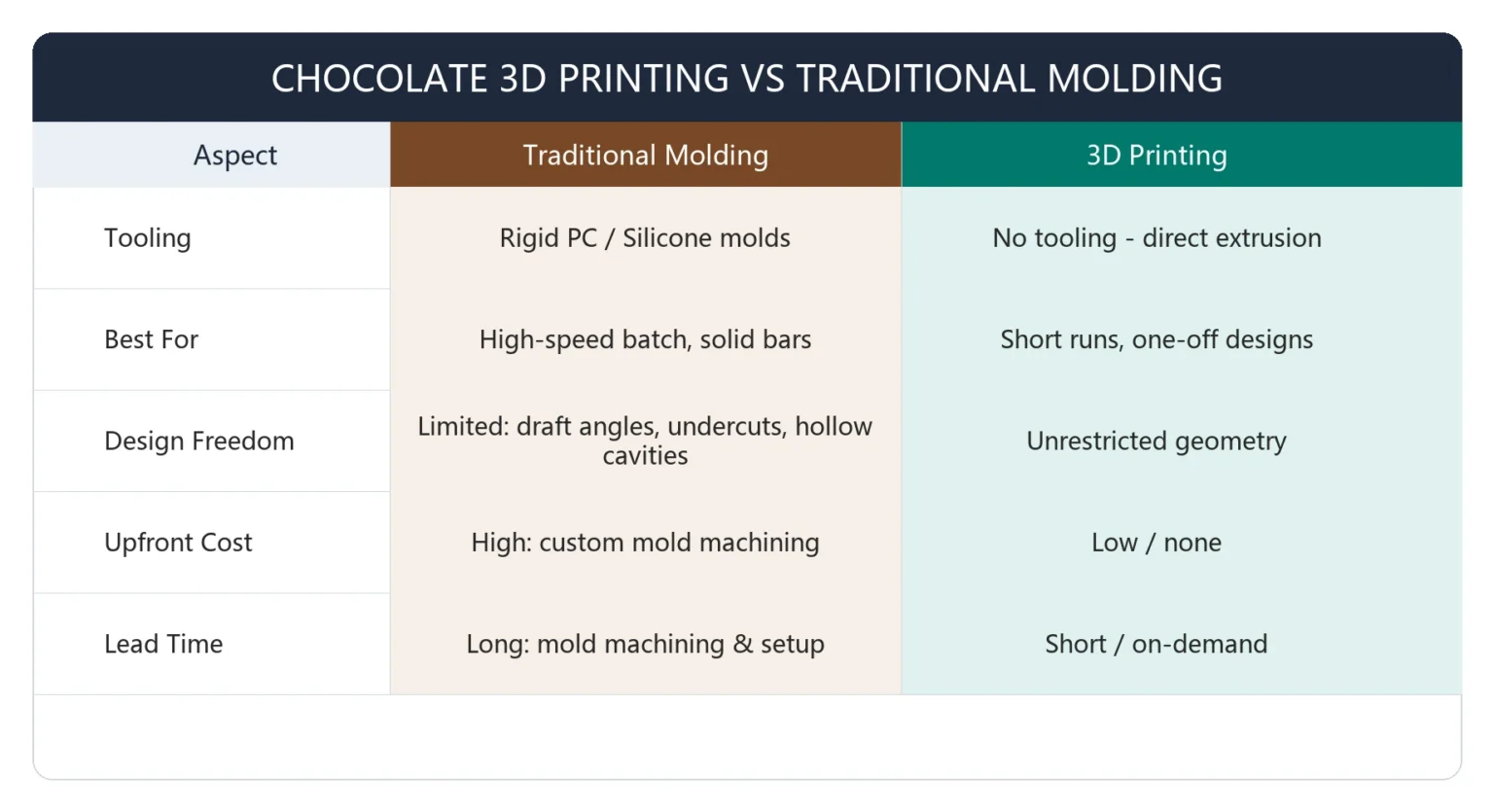
Traditional confection production depends on rigid polycarbonate or silicone molds. Molds excel at high-speed batch runs for solid bars, but they suffer from severe design constraints. Draft angles, undercuts, and hollow internal cavities limit what a mold can release. Direct edible fabrication via extrusion bypasses tooling entirely. You bypass the high upfront costs and long lead times of custom mold machining, making short runs and one-off designs economically viable.
Related: 3D Printed Beyblade: How to Design, Print, and Battle Like a Pro
Why Chocolate 3D Printing Is Growing in the Food Industry
Consumer demand for personalized experiences drives rapid adoption across food additive manufacturing. Modern buyers want bespoke wedding favors, branded corporate gifts, and allergen-controlled specialized treats. Direct digital food manufacturing gives businesses the agility to design, print, and ship custom orders on the same day without retooling assembly lines.
Types of Chocolate 3D Printers
Consumer Chocolate 3D Printers
Consumer-grade units focus on simplicity and desktop operation. These small machines typically use pre-filled chocolate cartridges and simple push-button interfaces. While limited in build volume and thermal calibration, a desktop 3d printer for candy serves well for hobbyists, small bakeries, and educational demonstrations.
Professional Chocolate Printing Machines
Designed for artisanal bakeries and pastry kitchens, a professional chocolate printer features precise thermal control loops, replaceable stainless steel syringes, and open-source slicer compatibility. These machines accept raw chocolate off the shelf, providing full control over viscosity, printing speed, and layer heights.
Commercial Chocolate 3D Printers
A commercial chocolate 3d printer scales up output with multi-cartridge systems, automated build plate cleaning, and integrated cooling systems. Commercial kitchens and boutique candy brands deploy these units to run semi-automated production lines capable of producing hundreds of personalized units daily.
Industrial Chocolate Printing Systems
At the enterprise scale, an industrial chocolate printer integrates continuous mass-feeding hoppers, multi-axis robotic arms, and conveyer-belt systems. These systems plug directly into digital food manufacturing environments for high-throughput custom manufacturing.
Multi-Food and Edible 3D Printers
Multi-material platforms expand beyond cocoa paste. A versatile 3d printer for chocolate and food handles additional pastes including sugar frosting, marzipan, dough, and fruit purees. Investing in a multi-use food 3d printer or edible 3d printer gives culinary labs maximum flexibility across diverse recipe development.
Chocolate 3D Printing Process Explained
Creating the CAD Model
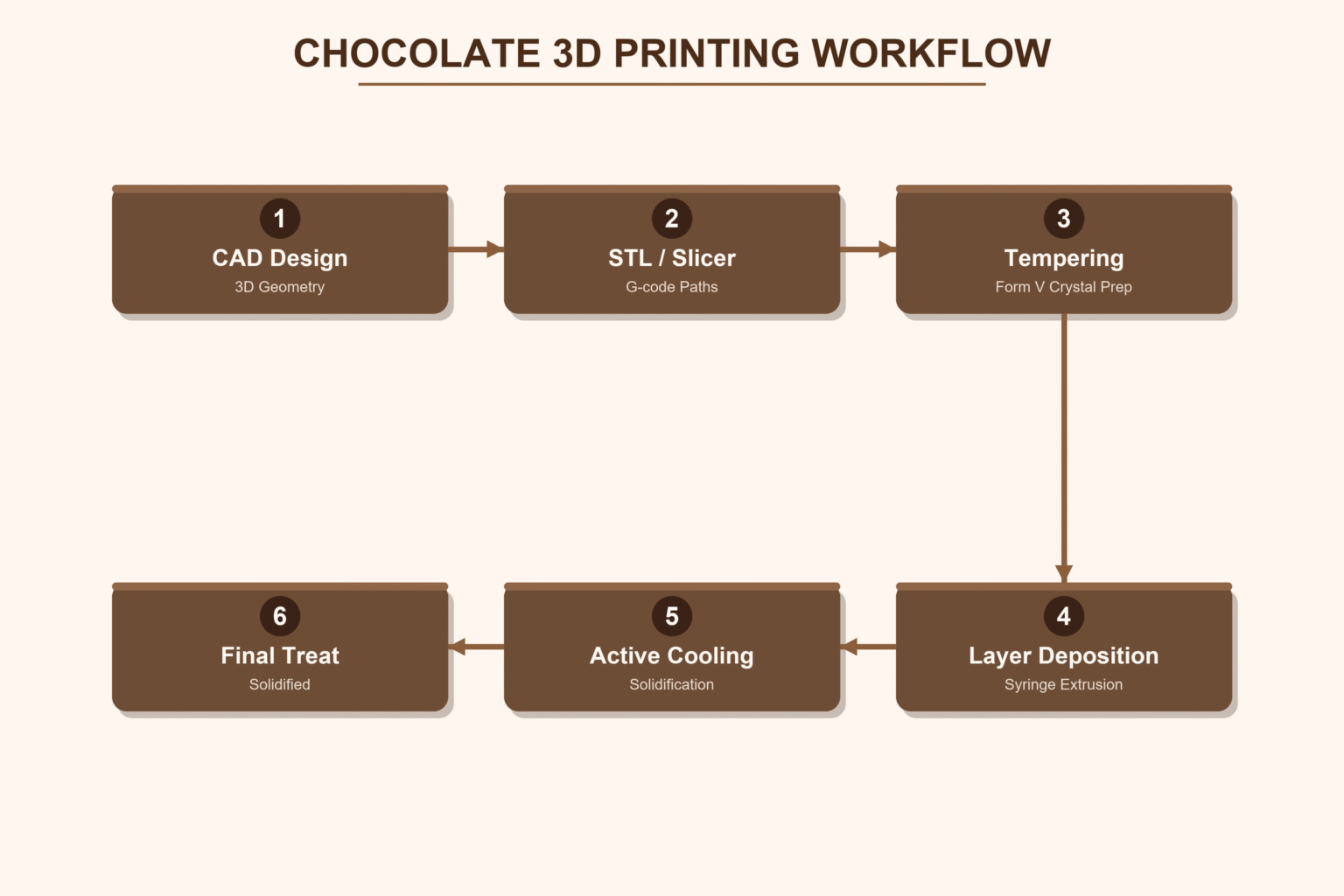
Every print starts in computer-aided design software. Engineers and pastry chefs draft solid models optimized for self-supporting geometry. Designing an edible structural model requires careful attention to center-of-gravity placement and structural weight distribution.
Preparing STL Files and G-code
Once the 3D geometry finishes, export the design as an STL file. Slicing software converts the vector model into toolpath lines recorded in G-code. This file instructs the printer on movement speed, layer thickness, retraction distances, and precise extrusion rates.
Chocolate Preparation and Tempering
You cannot simply melt candy and expect structural integrity. You must prepare cocoa paste through precise thermal staging to create stable Form V fat crystals. Properly tempered paste flows smoothly through small orifices and sets instantly upon deposition.
Extrusion Printing Layer by Layer
During the core chocolate 3d printing process, the heated syringe unit maintains the material at its exact working temperature. The motor pushes the drive plunger, forcing material through the food-grade nozzle onto the build plate. The layer-by-layer manufacturing sequence repeats continuously until the entire height completes.
Cooling, Solidification and Finishing
Controlled thermal dissipation locks the structure in place. Active cooling airflow stabilizes the lower layers as the higher sections stack on top. Once complete, the finished piece undergoes final inspection before packaging or plating.
Related: 43 Personalized 3D Printed Gifts Ideas That Make Every Occasion Special
Chocolate Materials Used for 3D Printing
Dark Chocolate
Dark chocolate stands out as the easiest material for additive production. Its high cocoa butter concentration and low dairy content yield stable viscosity profiles across a wider temperature window (31°C to 32°C), providing excellent structural rigidity for tall vertical walls.
Milk Chocolate
Milk chocolate poses higher handling challenges due to added milk fats and dairy solids. These fats lower the melting point and soften structural stability. Printing milk chocolate demands tighter temperature control (29°C to 30°C) and aggressive cooling during extrusion.
White Chocolate
Containing zero cocoa solids, white chocolate relies purely on cocoa butter, sugar, and milk solids. It exhibits high fluid mobility when warm and collapses easily under its own weight. Successful printing requires careful formulation adjustments to increase shear resistance.
Cocoa Butter and Specialty Chocolate Blends
Pure cocoa butter acts as a carrier medium for specialized formulations. Some operators mix extra butter to reduce paste thickness, while others add fat-soluble food colorings. Operators often search for chocolate filament for 3d printer setups; however, true filament spools do not exist for paste extrusion. Instead, raw chocolate gets melted into standardized pellets or liquid charges before cartridge loading.
Food-Safe Ingredients and Additives
Formulators sometimes mix natural starches or emulsifiers (such as soy lecithin) into raw recipes. These additions stabilize flow characteristics, minimize stringing between travel moves, and prevent phase separation inside heated barrels during extended print jobs.
Chocolate Tempering and Printability
Why Tempering Is Essential
Untempered chocolate cools into a dull, soft paste that blooms with white fat streaks and collapses under mild pressure. Tempering creates stable Beta V (Form V) polymorph crystals inside cocoa butter. This specific crystal structure gives finished pieces a clean glossy shine, firm structural snap, and high thermal resistance at room temperature.
Chocolate Viscosity Explained
Viscosity measures liquid flow resistance. Chocolate behaves as a non-Newtonian fluid with shear-thinning properties. Under mechanical shear inside a narrow extrusion channel, its internal resistance drops, allowing smooth flow. Once deposited on the build plate, the shear stress drops to zero, and the material must firm up immediately to hold shape.
Viscosity Characteristics:
High Shear (Inside Nozzle) –> Lower Viscosity –> Smooth Extrusion
Zero Shear (On Build Plate) –> Higher Viscosity –> Rapid Form Retention
Ideal Printing Temperatures
Thermal precision separates successful edible fabrication from absolute failure. Operating outside the target temperature window by even 0.5°C ruins print accuracy.
| Chocolate Type | Meltdown Temp (°C) | Tempering Temp (°C) | Printing Working Window (°C) |
| Dark Chocolate | 45°C – 50°C | 27°C – 28°C | 31.0°C – 32.5°C |
| Milk Chocolate | 42°C – 45°C | 26°C – 27°C | 29.5°C – 30.5°C |
| White Chocolate | 40°C – 43°C | 25°C – 26°C | 28.0°C – 29.0°C |
Cooling Chamber Requirements
Ambient temperature control dictates success. Setting an internal enclosure or directional ducting system between 16°C and 18°C pulls heat out of freshly laid tracks quickly without causing thermal shock or unwanted condensation.
Common Tempering Mistakes
- Overheating: Destroying stable Beta crystal seeds by exceeding 33°C.
- Under-cooling: Depositing material before sufficient crystal seeds form, causing structural sagging.
- Moisture Contamination: Introducing water drops into raw material, causing immediate paste seizure.
Related: How to Make 3D Printed Molds for Silicone, Resin, and Small Batch Production
Chocolate 3D Printer Components
Syringe Extruder Systems
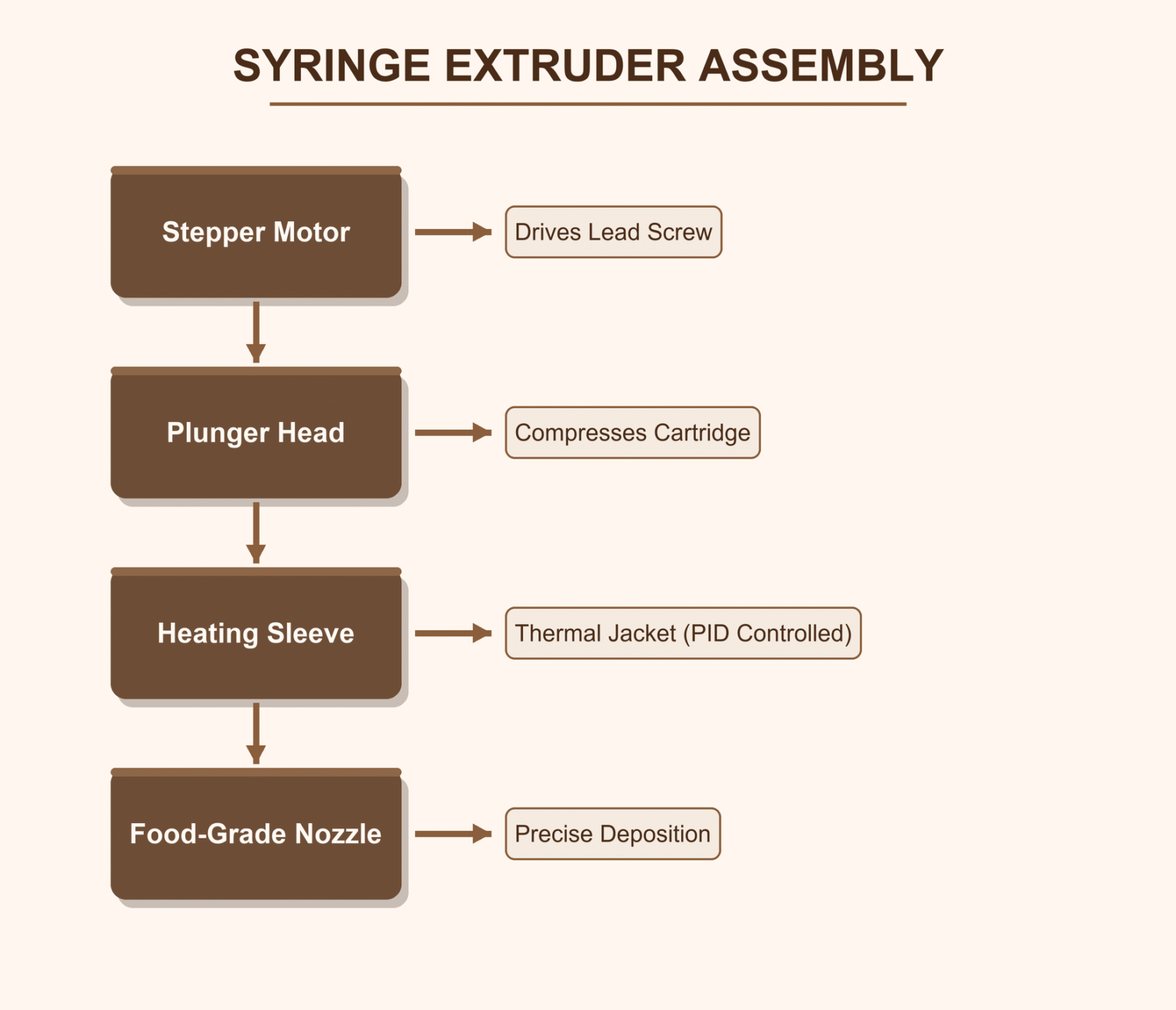
The core mechanical assembly utilizes a syringe extruder powered by a lead-screw stepper motor or direct pneumatic pressure. Stepper-driven lead screws offer superior volumetric accuracy and precise retraction control, eliminating messy drips during non-printing transit moves.
Food-Grade Nozzles
Material exits through a specialized chocolate 3d printer nozzle made from food-safe materials like 316 stainless steel or anodized aluminum. Diameters range from 0.4 mm for ultra-fine decorative detail up to 1.5 mm for high-speed commercial production.
Heated Extrusion System
PID-controlled heating elements enclose the syringe cartridge. Dual thermal sensors continuously monitor barrel conditions, preventing hot spots that destroy tempering while maintaining fluid mobility across the entire barrel volume.
Motion System and Build Platform
Cartesian (X/Y/Z) and Delta frame architectures provide precise positioning. Heated build plates with removable glass surfaces simplify post-print removal and sanitation procedures.
Cooling System
Directed dual fans or Peltier cooling manifolds blast cold, dry air straight at the nozzle tip. This spot-cooling freezes the freshly deposited track before the weight of upper layers deforms it.
Software and Printer Controls
Onboard microcontrollers manage thermal feedback loops, spatial motion algorithms, and extrusion pressure. Touchscreen interfaces let operators adjust flow rates and temperatures in real time during live operations.
Best Chocolate 3D Printing Software
CAD Design Software
Standard parametric tools like Autodesk Fusion 360, SolidWorks, and Tinkercad handle edible modeling well. Designers must maintain flat base surfaces and avoid extreme overhangs when creating geometry for paste extrusion.
STL File Preparation
Mesh inspection utilities like Autodesk Netfabb or Meshmixer fix manifold errors, close holes, and repair inverted normals before slicing. Non-manifold meshes cause slicing software to generate corrupt toolpaths that ruin prints mid-job.
Slicing Software
Slicing programs such as Cura, PrusaSlicer, or Simplify3D require custom profiles tuned specifically for paste rheology. Key custom profile adjustments include disabling retractions or mapping custom G-code delays to handle viscous fluid dynamics.
Printer Calibration Settings
- Layer Height: Typically set to 50%-80% of nozzle diameter (e.g., 0.4 mm height for an 0.8 mm nozzle).
- Print Speed: Restricted to 15–40 mm/s to allow adequate cooling between passes.
- Flow Rate: Calibrated precisely to prevent over-extrusion blobs or under-extrusion gaps.
Chocolate 3D Printer Design Guidelines
Minimum Wall Thickness
Thin features collapse easily under internal weight. Maintain a minimum wall thickness equivalent to at least two perimeter extrusion passes (minimum 1.6 mm when using a standard 0.8 mm nozzle).
Overhang and Support Considerations
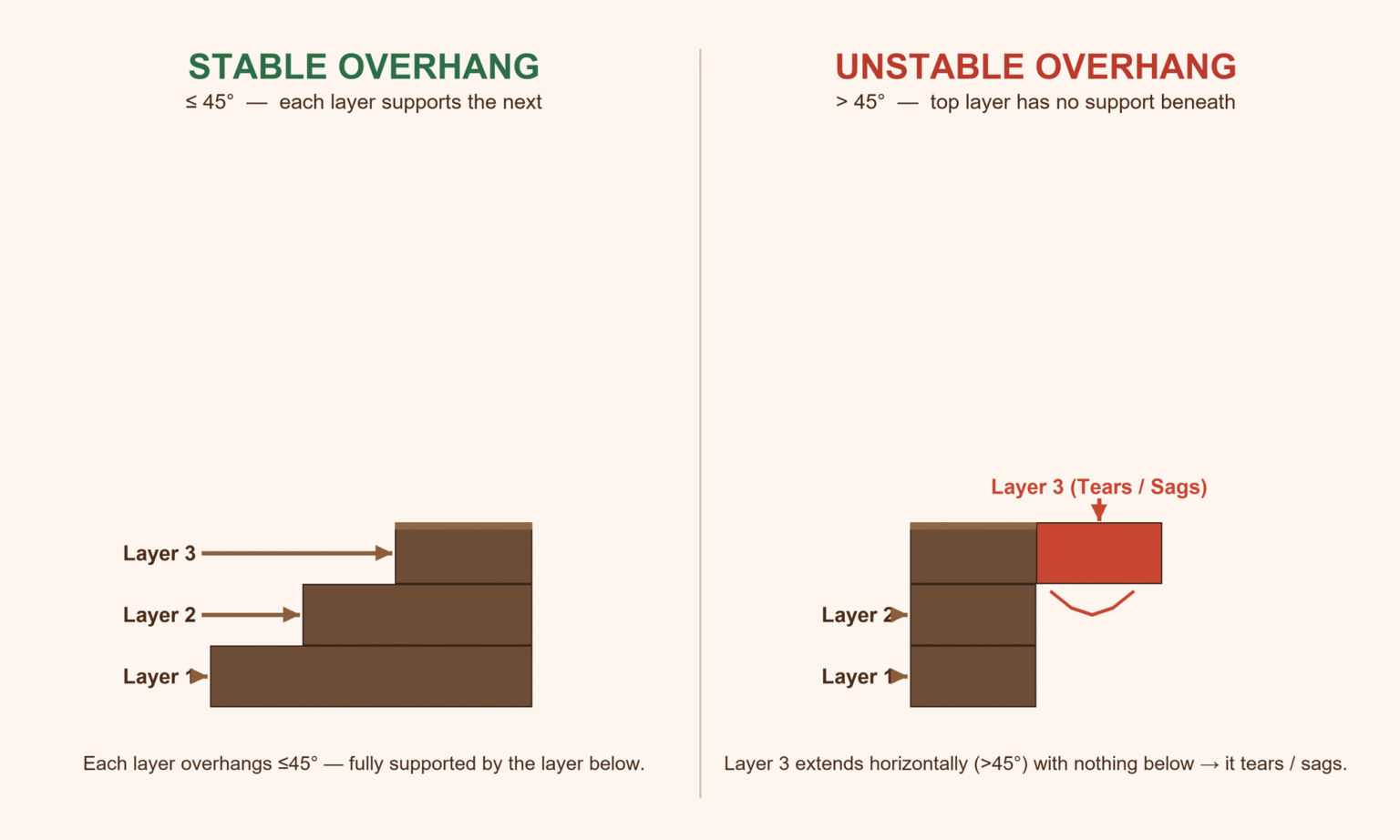
Unlike standard plastics, soft edible material cannot utilize removable support structures without ruining visual appearance and surface finish. Limit overhang angles to 45 degrees or lower. Use bridging techniques sparingly over short distances (under 10 mm).
Detail Resolution
Fine facial features or text below 2 mm font size blur together due to fluid surface tension. Design broad geometry and crisp outline contours to maximize visual impact.
Recommended Layer Heights
Optimum settings balance visual fidelity against structural build time. A 0.6 mm layer height using an 0.8 mm nozzle offers the ideal balance between structural stability, layer adhesion, and surface finish.
Optimizing Print Time
To prevent thermal collapse during extended print jobs, add cooling pauses between layers or print multiple parts simultaneously on the build plate. Distributing layers across several parts gives each piece extra time to solidify.
Chocolate 3D Printing Applications
Bakery Products
A dedicated bakery chocolate printer allows pastry chefs to top custom cakes, donuts, and pastries with geometric lattices and intricate cake toppers that set their menus apart from competitors.
Personalized Chocolate Gifts
Boutique confectioners print customized name plaques, anniversary gifts, and holiday novelties on demand, eliminating expensive custom tooling for short-run items.
Restaurants and Fine Dining
High-end chefs use a restaurant food printer to construct architectural dessert components that add dramatic flair to plated desserts.
Luxury Confectionery
Artisanal chocolatiers combine traditional ganache fillings with printed external shells, creating unique textures and visual designs impossible to achieve with traditional molds.
Wedding and Event Chocolates
Event planners deliver personalized table favors featuring custom dates, guest names, or intricate structural themes for weddings and corporate galas.
Corporate Branding
Businesses upload vector corporate logos to print edible branded marketing gifts for trade shows, VIP packages, and product launches.
Food Research and Development
Food scientists utilize rapid prototyping to evaluate structural geometries, test sugar-reduction formulas, and investigate texture perception in food design.
Culinary Education
Modern gastronomy academies use digital food manufacturing equipment to train students in advanced structural culinary techniques and food computer science.
Related: 10 Best Resin 3D Printers in 2026: Tested Picks for Every Budget
Industries Using Chocolate 3D Printing
Food Manufacturing
Large industrial plants deploy automated arrays to manufacture customized seasonal lines alongside their primary mass-production tracks.
Hospitality
Luxury hotels, resorts, and cruise ships produce custom amenities in-house, surprising VIP guests with personalized room treats.
Retail Confectionery
Flagship candy stores place printing hardware front-and-center in customer viewing areas, turning order fulfillment into an engaging retail experience.
Food Automation
Automated kitchens integrate robotic cartesian paste extruders to streamline dessert decoration without requiring manual piping skilled labor.
Product Development
Corporate R&D departments utilize 3D systems to model, evaluate, and present new physical confectionery concepts within hours instead of waiting weeks for custom tooling.
Edible Prototyping
Design studios render real physical samples of proposed candies to evaluate weight, aesthetics, and package fit before investing in expensive mass-production molds.
Benefits of Chocolate 3D Printing
Unlimited Design Freedom
Additive manufacturing handles complex internal voids, interwoven lattices, geometric meshes, and mathematical wireframes that cannot be released from traditional molds.
Mass Customization
Print 100 completely distinct pieces in a single batch without changing physical hardware. Every single item on the build plate can carry a unique name or design at zero additional setup cost.
Reduced Material Waste
Cartridge systems deposit material strictly where needed according to file coordinates. Unused cocoa paste stays inside the sealed syringe barrel without contamination or scrap waste.
Faster Product Development
Take a concept from an initial vector sketch to a physical edible product in under two hours. Rapid feedback cycles let teams iterate and refine designs fast.
Personalized Manufacturing
On-demand local manufacturing minimizes finished goods inventory storage risks. You print exact order quantities as purchases arrive.
Digital Food Production
Storing designs as digital CAD files eliminates physical mold storage, lowering facility overhead while making custom recipes accessible globally via simple file transfers.
Limitations and Challenges
Temperature Sensitivity
Minor ambient temperature changes ruin print quality. Operating near drafty doors, HVAC vents, or warm kitchens causes material sagging or premature barrel clogging.
Chocolate Flow Control
Because molten chocolate is a viscous fluid, starting and stopping flow instantly is difficult. Retraction moves must be finely tuned to prevent thin strings from forming across open spaces.
Print Speed
Layer-by-layer paste deposition takes time. Building a 50-gram detailed figurine can take 15 to 30 minutes, making standard paste printing slower than rapid automated industrial mold filling for high-volume solid shapes.
Structural Stability
Pure chocolate possesses lower tensile strength than structural plastics. Tall, thin structures wobble during print bed moves and risk collapsing if lower tracks remain warm.
Food Safety Requirements
Every surface touching liquid food must meet strict hygienic standards. Minor material traps inside unwashed threads or internal nozzle channels cultivate dangerous bacterial growth if neglected.
Chocolate 3D Printing vs Traditional Chocolate Manufacturing
| Parameter | Chocolate 3D Printing | Traditional Molding / Casting |
| Tooling Upfront Cost | $0 (Digital files only) | High ($1,000–$10,000 per custom mold set) |
| Setup Time | < 10 Minutes | Weeks (Mold design, machining, polishing) |
| Design Flexibility | Complex 3D geometries, hollow lattices | Limited by draft angles & mold release |
| Unit Cost (Short Runs) | Extremely Low | Extremely High |
| Unit Cost (Mass Production) | Moderate | Extremely Low |
| Customization Capability | Unlimited (Every unit unique) | Non-existent without new tooling |
Production Speed
Molding wins for simple solid mass-production shapes, outputting thousands of identical bars per hour. Printing wins for short-run, complex, or personalized designs that would take hours to hand-carve or weeks to tool.
Design Flexibility
Printing provides complete creative freedom. Under-cuts, internal cavities, and fine wireframe lattices are simple to manufacture via direct gcode translation.
Cost Comparison
For batch runs under 500 custom units, additive manufacturing completely bypasses custom mold tooling costs. Traditional molding only becomes cost-effective once high volume amortizes machining expenses.
Customization Capability
Direct digital fabrication allows instant name, logo, and shape customization between individual prints on the same build tray.
Best Use Cases
- 3D Printing: Bespoke gifts, prototyping, fine dining garnishes, intricate geometries, short-run branding.
- Traditional Molding: High-volume standard candy bars, solid chocolate Easter eggs, simple geometric shapes.
Related: Best Budget 3D Printers in 2026: Affordable Options for Every Maker
How to Choose the Best Chocolate 3D Printer
Print Volume
Match the physical build envelope to your output goals. Small boutique setups thrive with 150 x 150 x 150 mm beds, while commercial bakeries benefit from larger build areas (300 x 300 x 300 mm or higher).
Temperature Control
Choose systems featuring active PID thermal regulation along the syringe body, nozzle tip, and ambient enclosure. Dual thermal zone control prevents clogging and maintains proper temper.
Extrusion Technology
Precision stepper-driven lead-screw systems outperform basic pneumatic pressure designs by offering direct control over retraction and micro-stepping output.
Food Safety Certifications
Ensure all wet-contact parts hold official FDA or EU food-contact approvals. Look for 316 stainless steel barrels, food-grade silicone seals, and PEI or glass build surfaces.
Ease of Cleaning
Equipment must tear down quickly without tools. Removable autoclavable or dishwasher-safe syringe cartridges save hours during end-of-day sanitation runs.
Software Compatibility
Select hardware that accepts standard open G-code. Proprietary slicing software lock-ins limit your ability to tune custom speeds, retractions, and cooling scripts.
Maintenance Requirements
Verify parts accessibility. O-rings, drive screws, and nozzle tips are wear items that require periodic replacement during routine service schedules.
Best Chocolate 3D Printers in 2026
Entry-Level Chocolate Printers
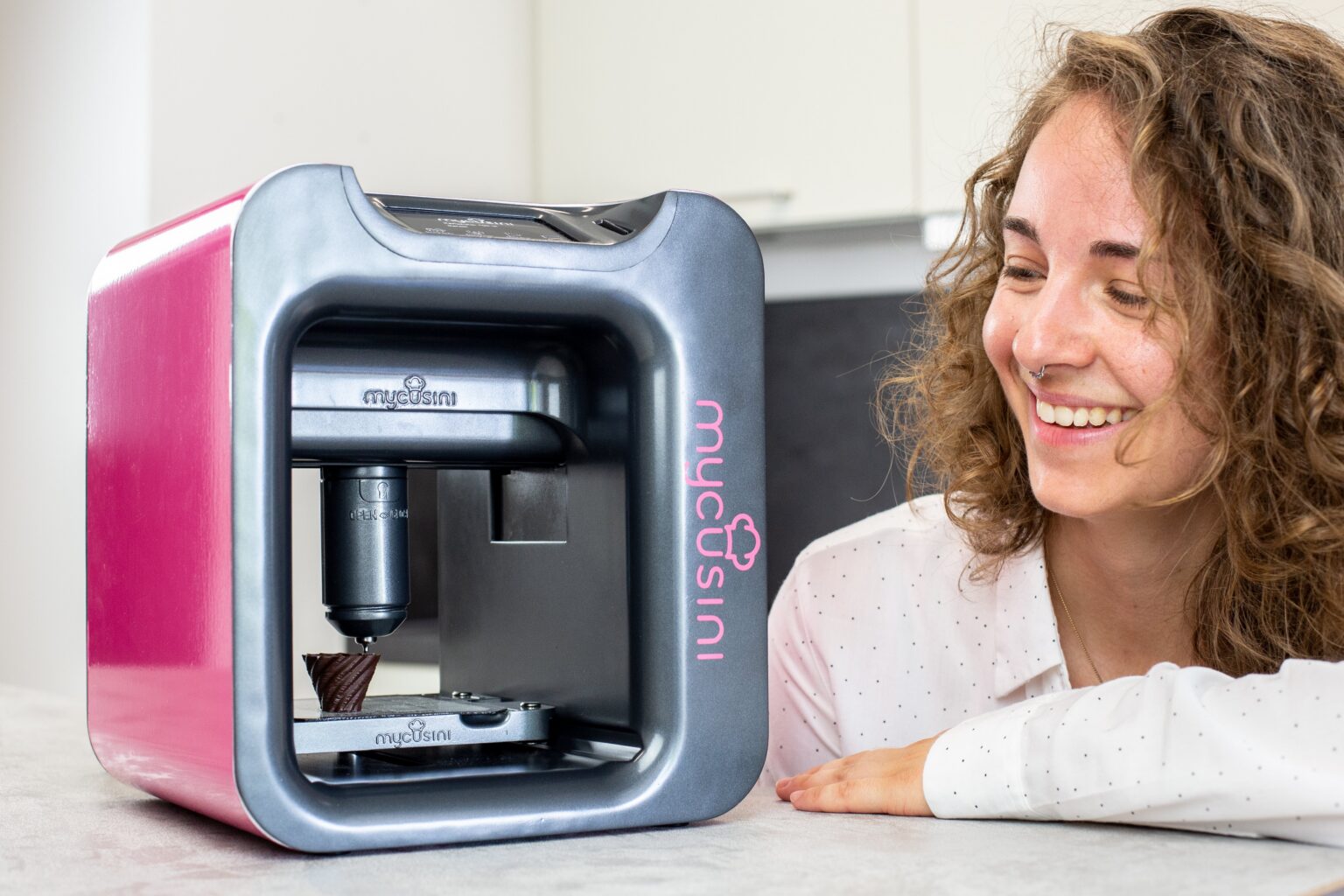
Mycusini 2.0:
A compact, accessible option for home enthusiasts, small bakeries, and educators. Uses pre-filled material cartridges to deliver simple plug-and-play operation.
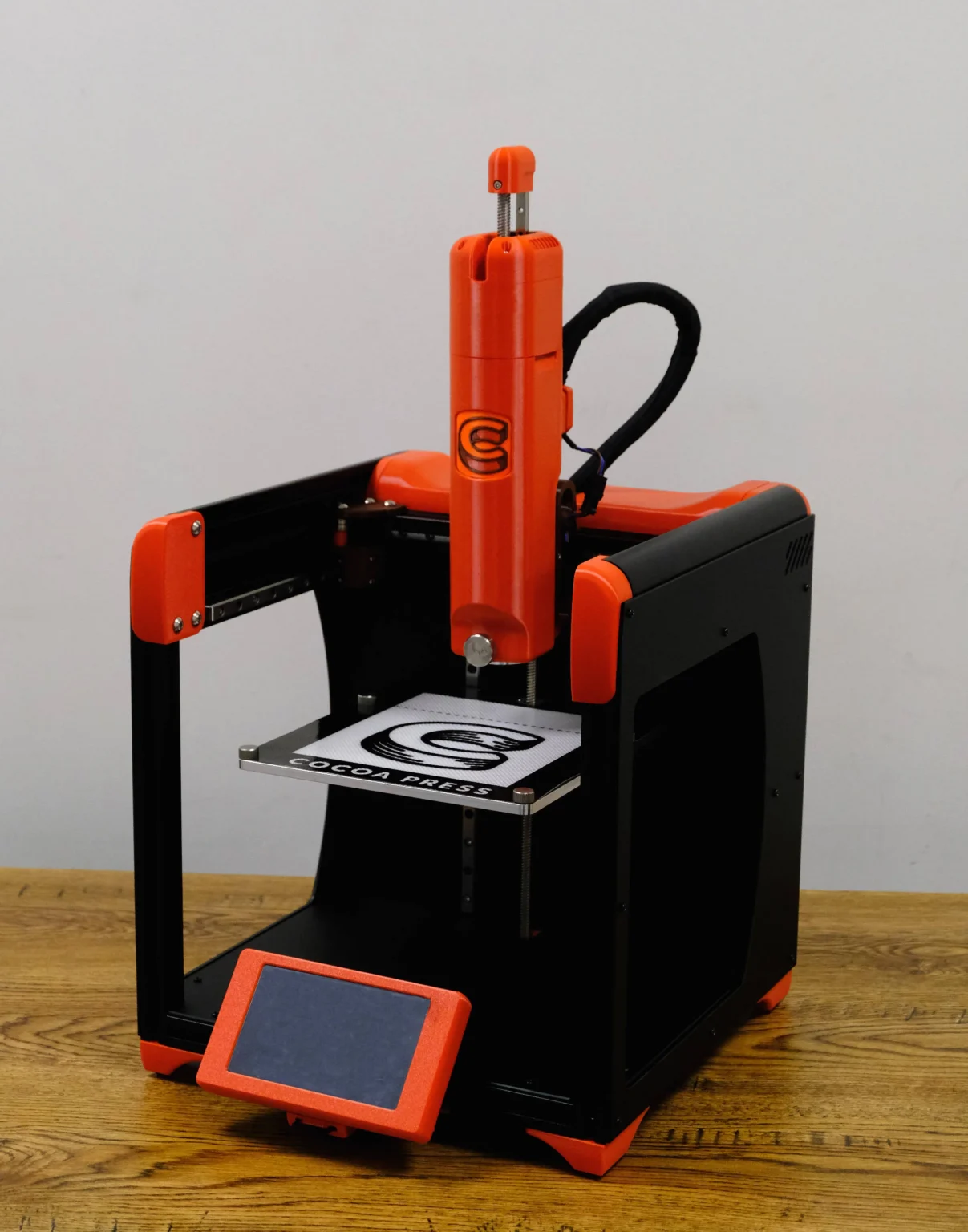
CocoaPress:
A popular DIY/assembled desktop machine designed specifically for chocolate enthusiasts. Features precise syringe heating and an open-source framework that makes dialing in custom settings easy.
Professional Chocolate Printers
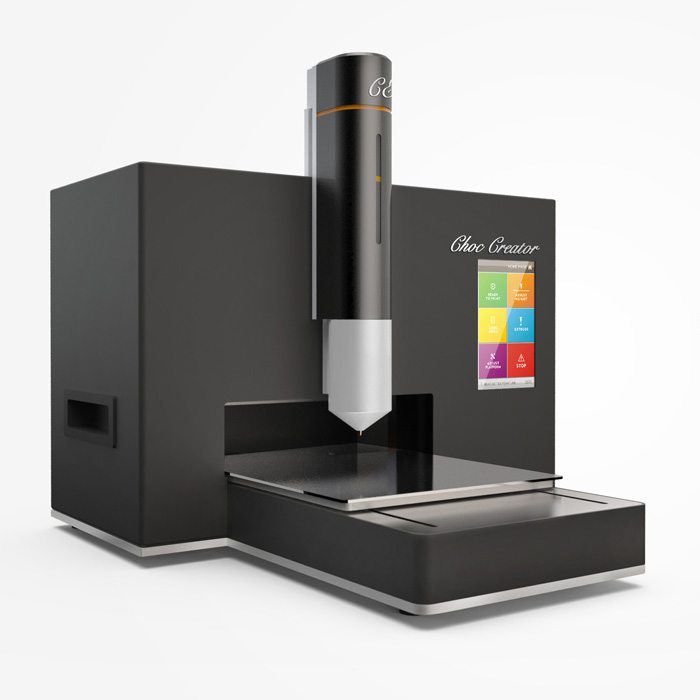
Choc Edge Choc Creator 2.0 Plus:
A proven dual-syringe platform favored by artisanal pastry chefs. Delivers precise thermal controls and high spatial accuracy for custom cake toppers and intricate decorations.
Commercial Food Printers
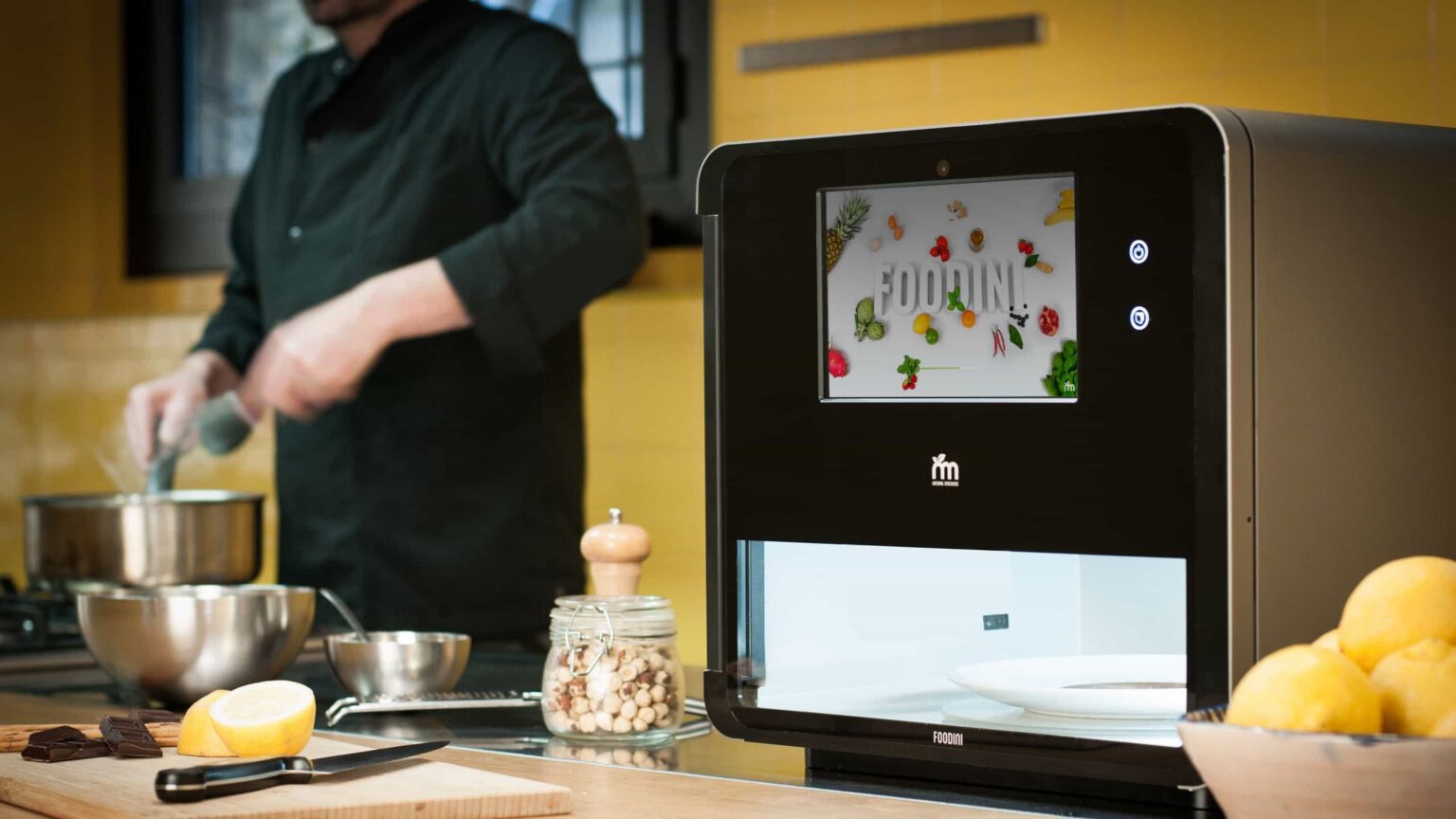
Focus Food Printer (by Natural Machines):
A versatile platform engineered for commercial kitchens. Uses refillable multi-material cartridges to handle cocoa pastes, savory pastes, and soft doughs with equal ease.
Industrial Chocolate Printing Machines
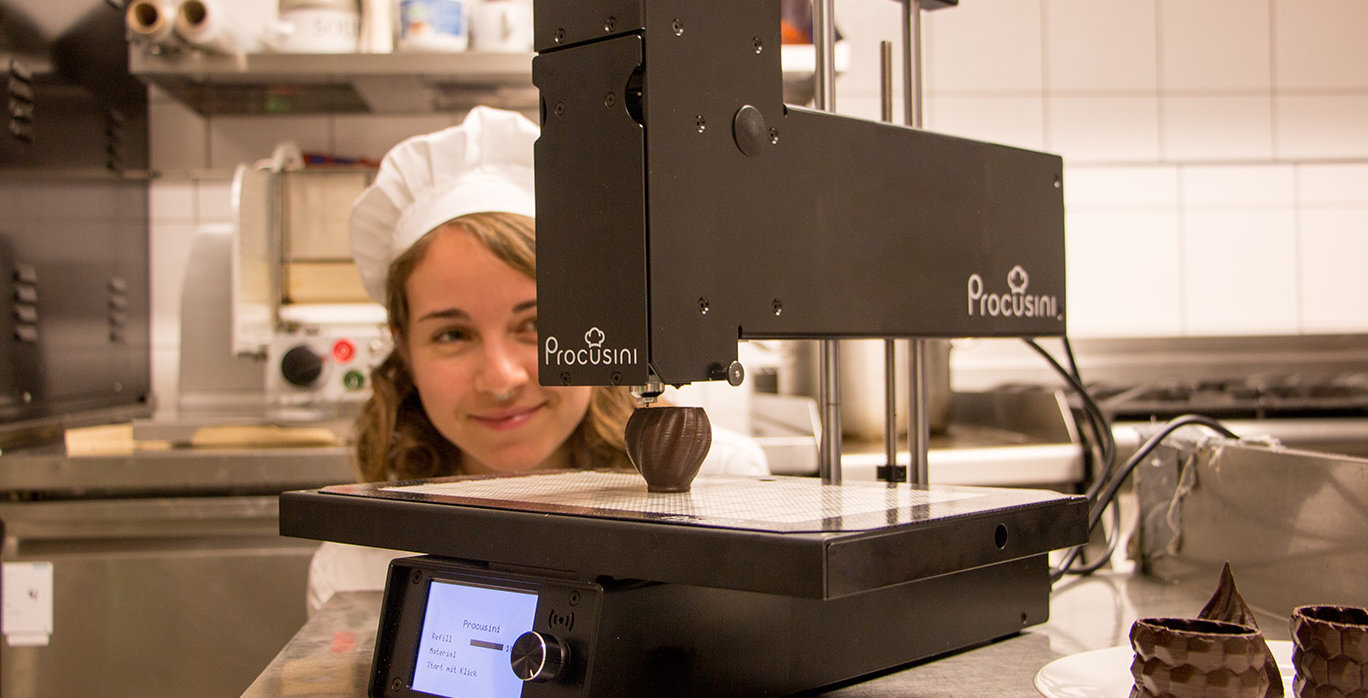
Procusini 5.0:
A robust system built for commercial food operations and catering facilities. Combines automated calibration features, an intuitive touch interface, and fast cartridge reloads for continuous production.
Chocolate 3D Printer Price Guide
| Tier | Price Range (USD) | Targeted User | Key Features |
| Hobby / Entry-Level | $600 – $1,500 | Home users, small bakeries | Compact footprint, basic thermal controls, pre-filled cartridges |
| Professional | $2,500 – $6,000 | Pastry shops, caterers | Refillable stainless steel syringes, precise PID control, custom software profiles |
| Commercial | $6,000 – $15,000 | Commercial food producers | Multi-head extrusion, active cooling chambers, larger build envelopes |
| Industrial Systems | $20,000 – $70,000+ | Large factories, R&D labs | Automated cartridge reloading, conveyer output, multi-axis robotic arms |
Factors That Affect Pricing
Key cost drivers include frame rigidity, thermal sensors accuracy, active cooling refrigeration, build volume size, food compliance certifications, and software support packages.
Common Chocolate 3D Printing Problems and Solutions
Chocolate Not Extruding
Nozzle temperature too low, or solid chocolate particles clogging orifice.
Increase nozzle temperature by 0.5°C increments; purge syringe cartridge and clear nozzle with a cleaning wire.
Layer Separation
Excessive cooling air freezing the previous layer before the new track lays down, preventing inter-layer bond.
Reduce cooling fan speed slightly or increase extrusion feed rate to raise heat deposition per track.
Nozzle Clogging
Moisture contamination causing sugar bloom seizure inside barrel.
Thoroughly dry all syringe components before loading material; never introduce liquid flavorings containing water into raw melt batches.
Poor Surface Finish
Material out of temper or improper layer height configuration.
Re-temper material batch; adjust layer height ratio down to ~60% of nozzle diameter.
Chocolate Melting During Printing
Build room ambient temperature exceeds 22°C, or lack of spot cooling fans.
Relocate machine into an air-conditioned space (18°C target); install auxiliary cooling ducting directed at nozzle tip.
Dimensional Accuracy Issues
Over-extrusion due to miscalibrated stepper motor steps-per-millimeter settings.
Recalibrate extrusion multiplier settings in slicing software profile.
Food Safety and Hygiene Best Practices
Food-Grade Materials
Verify every wet component utilizes verified food-safe materials (e.g., 316 stainless steel, PTFE tubing, food-grade silicone). Never use standard 3D printer brass nozzles, as they contain trace lead amounts that leach into acidic food products.
Cleaning Procedures
Establish strict cleaning protocols. Strip syringe assemblies completely at the end of every shift. Soak, scrub, and sanitize parts using food-safe antibacterial detergent before hot-air drying in clean environments.
Chocolate Storage
Store raw mass in sealed airtight containers at 15°C to 18°C with relative humidity below 50%. Keep away from light and foreign odors, which alter cocoa butter structure and taste over time.
Cross-Contamination Prevention
Isolate dedicated equipment sets when handling common allergens (e.g., dairy, peanuts, tree nuts). Color-code distinct syringe assemblies to prevent cross-contact when shifting between dark and milk formulations.
Safe Operating Temperatures
Maintain raw paste outside bacterial incubation zones. While low moisture content restricts bacterial proliferation in pure cocoa products, maintaining clean sanitation routines prevents mold growth during high-humidity periods.
Related: From Cats to Dragons: Popular Cute 3D Printed Animals You Should Try
Sustainability of Chocolate 3D Printing
Reduced Food Waste
Direct additive manufacturing utilizes exact ingredient quantities needed for a given geometric file, reducing trimmings and material scrap common in traditional hand carving.
On-Demand Manufacturing
On-demand digital manufacturing eliminates overproduction risks. You produce exact quantities required by real orders, lowering storage waste and reducing inventory spoilage.
Efficient Ingredient Usage
Software algorithms optimize structural density via hollow internal infill patterns (e.g., 20% gyroid infill), reducing cocoa consumption while preserving overall visual volume and structural strength.
Sustainable Packaging Opportunities
Custom geometric designs fit tightly inside compact modular packaging, reducing spatial footprint requirements and cutting shipping material waste during transport.
Why Choose Lava3DP for Food and Chocolate 3D Printing
Transitioning into food additive manufacturing requires serious technical skill across thermal dynamics, mechanical hardware, and material behavior. If buying and maintaining dedicated hardware isn’t practical for your current workflow, partnering with an experienced service provider is the fastest way to bring custom designs to market. Lava3DP provides high-precision rapid manufacturing services to turn your creative concepts into production realities.
Industrial Food 3D Printing Expertise
Lava3DP leverages advanced additive equipment and mechanical expertise to handle complex geometries with tight tolerances. Our engineering team understands how to convert intricate CAD geometries into production-ready toolpaths. By relying on our professional chocolate 3d printing service, you get access to top-tier output without investing tens of thousands of dollars in specialized hardware.
Custom Chocolate and Edible Product Development
Whether you need specialized promotional shapes, customized event favors, or structural components for high-volume lines, Lava3DP supports your journey from initial sketch to final production run.
Rapid Prototyping for Food Innovation
Validate design concepts fast. Lava3DP provides rapid turnarounds on physical samples, letting food brands evaluate geometry, weight, and visual appeal before committing to expensive production lines.
Design Optimization Support
Our engineers review your source CAD models to ensure proper wall thickness, overhang angles, and self-supporting geometries, preventing print failures before production starts.
High-Quality Production and Global Shipping
With rigorous quality management standards, Lava3DP manufactures parts to exact specifications, packaging and shipping your orders directly to facilities worldwide.
Instant Online Quoting
Skip long waiting periods for project estimates. Upload your 3D CAD files directly to the Lava3DP platform to receive an instant online quote and complete manufacturability review within minutes.
Related Manufacturing Services from Lava3DP
Beyond specialized edible fabrication, Lava3DP provides a comprehensive suite of advanced manufacturing services to support your end-to-end product development workflows:
Food-Safe 3D Printing
We produce high-precision food-safe components, custom housing enclosures, and specialized handling jigs using certified food-contact polymers and stainless steel alloys.
SLA 3D Printing
Stereolithography (SLA) delivers master models with smooth surface finishes, ideal for producing master patterns used to cast food-safe silicone molds.
SLS 3D Printing
Selective Laser Sintering (SLS) generates strong, heat-resistant nylon components without requiring temporary support structures—perfect for custom food-processing machinery parts.
FDM 3D Printing
Fused Deposition Modeling (FDM) offers cost-effective rapid physical prototyping for large-scale structural models, housings, and functional fixtures.
Silicone Mold Manufacturing
Need high-volume output of custom shapes? We print high-resolution SLA master patterns and cast flexible, food-grade silicone molds so you can pour chocolates using traditional high-speed methods.
CNC Machining
Our high-precision 3-axis and 5-axis CNC machining services mill custom food-grade stainless steel nozzles, aluminum heating blocks, and durable factory automation tooling.
Injection Molding
When your business scales up to mass production, Lava3DP delivers custom plastic tooling and high-volume injection molding services for food packaging, tools, and consumer products.
Vacuum Casting
Vacuum casting provides short-run production of high-quality plastic prototypes and functional pre-production parts with production-grade surface finishes.
Product Development Services
From initial napkin sketch concept generation to full DFM (Design for Manufacturability) analysis and mass manufacturing, Lava3DP acts as your end-to-end engineering partner.
Ready to Manufacturing with LAVA3dp?
Upload your CAD file today and receive instant pricing, expert engineering support, fast production, and worldwide delivery.
Get an Instant Quote →Frequently Asked Questions
Is it possible to 3D print chocolate?
Yes. Paste-extrusion printers build complex three-dimensional objects by depositing tempered chocolate layer by layer. The process requires tight temperature control so the material flows smoothly under nozzle pressure and sets quickly upon deposition.
How much does a chocolate 3D printer cost?
Prices range widely based on capabilities and scale:
- Hobbyist / Entry-Level: $600 to $1,500
- Professional / Artisanal: $2,500 to $6,000
- Commercial Kitchen: $6,000 to $15,000
- Industrial Factory Systems: $20,000 to $70,000+
How does chocolate 3D printing work?
A heated syringe cartridge holds liquid paste at its exact tempering temperature (typically 29°C–32°C). A computer-controlled stepper motor drives a plunger to push paste through a narrow nozzle onto a build plate, constructing structural geometry layer by layer from digital G-code instructions.
What chocolate is best for 3D printing?
Dark chocolate is the easiest material to print because of its high cocoa butter content, low milk fat concentration, and wide working temperature window. Well-formulated dark chocolate sets fast and maintains structural shape across tall vertical walls.
Can any 3D printer print chocolate?
No. Standard desktop plastic 3D printers reach temperatures over 200°C and use drive gears built strictly for solid filament. Printing paste requires a specialized food-grade syringe extruder, precise PID heating within a tight 28°C–32°C range, and fully certified food-safe wet-contact parts.
Do you need tempered chocolate for 3D printing?
Yes. Untempered chocolate lacks stable Form V cocoa butter crystals. Without proper tempering, the material will extrude as a soft paste that refuses to solidify, blooming into a dull gray mess that collapses under its own weight.
What temperature should chocolate be printed at?
Working temperatures vary depending on formulation:
- Dark Chocolate: 31.0°C to 32.5°C
- Milk Chocolate: 29.5°C to 30.5°C
- White Chocolate: 28.0°C to 29.0°C
Are chocolate 3D printers food-safe?
Only machines built specifically with certified food-grade materials are safe. Look for 316 stainless steel nozzles, food-safe syringe cartridges, non-toxic seals, and smooth frame surfaces that tear down easily for thorough daily cleaning and sanitation.
What industries use chocolate 3d printing?
Key sectors include boutique bakeries, luxury hotels, fine dining restaurants, custom gift confectioners, corporate event caterers, academic culinary institutes, and commercial food R&D labs.
Can Lava3DP help develop custom edible 3D printed products?
Yes. Lava3DP provides professional engineering support, custom design optimization, rapid prototyping, and high-precision manufacturing services to bring your edible concepts to life. Upload your CAD file to our online platform today for an instant quote!